


On June 18, 2026, a sudden downdraft within a severe thunderstorm hit Haven Park in Portsmouth, NH. The powerful “microburst” toppled stately shade trees, but left a Civil War memorial standing. It was sad. In 2012, the removal of a 90-year-old copper beech threatened the historic South Church on State Street and had to be cut down. People protested.
Trees are mortal, and the death of a stately old friend reminds us of our own brief passage. We measure our lives against them, and their demise makes headlines.
Portsmouth historian Charles Brewster (1802-1869) wrote frequently about his favorite city trees. When he was a child, Brewster reported, he stole the sweet fruit of a bergamot pear tree that stood in the yard of Daniel Webster’s home off Vaughan Street. That area, once lined with fruit trees and gardens has been a parking lot and a pedestrian mall since the 1970s.
Brewster recalled a handsome Linden tree, planted in 1750 near the Wentworth-Gardner Mansion in the South End. In Brewster’s time, it rose 60 feet and was 12 feet in circumference at the height of a man’s head. The ancient linden was still standing – though 10 feet taller and seven feet wider –when local artist Beatrice Pearson sketched it in 1910. Each July the fragrance of its yellow blossoms scented the entire neighborhood and the blooming event made newspaper headlines. Today it too is gone.
Feeding the Whipple tree
Barbara Ward sympathizes with the plight of the South Church. A former director and curator of the Moffatt-Ladd House and garden on Market Street, she was responsible for what must be the most historic tree in New Hampshire. The towering horse chestnut, legend says, was planted by General William Whipple in 1776 when he returned to Portsmouth after signing the Declaration of Independence. It is listed on the National Register of Historic Trees.
“There are trees we have lost over the years,” Ward said. “There used to be two big elms in front of the house. And we’ve already been told by the arborist that one of our larch trees is very close to the end of its life.”
Years ago, the Moffatt-Ladd House also had problems with a tall ash. Its roots were twisted around the corner of the 18th-century warehouse on campus. The tree was at risk of falling and endangering museum visitors. It had to be removed to protect people and preserve the warehouse.
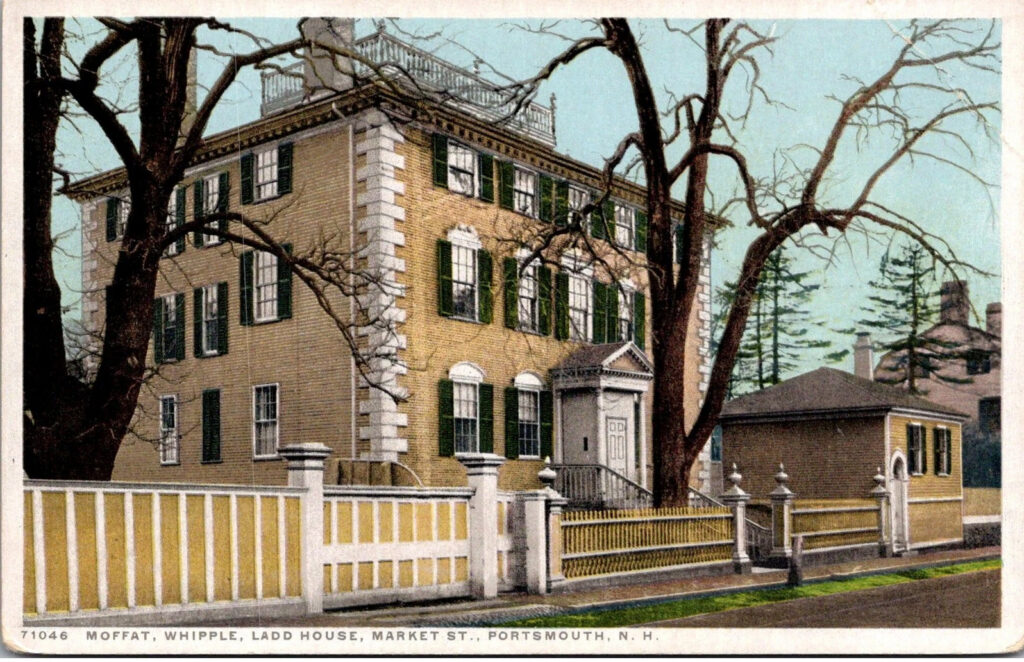
“You can’t save everyone. When I read what the Unitarian Church was doing, the first thing I thought was – that’s exactly what happened to us,” Ward said. “We had to cut it down and it broke my heart. But we milled the tree into boards that are now the floor of the restored warehouse. We had no choice, but we wanted to give the tree another life.”
Having lost elms, larches, ash, and pine trees, the stewards of the nonprofit Moffatt-Ladd House know that, eventually, the Whipple Tree too will pass away. Each spring, seedlings from the Whipple Tree are sold to visitors as part of a spring fundraiser. The planting of a replacement horse chestnut has been discussed.
“We work with Northeast Shade Tree and really go to a lot of trouble to keep our tree alive and healthy and well-cared for,” Ward explained. “It is fertilized every year.”
“As the horse chestnut grows,” Ward said, “it naturally hollows itself out. So all of the nutrients come up through the tree very close to the bark. So the tree remains very healthy – lush with lots of horse chestnuts and leaves – but you have the problem that the weight gets to be too much for the tree. So that’s why we have extensive cabling in the tree.”
“We think about our tree every single day. To me, it’s very intimately connected to the house.”
Shade trees come and go
Giant trees once dominated New Hampshire. Portsmouth historian Bruce Ingmire once joked that, before the arrival of white settlers, a squirrel could walk from Portsmouth to the Hudson River without leaving the treetops. But European settlers quickly clear-cut eastern New England, selling off the tall pines for lumber and ship masts, then farming in the rocky fields left behind. But trees grow back. Today our region is more heavily forested than it has been for the last 300 years.
Urban trees are especially precious and vulnerable. Statistics suggest the average downtown tree lives only seven years. You can tell a lot about a city by its ornamental trees. According to Charles Brewster, the first official city plantings were made haphazardly before the American Revolution.
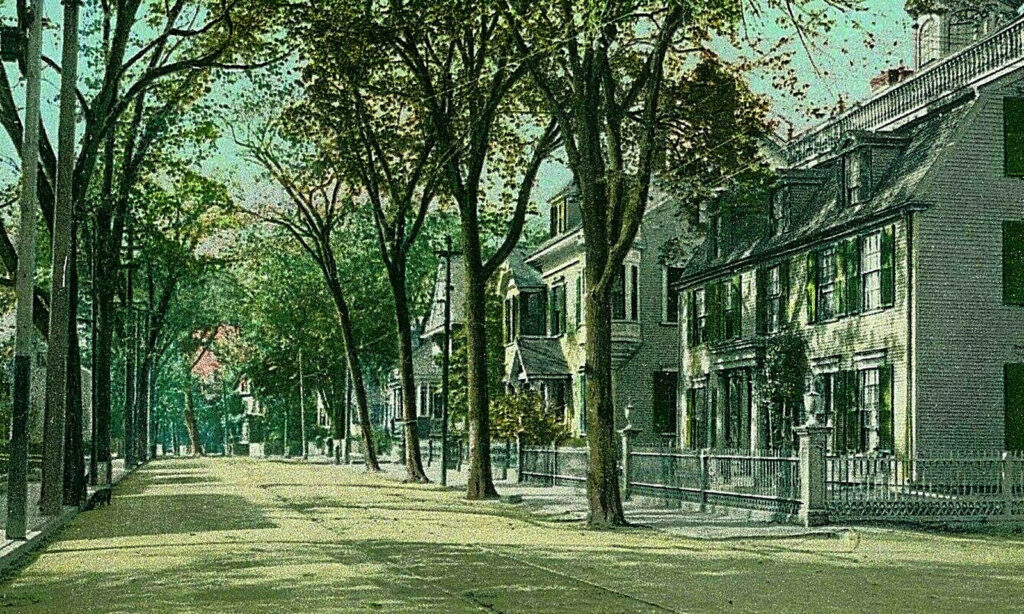
By around 1792, Brewster tells us, Governor John Langdon introduced the first Lombardy poplars in front of his mansion on Pleasant Street. The decorative trees caught on and, within six years, poplars lined most of the city’s major streets: Pleasant, Court, State, Islington, and Deer streets and the North End. The city government just sat back and let the private citizens do the work.
Brewster, the longtime editor of the Portsmouth Journal, recalled a massive elm on Pleasant Street. Planted when Portsmouth was a royal province, it had grown to a circumference of 16 feet by the 1850s. But a tree in Northwood that marked the entrance to the state’s first toll road took the record, measuring 26 feet around.
Even before the Civil War, the first of the early Portsmouth urban plantings had gone awry. Stately downtown trees were reduced to blackened trunks by a series of devastating fires. The elms had been carved away to accommodate the burgeoning cityscape.
Brewster wrote: “But beauty soon faded. The trees ran up to an elegant taper for a time; but the frost or the lightning in a few years nipped their tops. Their decapitated trunks, shorn of every vestige of beauty, sending out a seven-fold number of new shoots, had more the appearance of the fabled hydra than of the produce of Eden.”
Try, try again
Portsmouth’s poplars were replaced by sycamores and buttonwoods that enhanced residential streets. The smooth bark and lush shady leaves were all the rage. But the sycamores attracted caterpillars that chewed the leaves. Wriggling nests hung by the thousands on invisible strands directly in the path of pedestrians. So the sycamores were executed by public decree, Brewster tells us, faster than the French guillotined the aristocracy. And in their place came the maples and the elms so popular around the middle of the 1800s. Again, the public did the planting, either as individuals or as members of the Portsmouth Tree Society.
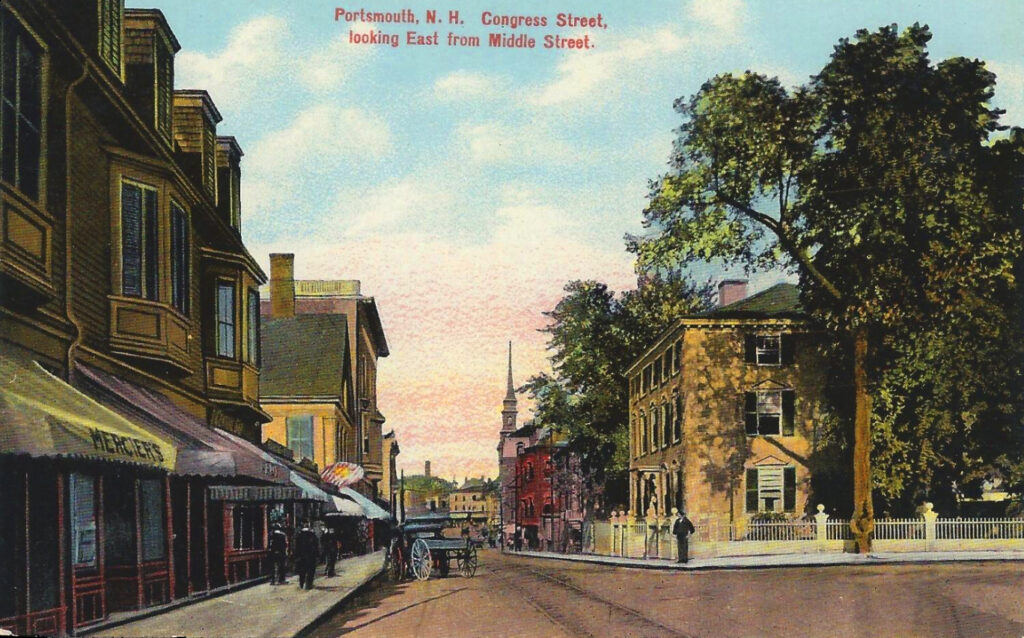
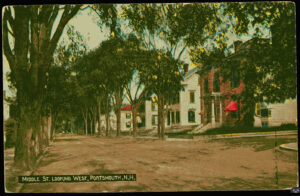
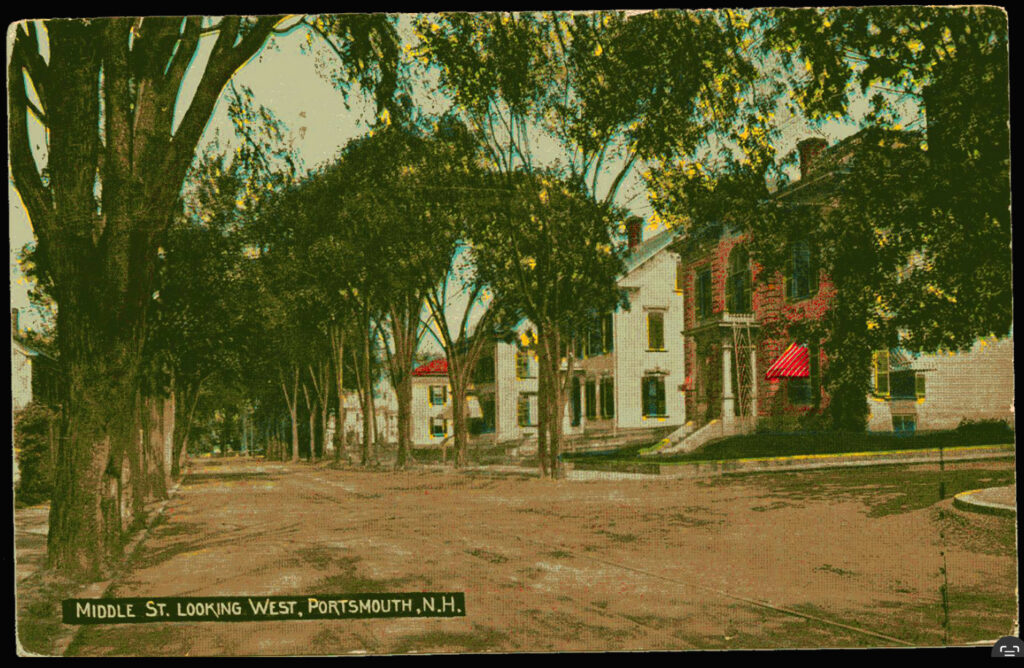
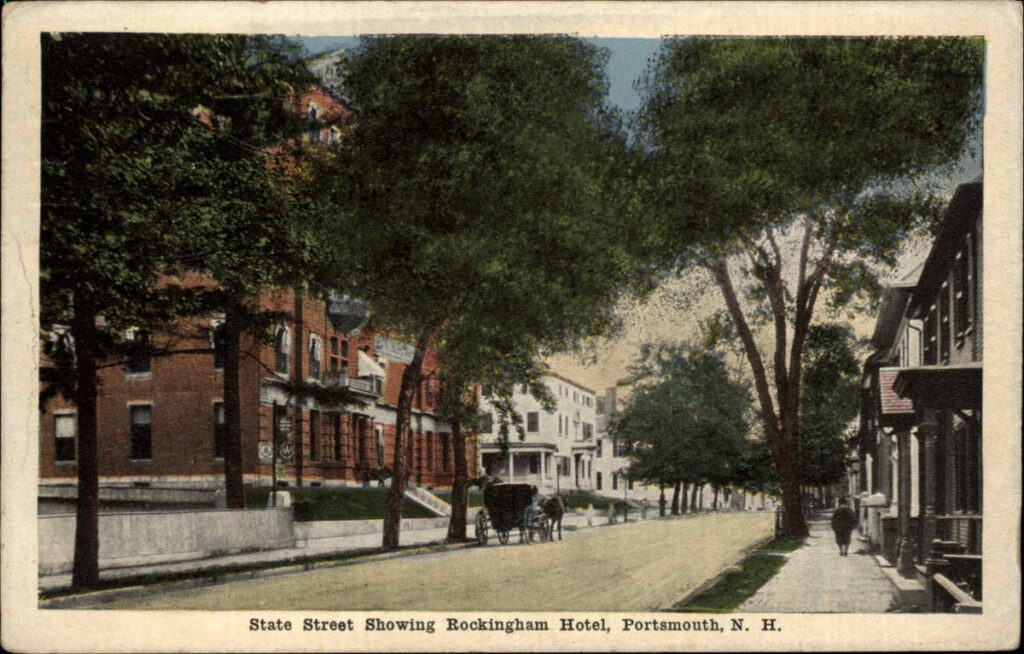
Henry Richards is often remembered as a great tree planter in Portsmouth. When he died, the tree-lined Richards Avenue was given his name. But in 1872 the Portsmouth Journal noted an even more prolific tree planter — Mr. Joseph Fuller of Sagamore Road. The article details the location of over 2,000 trees that Fuller planted between 1812 and 1865. The earliest Portsmouth photographs and later colorized postcards show thick tree-lined streets all around the city, thanks to Richard and Fuller and other independent planters who provided what the city did not.
Local ale tycoon Frank Jones, though not known for his philanthropy, had a passion for ornamental trees. He installed them near his many properties. Since Jones owned much of the area, from his Maplewood Farm to the Rockingham and Wentworth hotels, the public benefited. With its ancient mansions and young plantings, Portsmouth became the beautiful “Old Town by the Sea.” But that beauty was often fleeting.
It’s not easy being green
Nature and nurture continued to conspire against the city’s ornamental trees. Those not destroyed by Dutch elm disease were often manicured to death by man. Trees were trimmed back by new sidewalks, carved around telegraph and telephone wires, gouged by horse carts, smothered by automobile fumes, and sacrificed to new buildings and parking lots. Portsmouth’s shade tree population declined again in the 20th century. By World War II, the city had adopted an industrial look. In 1954, Hurricane Carol took three hundred trees in the area around the Wentworth Hotel in New Castle. A popular elm on the golf course was uprooted by the storm, but four days later, miraculously, Hurricane Diane pushed it back upright.
The tourism renaissance in Portsmouth was a boon for its trees. From 1968 until the early 1990s, the city set aside $10,000 in its annual budget for city landscaping. Long-time city arborist Clotilde Strauss volunteered countless hours to oversee the city’s trees.
The late mayor Evelyn Sirrell set up a Blue Ribbon Committee now known as the Trees and Greenery Committee to pick up where Strauss left off. The group meets monthly under the direction of former city attorney Peter J. Loughlin. According to Loughlin, the all-volunteer committee has recommended that Portsmouth appoint an official “tree warden,” as is common in other local cities like Newburyport. (Note: Peter retired as chairman of the committee in 2025 after 25 years.)
In the 1940s and 50s, Loughlin noted, “there was hostility toward anything green” among city officials. That changed, he says, with the redesigned downtown streetscape in the 1970s that fostered the modern attitude that urban trees are an essential part of the aesthetic of the city.
The committee meets monthly to oversee new plantings and respond to citizen requests to cut down trees on city-owned land. “We turn down a fair number of requests to remove trees,” Loughlin said. “If it’s a healthy tree, we don’t allow it to be removed.”
“We take it one tree at a time. It’s a balancing act. There’s a constant tension between the tree roots, the sidewalks, the wires, the shade, the light, the parking spaces. Every time we plant a tree in urban Portsmouth, it’s a plus. You just have to be vigilant.”
Loughlin commends the city for its work in recent years and for providing “adequate funding” to every request by the volunteer committee for new plantings. The city looks better than any time in the 20th century, he says. Keeping greenery part of the cityscape means constantly replacing dead and dying trees with new ones that, when carefully managed, Laughlin believes, can live for at least 25 years.
“They are not going to live forever,” Loughlin adds. He has been called a modern-day Johnny Appleseed for his private work both growing and planting trees across the city. He wraps up by reciting a quotation from 19th-century landscape designer Andrew Jackson Downing, printed on his office stationery. Downing wrote:
“There is not a village in America…that may not be redeemed, in great measure, by the aid of shade trees in the streets…and it is never too early or too late to project improvements of this kind.”
Copyright © 2012-2026 by J. Dennis Robinson, all rights reserved.
 Reviving the Good Old Days