



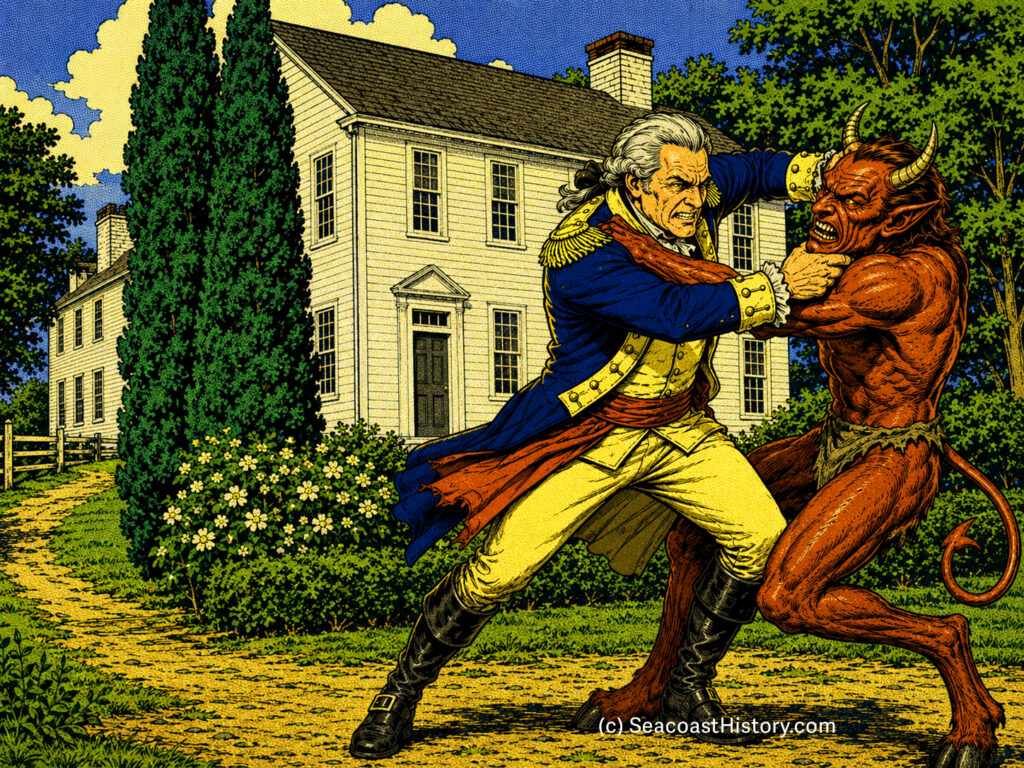
Billionaires take a lesson. Gen. Jonathan Moulton was a Revolutionary War hero. But a rich man in the poor Puritan town of Hampton, NH, left his legacy in tatters. Did he own too much land, build too large a home, marry his second wife too soon, or tick off too many locals? As so often happened in provincial New England, townspeople claimed he was in league with the devil – and the legend stuck. It’s why we’re talking about him today.
Resourceful and ambitious, Moulton became the wealthiest man in Hampton, some say in the province of New Hampshire. No man could get so rich so fast, the townsfolk whispered, unless he had made a deal with the devil. That’s how people talk when a man builds a grand mansion in a poor Puritan town. When Moulton’s house burned down suddenly in 1769, legend claimed, the devil had taken revenge on Moulton. When Gen. John Moulton (1726-1787) rebuilt the mansion and, at 50, married the 36-year-old friend of his recently dead wife – tongues truly began to wag. Moulton’s first wife had borne 11 children, they complained, and now he was flaunting his trophy bride. When the general finally died at 61, his body disappeared from the coffin. The devil, people whispered, had spirited him away.
A century later, poet John Greenleaf Whittier picked up the Hampton story. Fascinated by New Hampshire and by the trendy study of spiritualism, Whittier often combined Hampton and the supernatural in his wildly popular ballads. A century after Moulton’s death, the poet published “The New Wife and the Old.” In the poem, Moulton’s second wife Sarah Emery wakes on her wedding night to discover the ghost of her former friend and her husband’s late wife. Abigail Moulton had died less than a year before of smallpox. Abigail returns to the marriage bed to reclaim her wedding ring, which the penurious Mr. Moulton had recycled to his second wife.
It’s a horror story straight from the poet’s imagination, but it conjured a powerful image. A glowing white wife clatters up the mansion stairs to reclaim her jewelry after 28 years of marriage. She peels the ring off her best friend’s hand while Moulton snores nearby. Then the old wife disappears under the marriage bed, filling the new wife with shock and awe.
Equally powerful is the often-told Hampton legend of Moulton and the devil. In the story, the wealthy Hampton land-owner agrees to give up his soul if Beelzebub will fill the man’s boots with gold doubloons each month. Always the businessman, the fictional Moulton has larger and larger boots custom-made, which he hangs just inside the fireplace. Each month he finds them brimful of gold which the devil has deposited down the chimney. Greedy still, Moulton tricks the devil further by cutting holes in the toe of the boot. The devil, sticking to his bargain, tries to fill the giant boot. The coins pour out the bottom of the boots, filling Moulton’s kitchen so deep with gold that the door cannot be opened. It is only when the devil discovers he has been duped that he sets fire to the Moulton home. In reality, Moulton, his family and guests, barely escape the blaze.
The legends serve both literary and social functions. They are macabre, revealing the Victorian taste for horror tales. They are vengeful, allowing those citizens who Moulton outstripped to explain away his success. They restore balance. Men who gain too much wealth, love and power will certainly be brought low because cheaters never prosper.
This moralistic theme of justice as a rotating “wheel of fortune”, prevalent in Medieval literature, is at the heart of many of Shakespeare’s plays that followed in the Elizabethan era. The Puritans had a powerful sense of justice, a justice often harsh and meted out by men in the name of God. Hampton, a town formed by Puritan settlers, held strongly to the belief that anyone who rocked the boat, was risking an eternity in Hell. The town’s treatment of Goodwife Eunice Cole is a matter of record.
Indeed, Jonathan Moulton has been so completely consumed by tabloid folklore that it’s hard to imagine him outside the context of a Halloween campfire tale. His second house, restored at the turn of the century and privately owned, still stands in Hampton. The Moulton legends were so strong after his death, that the next owner had the building officially exorcised by clergymen. It stood abandoned through much of the 19th century and was known to locals as “the haunted house.”
The historical Jonathan Moulton, for the record, seems more heroic than devilish. He was descended directly from the colonial settlers of Hampton. He spent his childhood as an indentured worker, and purchased his own freedom. (He would, ironically, go own to enslave others, including men named Johnny, Philip, and Caesar. Moulton offered a reward for a runaway slave named Cato in the New Hampshire Gazette.) The flesh and blood Moulton marched hundreds of miles to fight with Yankee forces in the siege on Louisbourg, Nova Scotia in 1745 and fought at Saratoga. Like wealthy John Langdon of Portsmouth, Moulton organized the raid of Fort William and Mary, served on the Committee of Safety, at the Continental Congress and held office consistently in state government. Moulton owned mills, a store and lots and lots of land. When George Washington visited the Seacoast two years after Moulton’s death, according to Hampton legend, the President made a point of stopping to see the house of his former general. Moulton, like Washington, was among the country’s first major real estate speculators, turning ten’s of thousands of acres of Lake Region land into New Hampshire towns in what is today the Moultonborough area. His holdings developed into the towns of Eato, Tamworth, Burton, Chatham, Center Harbor, Ordord, and Piermont. Moulton openly solicited Irish citizens to move here and populate his new towns on some 80,000 acres of land.
Why this Revolutionary War hero should be singled out for public disgrace remains a mystery, but we can tease out a few likely reasons. Moulton apparently reached too far when he and a business partner negotiated salvage rights to a beached British ship that was loaded with salable goods. Whether they paid off the pilot who wrecked the vessel is unknown. (When he returned to England, two decades later, the ship captain was reportedly drawn and quartered.)
Poor Hampton citizens apparently rushed to claim items from the wrecked ship, but Moulton rigidly enforced his right to keep all the booty. This act may have alienated locals who were forced to give up what they had taken from the wrecked ship. Angry Hamptonians are dangerous, as the elderly Goody Cole found out a century earlier when she was declared a witch, then jailed and starved to death when she returned home. Moulton was also highly litigious and never missed a chance to sue for money he believed was due him. The lesson? Be careful who you step on as you climb the ladder of wealth and political success.
In 1775, perhaps aware of his fading legacy, Moulton wrote a letter to the citizens of Hampton. As the recipient of great fortune, he claimed, he wanted to give back a portion to the townies. He planned to set aside a large chunk of local land for a town farm for the poor and another for a school. The letter was found in an attic a century later. If the city fathers received the donation of land, no school or farm were built.
The second lesson of Moulton’s demise offers a warning to future millionaires and leaders — don’t suck up to the wrong people. With the American Revolution in the wind, most locals were not fond of wealthy British Governor Benning Wentworth of Portsmouth. Moulton, however, curried his royal favor, naming his fifth son Benning. In another grand gesture, Moulton marched his fattest ox all the way to Portsmouth as a gift to the governor. The 1,400-pound beast, draped in flowers, led by slaves and wearing a flag between his horns could not have been missed by the jealous locals. In return Moulton got an additional 18,000 acres of land near Moultonborough. A recent granite memorial was erected to Moulton at Hampton’s Pine Grove Cemetery, but his remains were never found.
Thirdly, don’t flaunt it. Moulton’s Hampton mansion was the most amazing house in town. It was reportedly the first of its kind in the region, decorated with costly white paint, imported from Britain. After toadying up to the royal governor, Moulton became a revolutionary. He was among the first to sign a patriotic loyalty oath and fought with distinction in the American Revolution. Yet he is the only high-ranking NH war hero of that era whose grave site remains unknown. It is assumed he was buried near his first wife Abigail, in a field that was later plowed up by farmers and covered with a railroad track.
A final lesson — honor the dead. When Abigail Moulton died of smallpox after nursing local victims of the disease, she was buried not far from the mansion. Legend says her husband neglected to raise a tombstone in her honor, and turned her considerable jewelry collection over to his second wife. Although Moulton was just 14 years older than Sarah, poet Whittier exaggerated her youth and his age in the famous poem. Considering that Gov. Benning Wentworth was 40 years older than his second wife, Moulton’s indiscretion seems forgivable – but not for the good folks of Hampton.
The Yankee message, drawn from its medieval English heritage, is inevitably the same. Life, like the seasons, should be an exercise in balance. Don’t get too cocky, too happy, too rich, too lucky. If you do, the neighbors will gossip, the poets will write and the historians will get the facts wrong. Then the townsfolk will bury you without even a tombstone — and the devil will have his due.
Copyright © 2006 by J. Dennis Robinson, updated 2026. All rights reserved.
 Land-locked: Celia Thaxter’s First Published Poem