



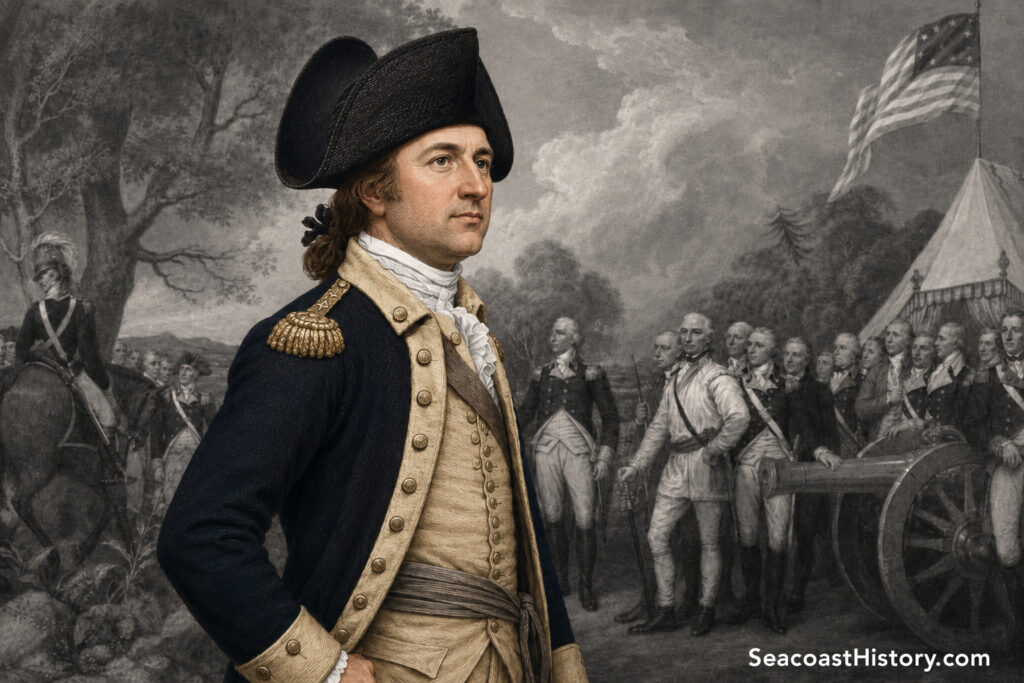
by Dorothea M. Thompson
Lt. Jeremiah Fogg sat at the small camp desk writing in his diary. It was early evening. The breeze rustling the leaves of the trees under which they were encamped and the labored breathing of his commanding officer were the only sounds. He dipped his pen in the ink and wrote: “Sept. 7, 1780, at Paramus, N. J.” and paused. The breathing had stopped, and he turned toward the camp bed. As he watched, the doctor pulled up the blanket over the patient’s head.
Jeremiah Fogg turned back to his diary and wrote, “My general is gone. A cruel stubborn fever has deprived us of the second man in the world…”
Word was sent to Gen. Lafayette, who, in turn, informed Gen. Washington that Brig. Gen. Enoch Poor had just died of putrid fever at his camp. The commander-in-chief ordered the most elaborate and elegant military funeral of the American Continental Army to be held the next day. Enoch Poor had been one of the best-liked and ablest officers of the army, a trusted friend of Gen. Washington, a good leader of his men, and as much a New Englander as four generations of living in the New World could make him.
Enoch Poor was born June 21, 1736, in North Andover, Massachusetts. When Enoch was 19, at the close of his apprenticeship to a master cabinet maker, he enlisted in the militia as a “mechanic” and was sent to Nova Scotia during the French and Indian Wars. After nearly two years service, he returned home, and a short time later, moved to Exeter, NH, where he established himself in business.
From 1760 to 1775, his name appeared on committees in Exeter in business as a man of growing importance. He was a member of the Provincial Congress during the third and fourth sessions. Gradually, identification of his name on the tax rolls of Exeter was changed from the humble “artisan” to “merchant” to “esquire” to “ship-builder.” He was a faithful member of the church, a good taxpayer, a thoughtful employer, and a man blessed with a happy marriage and two daughters.
After Lexington and Concord, as one of the wealthy men of the town, he volunteered to raise a regiment and became colonel of the 2nd New Hampshire Regiment. Men who had worked for him in his shipyards signed up, and the Committee of Safety assigned his regiment the task of building coastal defenses and fire ships for the harbor at Portsmouth.
In the late summer of 1775, his regiment joined the Northern Army in the siege of Boston. He and his troops took part in the 1776 march to Ticonderoga. They were at Valley Forge, Trenton, Princeton, Morristown, Monmouth, Barren Hill, Saratoga, and in the Western Campaign against the Indians. During the summer of 1780, he was at West Point until August. He and his men were transferred to New Jersey when Benedict Arnold requested and received the command of West Point. The size of Poor’s command varied but he usually had from 1600 to 2000 troops under him. In New Jersey he was assigned to lead the elite light infantry division under Gen. Lafayette.
Poor died of putrid fever in September of 1780. Secondary sources have attributed his death to wounds received in a duel with a French officer or a Lt. Porter, and this legend has become very popular. No primary sources mention the alleged duel, however, and it is now thought to be a complete fabrication.
© Dorothea M. Thompson (1928-2019)/ Originally published in “NH: Years of Revolution,” Profiles Publications and the NH Bicentennial Commission, 1976. Reprinted at SeacoastNH in 1997 by permission of the editor.
 Extremely Rare Diary of a New Hampshire Girl