

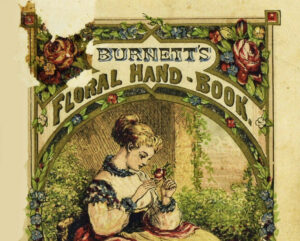
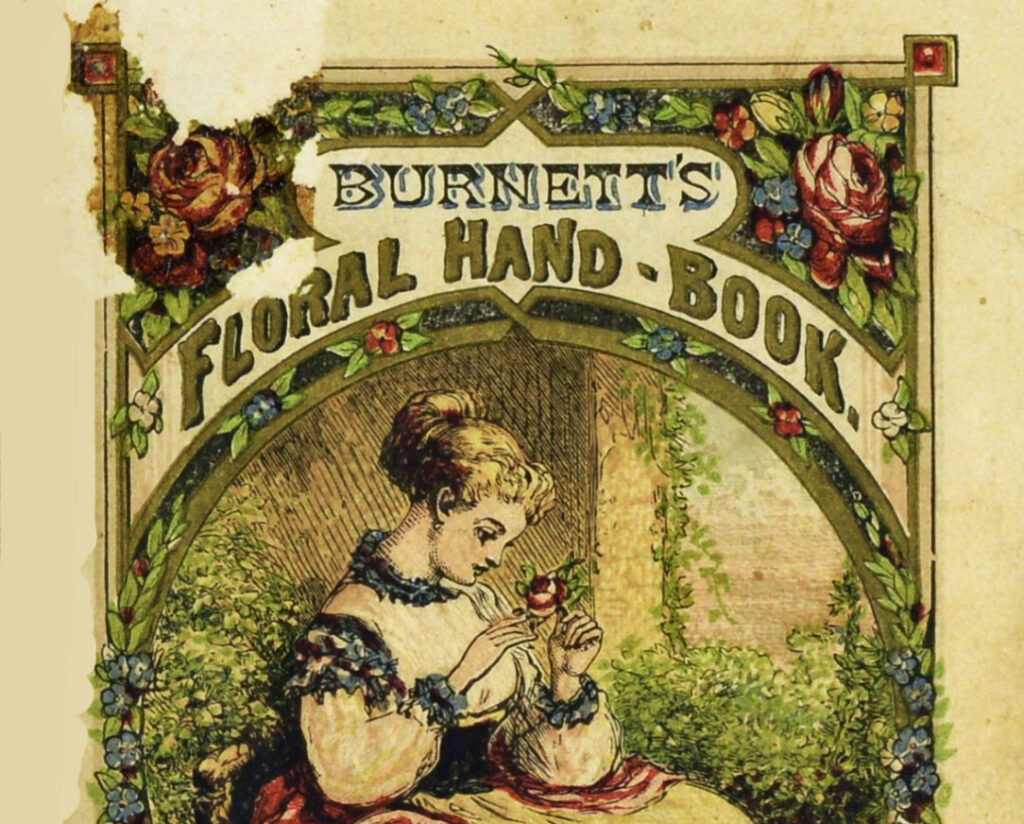
mayBe careful what your bouquet is saying. According to this popular guide, every flower sends a distinct message to the recipient. Like a modern emoji, the sentiment night be hidden between the lines. Burnett’s Floral Handbook was widely distributed in many editions by a successful Boston company. This one (see below), though undated, seems to be from the late Victorian era and came from Charles E. Laighton & Sons of 5 Exchange Building, Portsmouth, NH.
Joseph Burnett (1820-1894) is best known as the man who introduced premium vanilla extract to the American market and made a fortune. Burnett’s mid-1800s stone mansion in Southborough, MA was saved from demolition by teenaged protestors and is now being privately restored, most likely as a luxury bed and breakfast.
But back to the little booklet. Nothing says “spring” like a guide to flowers and plants. According to the preface, 15 million copies of this handbook had been published by 1880 or 1890. “We add to our list ]of flowers] every year,” the Burnett Company claimed, “and can guarantee that the present revised edition is the most complete and perfect vocabulary of the Language of Flowers ever published.”
Thick with advertising and sprinkled with poetry, Burnett’s Floral Hand Book also includes curious affirmations like “Be what you seem to be” and “Learn the luxury of doing good.” Roughly half of the text, bound with a thin hand-knotted bit of thread, is an alphabetical list of flowers and the “sentiments” they express when given to another.
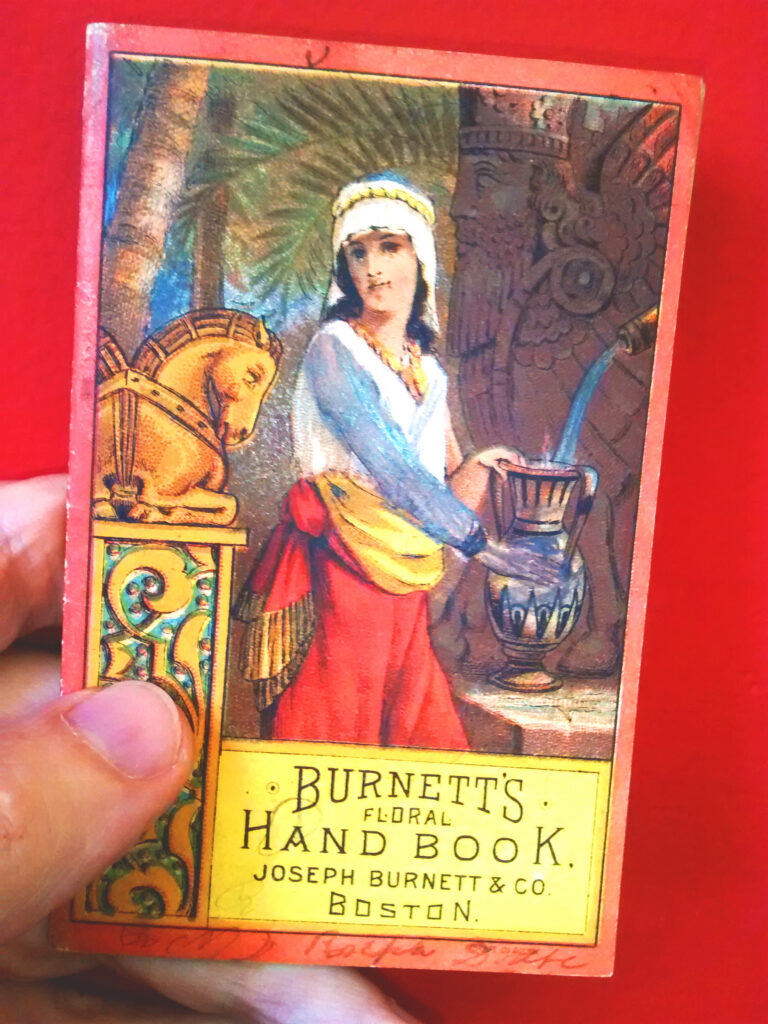
Acacia, for example, represents “concealed love.” Basil stands for “hatred.” Chickweed says, “I cling to thee,” and dandelions indicate “coquetry.” Each alternate page takes on the next letter of the alphabet until we finally reach “yew is for sorrow” and “zennae means absent friends.” A guide to the meaning of precious stones is tossed in at the end for good measure.
My interest in Burnett’s Floral Hand Book is all about the advertising of items available for sale from Charles Laighton who directed his inventory to Portsmouth “homemakers.” His shop, as seen in one 1897 photograph, appears to have been on the site of the modern-day Rusty Hammer. He specialized in teas, foreign fruits, andWest Indian Goods. Besides a wide array of extracts for cooking, Burnett’s booklet features ads for asthma remedies, Jamaican ginger drops for seasickness, and Kalliston toilet water for the complexion. The most frequently promoted product in the booklet is a hugely popular hair lotion called “Cocoaine” –and yes, I spelled it correctly. And yes, that is the topic of the feature story I’m working on for the next Vintage Pic column.
SEE ALSO: Floral display expert Thomas Moses
Copyright J. Dennis Robinson.
 Controversial McIntyre Building Stands on Historic Land