




With the nation’s 250th anniversary in the air, I was asked to recommend my favorite book on the Granite State’s key role in the American Revolution. One came immediately to mind—New Hampshire Years of Revolution, 1774-1783. In 1976, Profiles Publishing released a paperback anthology that, to this day, is the most readable and useful guide. If you can find a copy, grab it at any price. I asked editor Peter E. Randall to reminisce about the making of this unheralded little masterpiece. He was then editor of NH PROFILES, a superb and sorely missed Granite State magazine. Peter, for the record, was also the first editor to buy one of my freelance history articles after I graduated from college in the 1970s. He also published two of my hardcover history books. Our conversation became an introduction to a career that has shaped Seacoast arts and culture. Peter can trace his Seacoast ancestry back nine generations and he has an abiding connecting to the Isles of Shoals. –JDR
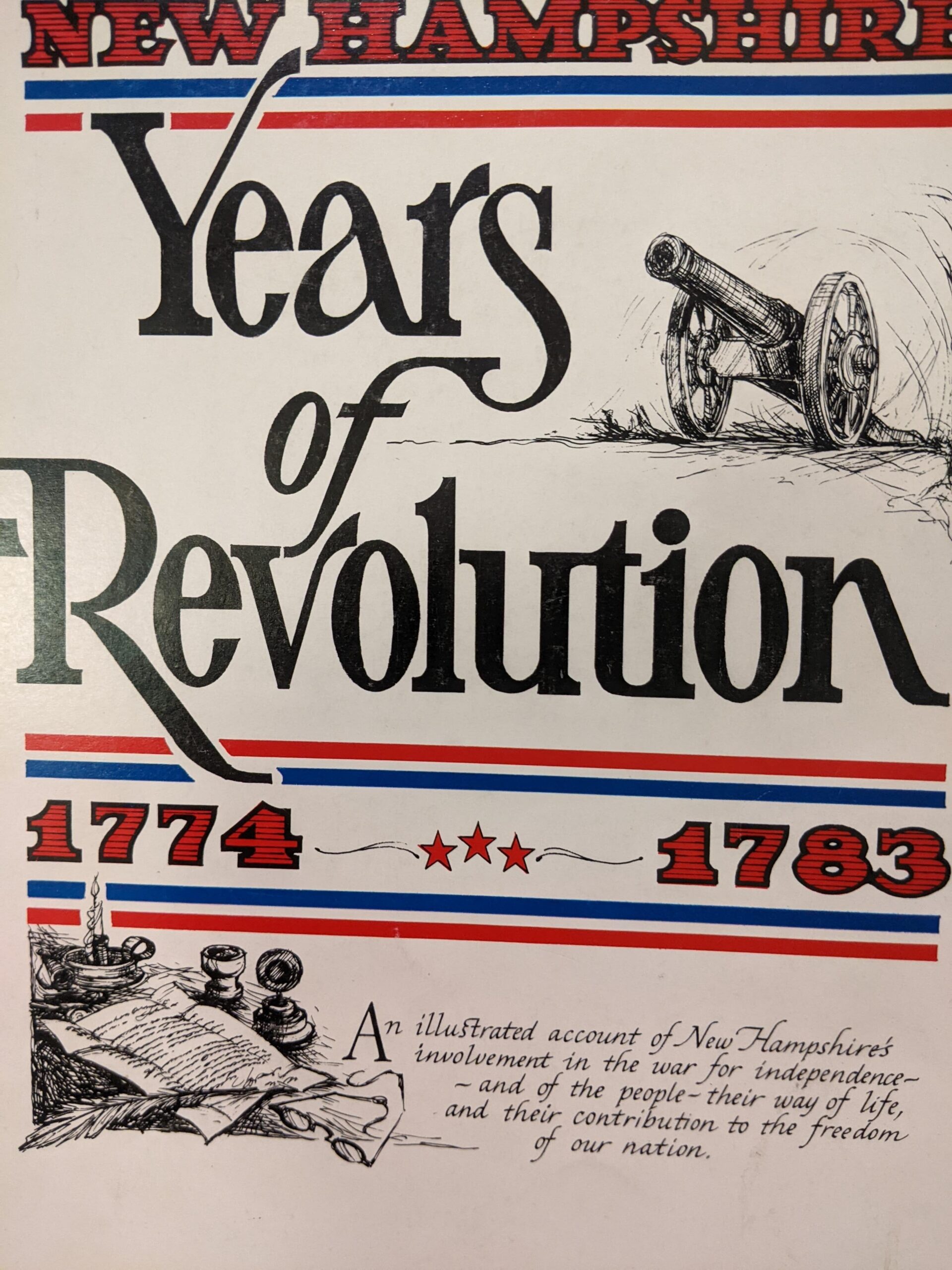
JDR: Peter, cast your mind back half a century to the Bicentennial of 1976. Whose idea was it to take on this project?
PETER: We wanted to do something with the magazine to commemorate the bicentennial. We talked with the state bicentennial commission. We came up with an idea to do a booklet as part of the magazine and to do additional copies for wider distribution. I think we got some money from the commission.
JDR: You were the editor at NH Profiles, a superb monthly magazine. Can you summarize its history?
PETER: You might say Profiles was an offshoot of the New Hampshire Troubadour, a small-format promotional monthly magazine published by the state. The first issue was April 1931.
BONUS: Harvey Reid, Seacoast Troubadour
In the late 1940s, Herbert Georges, station manager of radio WHEB, and his wife, Justine, women’s editor of the Portsmouth Herald, came up with an idea for a local magazine to cover the area between Newburyport, MA and Kennebunk, ME. The first issue was July 1950. A year later, Governor Sherman Adams decided the Troubadour was too expensive, and he stopped publication. Adams then convinced the Georges, based on their success with The Shoreliner, to do a statewide magazine. To sweeten the proposal, Adams gave them the 12,000 Troubadour subscriber list, folks who paid fifty cents a year for a subscription.
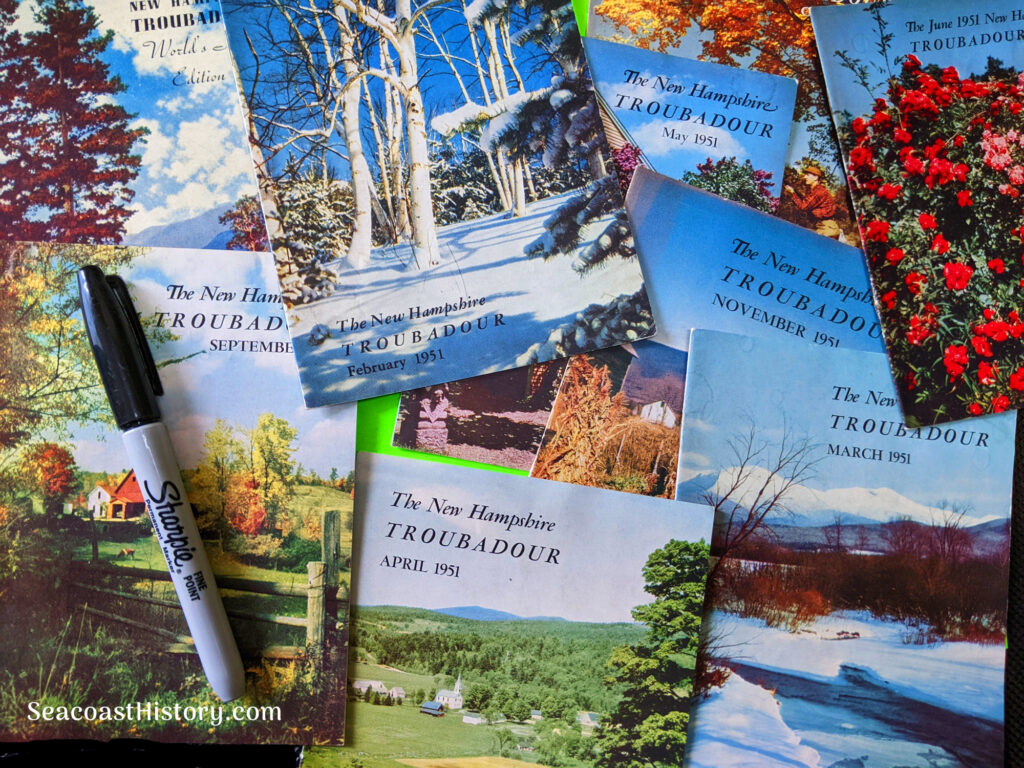
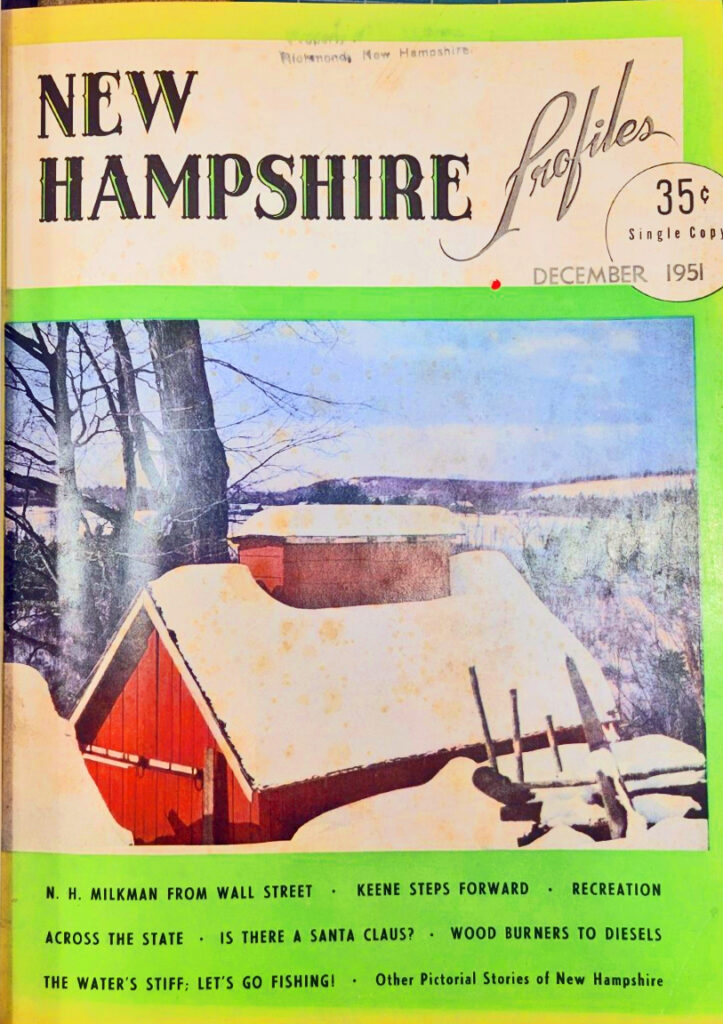
Herbert told me that most subscribers had paid for 3-4 years. He had to fulfill those subscriptions with a $4-a-year magazine. “We were in debt before we issued a single magazine,” he recalled. The Shoreliner ceased publication with the December 1952 issue. Profiles’ first issue was December 1951. They skipped January 1952, but it ran monthly from February 1952.
The Herberts sold the magazine in the mid-fifties to a group that included Harry Winebaum, the news distributor. The editor was Paul Estaver, and he remained when the publication was sold to a Nashua group headed by NH governor Hugh Gregg. After twelve years as editor, Estaver decided to leave.
Profiles was sold in 1965 to James Walsh, who owned a variety of trade magazines; he wanted to have one quality publication. Walsh brought back Herbert and Justine to run Profiles. He sold to Don Penfield in 1974, who moved the offices to Hanover. Penfield sold it after a few years. The magazine went through other owners until it died. I don’t know the date of the last issue, but I think early 1990s.
In 1964, I proposed to do an article for Profiles on the Mt. Washington alpine flowers. Estaver accepted the article, but left before it was printed in June 1965. I was hired by Profiles in March 1966 as an editorial assistant and was appointed editor in 1970 after Justine Georges died. I left in June 1976.
JDR: Revolutionary New Hampshire features four dozen essays by some of the best history writers of the era, including Jere Daniell and Charles E. Clark. How did you pull together all that content?
PETER: I knew most of the authors from my years as editor and got suggestions from others. I asked authors to write about specific subjects or individuals. We had a designer who laid out the issue and produced paintings for those articles for which we had no illustrations.
JDR: What can you tell us about the print run and publication process back before the digital age?
PETER: I don’t recall the actual print run, although the magazine sold about 18-20,000 copies per issue. The material was printed in the March 1976 issue, and there was an additional printing of a paperback and a limited hardbound edition. A Concord offset company was our usual printer.
JDR: The Randalls go way back on the Seacoast, and you’ve always been interested in combining history with photography
PETER: As Profiles editor, I became interested in White Mountain history books, especially guidebooks, all of which were out of print. I approached the University Press of New England about writing a guide and short history of Mt. Washington. That book was published in the early 1970s and was later reprinted by two other publishers.
After leaving the magazine, I got a contract from Downeast Publishing to create the first book of color photographs of New Hampshire. Over several years, the book sold 18,000 copies. With Downeast, I wrote and photographed four other books: All Creation and the Isles of Shoals, Portsmouth and the Piscataqua, Newburyport and the Merrimac, and Salem and Marblehead. While working on those books, I began producing books for various authors, including Portsmouth Herald editor Raymond Brighton. Ray’s biography, Frank Jones, King of the Alemakers, was my first new book. Previously, I had reprinted several out-of-print histories.
JDR: Your company has since created hundreds of books. How did this history book and your time at Profiles connect to your career as a publisher?
PETER: Peter E. Randall Publisher has created more than 600 titles since 1970. As a lifelong reader, I knew what books should look like, and my years at Profiles added to my knowledge of design and text. Mostly, I figured out how to do it by doing it.
JDR: Years of Revolution is packed with content and stands up really well today. Any thoughts on a digital reprint?
PETER: It is a copyrighted publication, and I don’t have the rights to it. Susan Conway of Exeter is the last owner and holds the copyright.
JDR: NH has plenty of Revolutionary War heroes with a good share of monuments and historic houses. And yet, except for John Paul Jones and possibly John Stark, there have been no major modern biographies. (Or did I miss them?) What about William Whipple, John Langdon, John Sulilven, etc? Have we lost interest in our founding fathers, in teaching local history, or have we lost interest in books?
PETER: There are biographies of Sullivan, Langdon, and John Wentworth, but nothing recent. Grades five and eleven learn NH history. Years ago, I met with the NH social studies teachers group and proposed producing new histories for both grades. The teachers present were rude, antagonistic, and apparently uninterested. Maybe this answers your last question!

JDR: I had a similarly disappointing experience promoting Portsmouth history to the school system here back in 1998. We printed 1,000 booklets for the high school, but they were turned down. “Not in the curriculum,” I was told. My recent graphic history met a similar fate in Portsmouth schools, but was welcomed by hundreds of students in Rye and Hampton schools. Go figure. What about your work with the Portsmouth Marine Society? Those books are now Seacoast history classics.
PETER: One day, I met Joseph Sawtelle, a Portsmouth developer, who was interested in local history. He had published a small book about Portsmouth’s clipper ships, but it was not well designed or printed. He knew of my work, and when I said I was looking for a Portsmouth office, Joe offered to give me a space, an agreement he made for the next seventeen years until his death in 2000.
Joe knew of a series of books about Salem, Massachusetts, history, and was determined to do something similar about Portsmouth. With other local people, Joe organized the Portsmouth Marine Society,, named for an organization of Portsmouth’s sea captains and officers in the Age of Sail. The reestablished, nonprofit society was created to promote local history by producing books. I was the editor and producer of 31 volumes of quality, hardbound titles. Ray Brighton and Richard Winslow each authored several volumes in the series.
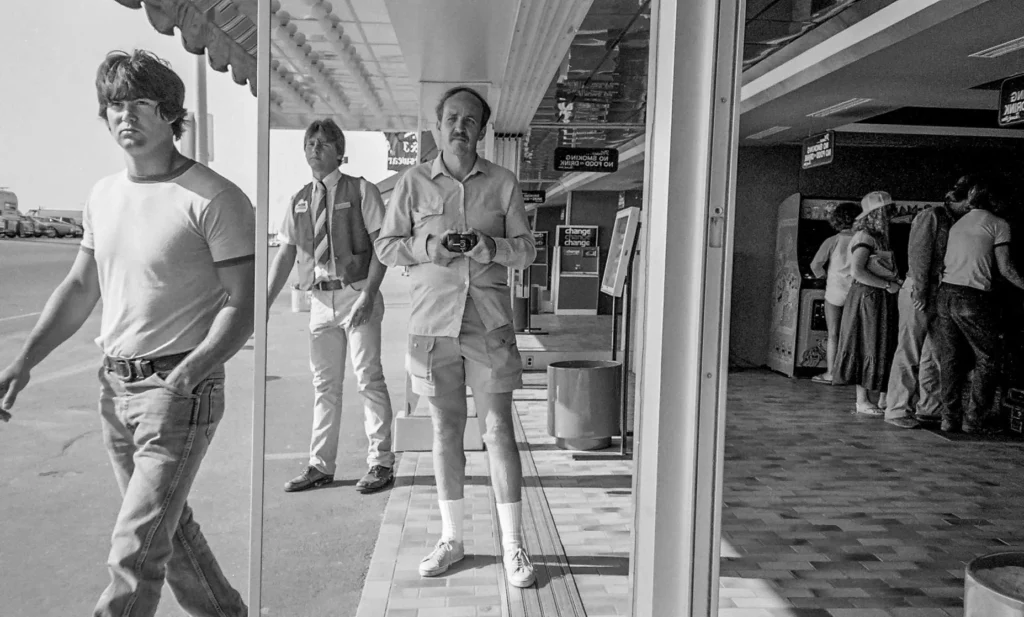
JDR: Your early books for the Portsmouth Marine Society inspired my history writing career. But I’ve always seen you as a photographer first. You may not recall, but in the early 80s, you took a portrait of me in my apartment in Pleasant Street that appeared in an exhibition. It was quite a thrill.
PETER: In 1983, I organized the Serious Photographers Weekend at the Shoals Marine Laboratory on Appledore Island. I was interested in establishing a get-together of fine art photographers, folks who were interested in making images for the love of the creative process. Ultimately, I created the New Hampshire Society of Photographic Artists. It continues today as the New Hampshire Center for Photography.
JDR: Nothing seems to slow you down.
PETER: In 1992, I survived cancer, although I was left with a disabled leg. I continued to publish, photographed two more books of New Hampshire images, and traveled to Ghana with five friends to photograph a book celebrating the country’s fifty years of independence. As a result of authoring a Marine Society title about the Treaty of Portsmouth (that ended the Russo-Japanese War of 1905), I was invited to Japan as part of that country’s public outreach program. I lectured in Tokyo and visited Kyoto, Nagasaki and, of course, made a few photographs.
With Downeast, I wrote a guide to country inns in New Hampshire and Vermont, and with Countryman Press, I co-authored several editions of a New Hampshire travel guidebook. As Peter E. Randall, Publisher, I continued to produce books, mostly history titles. When I retired in 2008, I had published more than 450 titles. The business continues to be operated by my daughter, Deidre Randall.
JDR: Congrats on a stellar career, Peter. And thanks for sharing your story.
(c) Harbortown Press/J. Dennis Robinson

 Rare Glimpse of “The Temple” Bell Tower