


SEACOAST POETRY
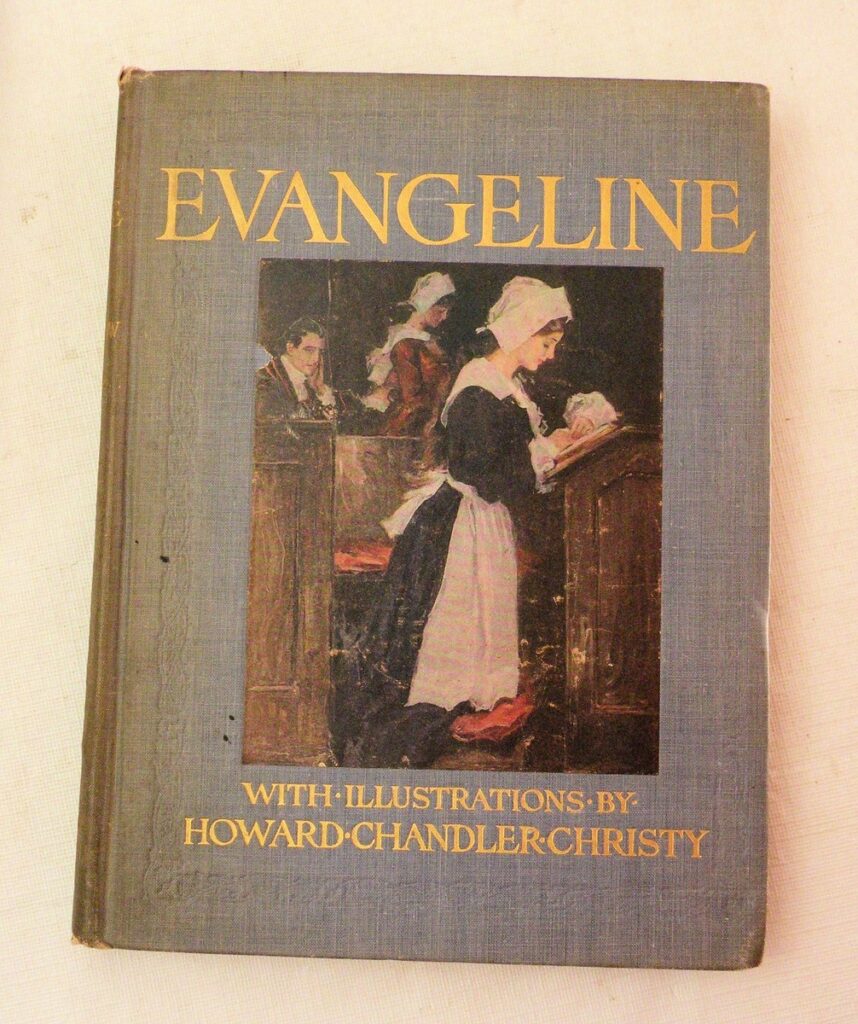
The poem “Evangeline” is among the national treasures of maritime Canada. It was penned by New England poet, Henry Wadsworth Longfellow, with connections to Maine, New Hampshire, and Massachusetts. Longfellow was always on the lookout for a melodramatic topic for one of his bestselling ballads. My copy of “Evangeline” is part of a two-volume hardcover collected works edition that, no exaggeration, weighs 20 pounds. One of the books is twice the size of my laptop computer and the cover itself is so heavy that it has been dangling by a thread for 100 years.
The fictionalized Evangeline was unlucky enough to live in the Canadian Maritimes during the famous “Expulsion of the Acadians” in 1755. That’s when the British, victorious in the siege of Fort Louisbourg in Nova Scotia, with the assistance of New England troops, decided to kick out the French. French farming families had lived in the region since the late 1600s. Assembled at the church of St. Charles in Grand Pré, they were told to leave. Some traveled as far as Louisiana, while others set off for city life in Quebec and Montreal, or to rural life in Newfoundland. Other Acadians buried money and heirlooms in the fertile soil in hopes of recovering it later, but the British found the loot. You can imagine Longfellow drooling at the symbolism of poor farmers burying money. Families tried to stay together, but were driven apart forever.
A good ballad needs a good plot and this one was the 19th-century poetic equivalent of a TV mini-series. Evangeline herself is a fictional device dropped into the middle of beautiful rustic scenery and turbulent times in Canadian history. It’s a moment the English prefer not to talk about, which suited Longfellow just fine. Remember, he also wrote about Hiawatha, Miles Standish, Lady Wentworth and Paul Revere. Longfellow got the idea for “Evangeline” from Nathaniel Hawthorne, another writer with an eye for good story-starters.
The epic poem is way too long to reprint here. It was published in 1847. The main character is separated from her family and her lover. The story is reportedly based on the lives of Emmeline Labiche and her love, Louis Arceneaux. I don’t want to give away too much of the plot, but it includes a long sea voyage, plenty of hopeless searching, a lot of angst, a nunnery, a dramatic reunion, some insanity, and eventual death.
“Evangeline” was a hit in New England, although it was banned from use in schools in Western Canada. British Canadians criticized Longfellow for his poor telling of history. True enough. Longfellow never let the facts get in the way of his ballads. But 6,000 Acadians were deported and many of them found their way into coastal New England communities, bringing their rich French cultural heritage.

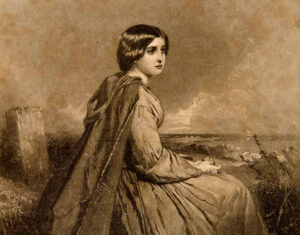
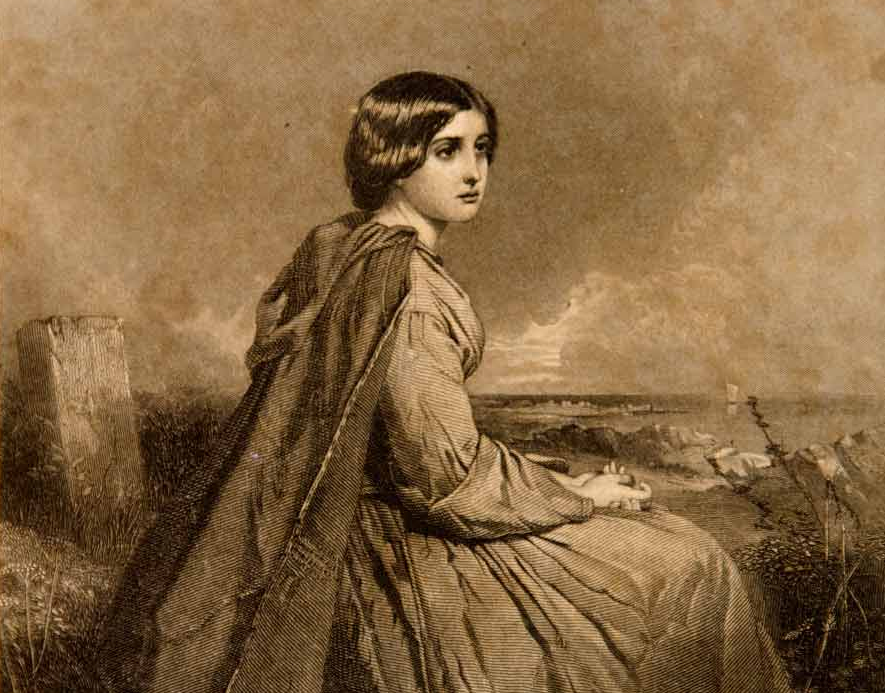
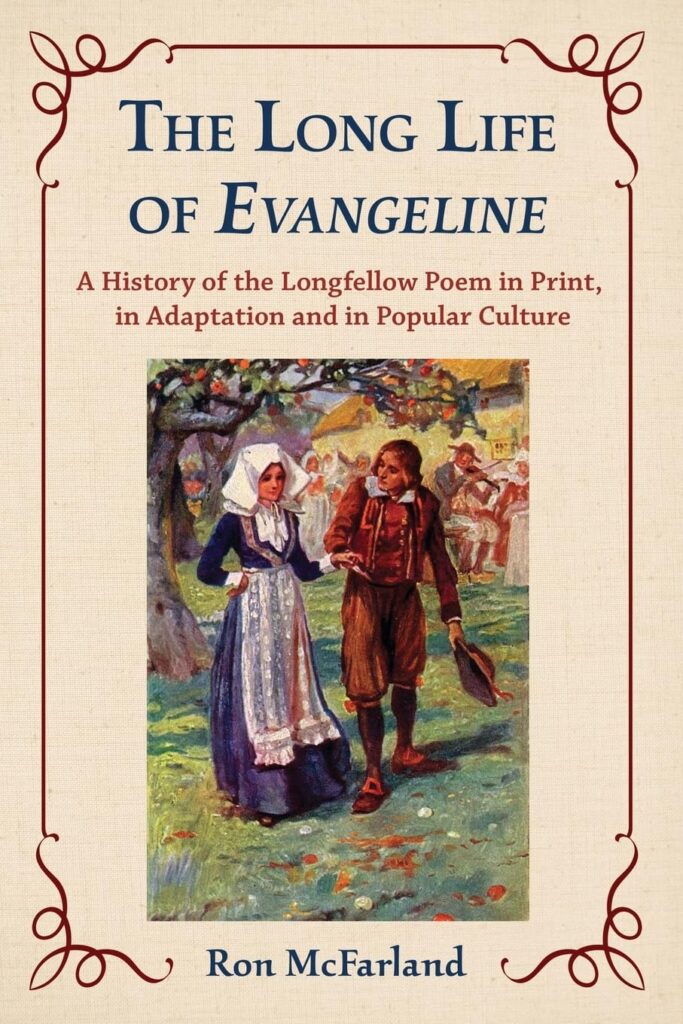
There are countless editions in book form. The character, Evangeline, was depicted as a pre-Raphealite beauty with long flowing hair. She appears much like Joan of Arc, as the perfect hybrid of the Madonna and a silent-film sex goddess. In a 19th-century engravings she has that innocent milk-maid look, much like Portsmouth’s “Lady Wentworth” was described in another Longfellow poem. In an 1855 engraving she appears as a draped nymph gazing forlornly at the ground, her bosom half exposed like Janet Jackson with no Justin Timberlake.
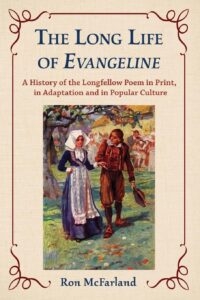
You can buy everything Evangeline in Canada. Her image was sold by Currier & Ives, appeared on comic books, and was embossed into shapely soda pop bottles. A film version from 1929 stars Dolores del Rio. There is a musical, too.
Seacoast locals can see a statue of Longfellow in the center of nearby Portland, Maine and visit his homestead, now a local museum and part of the Maine Historical Society. If you tour Nova Scotia, a good chunk of the province takes you along the Evangeline Trail, filled with reminders of the Acadian tragedy, including a large brass statue of the fictional Evangeline. The poem opens with the line: “This is the forest primeval,” and you can find the whole thing reproduced online. Or, if you have a pickup truck, I can lend you my copy.
Copyright J. Dennis Robinson
 Celia Thaxter’s Shocking Smuttynose Murder Letter