


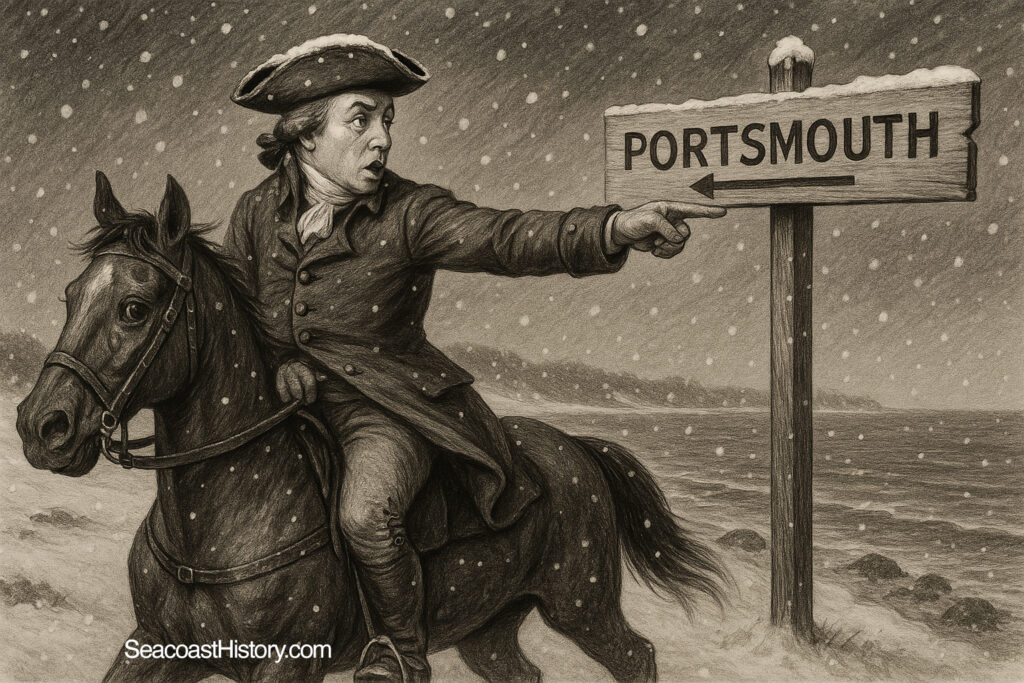
In my hand is an item most rare, but maybe not for long. Writer, artist and bookseller Nancy Grossman of Portsmouth has composed a poem about Paul Revere’s ride. No, not the famous one in Massachusetts, but the “other” ride Revere made up the wintry Boston Post Road to Portsmouth, New Hampshire on December 13, 1774. Her 130-line poem entitled “Paul Revere’s Other Ride” perfectly matches Henry Wadsworth Longfellow’s original in meter and rhyme. But this one tells the little-known story of the alarm that led to a local uprising at Fort William and Mary in New Castle. The fort, in ruins, is still there.
Nancy published the poem in an attractive booklet format. The idea is compelling; is it possible to sell poems one at a time? Portsmouth poet laureate Robert Dunn once sold his self-published work on the street for a penny. That is how he became “The Penny Poet.” But Nancy’s beautifully printed brochure-shaped poem goes for $4.95. Will the public pony up a fiver for art?
“Why did I do it?,” Nancy asks herself. “Because it needed doing. I’ve met too many folks in this town, young and old, native and transplant, who’ve never heard the story. With all the poets Portsmouth has spawned over the decades, it’s truly amazing that no one ever has.”
“Last summer, I finally got curious,” she says. “I looked up Longfellow’s original and gave it an adult read. I marveled at the sheer beauty of it, not to mention the complexity and imagery. What a bizarre rhyme scheme! It really is a wonder.”
Then came months of sporadic research on the Portsmouth-Revere connection. As an English major, Nancy says, there is no quicker way to get inside the head of a writer than to emulate the poet’s work. The self-publishing idea grew out of her experience creating a newsletter for a nonprofit group. Nancy explains:
“I love the chapbook format. It’s just the right shape for a Christmas stocking. I’ve always been commercially motivated. I love making money, even if it’s pocket change. I spoke with the Portsmouth Athenaeum, the Dunaway Store, and Riverrun Books. They agreed to carry it. With all the tourists Portsmouth attracts, plus a lot of locals with an interest in history, I think there’s a good market for both.”
Following its first appearance in The Portsmouth Herald, Nancy says, she got an order for 10 copies of “Paul Revere’s Other Ride”. That’s a start. Give the gift of verse. Nancy suggests the motto should come from a line by John Adams — “You’re never alone with a poet in your pocket.” –JDR
PAUL REVERE’S OTHER RIDE
By Nancy Grossman
LISTEN now, children, and you shall hear
Of the daylight ride of Paul Revere,
The thirteenth December, of Seventy-Four;
Hardly a student of Portsmouth lore
Remembers that famous day and year …
Four months before his long-famous ride
On the eighteenth of April, his ride through the night
After spotting the signal across the tide
That troops were afoot, the lantern light –
His “One, if by land, and two, if by sea” –
This peripatetic patriot, free
To drop all his work – news must travel fast!
At values-as-action, no one surpassed.
That wasn’t his first ride, nor either his last.
The British, quite conscious of gathering threat,
To the rebels would leave no shell, bayonet,
No powder keg, cannon, no arms for their cause –
To men who would free themselves of the King’s laws.
Such was the rumor o’er spreading the street,
As patriots eyed King George’s fleet
At anchor in Boston. A December sleet
Did nothing to quell the fast-rising fear
That harsh retribution was fast growing near.
Passing like phantoms fresh from their rest,
Whispers of gunships now nearing the coast
On the minds of the patriots lay uppermost.
British men o’ war, aimed to disarm
Rebels who chafed now at taxes impressed,
At soldiers billeted upon unwelcoming hosts,
At Orders in Council that could only alarm.
Loyalist spies dogged the silversmith’s steps –
Well-known were his travels spreading patriot news,
His stealth, care and haste, all ploys to confuse.
Rewards to the soldier whose guile intercepts
This Liberty’s Son as he hastens again
To the highways, the byways, to hill, dale and glen.
But none would deter him, as once on his way
He took to the road on his galloping bay
Through snow massing high as the hour advanced.
Hurtling, half-blinded, his fortunes he chanced.
To Portsmouth he flew, with reports to convey.
The frigate Scarborough and Cansean sloop,
Precursors laden with soldiers deep,
On good Revere’s mind, where others might creep,
Lent urgency as storm winds did swoop
Up rugged coast, from hamlet to town
From valleys to hills, from the heights at their crown.
Through Newburyport, hoofbeats muffled by snows,
’Cross the Merrimack to Seabrook, his course like the crow’s,
As direct and as fleet as a pigeon’s to coop,
Sweat icing his mount from its neck to its croup
As he galloped breakneck, up knolls and down
Through all the Hamptons, and on to the north.
On into Greenland? Where rode he thenceforth?
The trail grows elusive, the history unclear
As time becomes distance, growing longer each year.
Some think him in Durham, that afternoon,
To General John Sullivan came he first to commune.
Others say he’d head to Portsmouth, nonstop,
To the good people there, the time opportune
For the tillers of field, the keepers of shop,
The netters of fish, Sons of Liberty all,
To respond to his news, swiftly answer the call
Of patriots inflamed by this new British threat,
The gravest of dangers to menace them yet.
Whatever his route, whomever he saw
As he drew to the fire from the elements raw,
Shivering with cold, extremities froze’d
The plans of the English he swiftly disclosed.
His unburdened heart was encouraged by all
He heard and observed, of his listeners transposed
By his tale of new dangers, soon to answer his call.
The word, like a wildfire, quickly o’erspread the town,
From James Stoodley’s tavern to the top of Church Hill,
Through the shops, down the pond to Pickering’s mill,
Skirting by Staver’s, ’neath the sign of the crown.
From Samuel Cutts to Sheafes, Sherburnes and Halls,
From millers to merchants to fishmongers’ stalls
Whispered by men, lads and women in shawls,
The message passed swiftly up hill and down.
Fort William and Mary, on New Castle’s shore
Held munitions and arms, gunpowder and more.
Lightly defended, but not now for long
With the British approach just delayed by the storm.
With imminent onslaught sure due before long,
Plans for its capture must in haste take up form.
By noon the next day, to a drum beat’s tattoo,
A throng had assembled about the Parade,
Near to the State House, the multitude grew.
Governor Langdon, with rising alarm,
Told the Provincial Chief Justice the crowd to disarm,
To plead with their leaders, from rebellion dissuade.
But four hundred men, perhaps more or less,
An armada of gundalows assembled post haste
And took to the river, their plan to transgress
Langdon’s forewarning. Towards the fortress they sailed.
Five men and their captain the garrison manned.
Sorely outnumbered, they attempted a stand,
Refusing surrender. All quickly were jailed,
And England’s loathed flag was in no time replaced.
Powder was loaded and soon hauled away,
Taken by Sullivan’s men to safe shores,
To Durham’s Meeting House, ’cross the Great Bay.
Hid ’neath the pulpit until, come the spring,
It would fill John Stark’s muskets. Revolution would bring
Those who were governed and their governors
Finally to blows, fierce battle engaged
In Concord and Lexington, four months anon.
Pushed past endurance, completely enraged,
America would face her first Rubicon.
When back in England, the king heard the news,
His anger waxed bitter. Like a match to a fuse,
His fury ignited. His patience was spent
With the colonists’ protests, dispute and dissent.
Certain he was, now, of the course time would forge.
Premonitions of carnage assaulted King George.
Concessions exhausted, the crown now must fight.
To crush rank rebellion, he would harness his might.
Set into motion, in Portsmouth that day
By Paul Revere’s news so boldly declared,
Patriots proved they were more than prepared
To fend for themselves, to break clean away
From English oppression, for liberties prized,
The colonists’ fervor at last undisguised.
From open rebellion on New Hampshire soil
To a Lexington bridge, British might would recoil.
Out of wilderness, settlers a nation had hewed
From forest and prairie, from iron and clay.
With Revere’s Portsmouth journey and the raid that ensued,
History was changed – pray, forget not today.
Poem copyright © 2003 Nancy W. Grossman. All rights reserved.
 Whittier’s Anti-Slavery Ode to New Hampshire