


I’m writing this Tuesday, Nov. 3, so I don’t know how things went on election night. But whatever is happening in politics today – or any day – I’ll wager Sam Walter Foss, the poet of the “common man,” has already dissected it.
Born in Candia, New Hampshire, in 1858, Foss moved with his family to Portsmouth when he was a young teen. He attended Portsmouth High School where he was a mediocre student. Then, like so many young people of the Industrial Age, Foss abandoned the family farm for the city, working as an editor, humorist and librarian. His work, however, usually reflects life in the country.

Sam Walter Foss
Foss was more philosopher than poet. His moral compass was dead on. He carried a healthy distrust for authority. He had no patience for lazy, pretentious or quarrelsome people. A humanist of the highest order, Foss believed entirely in the goodness of “the average man” and wrote entirely for a popular audience he hoped to inspire with his “homespun” verse.
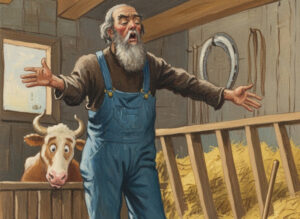
The world, for Foss, was a fascinating comic opera. The more powerful and rich men became, he continually pointed out in his poems, the sillier men became. If he wrote about a boy “who was dumber than snowbirds in summer,” that boy was likely to grow up to be president. His hero was often a humble farmer like the one in this week’s illustration by Merle Johnson that shows a farmer in his barn preaching to his cows and chickens.
In his poem “The Candidates at the Fair,” a slick politician and a hayseed face off. The crowd is most impressed by the simple bumpkin who promises voters only one thing: “I’ll make the things you sell go up, an’ things you buy come down.” The unsophisticated candidate wins the election by a landslide, but nothing changes as Foss wryly points out in this final couplet:
“And next week at the polls he beat his rival high and dry –
But things we sell continue low, and things we buy are high.”
For Sam Walter Foss, being average was something to be proud of. Average men and women were uncorrupted, hard-working, good-humored and resilient. The poet’s job, Foss believed, was to speak in an authentic voice that everyone could understand. His mission was not to use language to confuse or impress, but to use it like a bullhorn to call common people to step out of the crowd and perform great deeds. In a sing-song beat that paved the way for the work of Dr. Seuss, Foss ends his poem ‘The Man from the Crowd” this way:
“And where is the man who comes up from the throng
Who does the new deed and sings the new song
And who makes the old world as a world that is new?
And who is that man? Is it you? Is it you?
Copyright J. Dennis Robinson, all rights reserved.

 Let’s Create a Portsmouth Cultural Center