

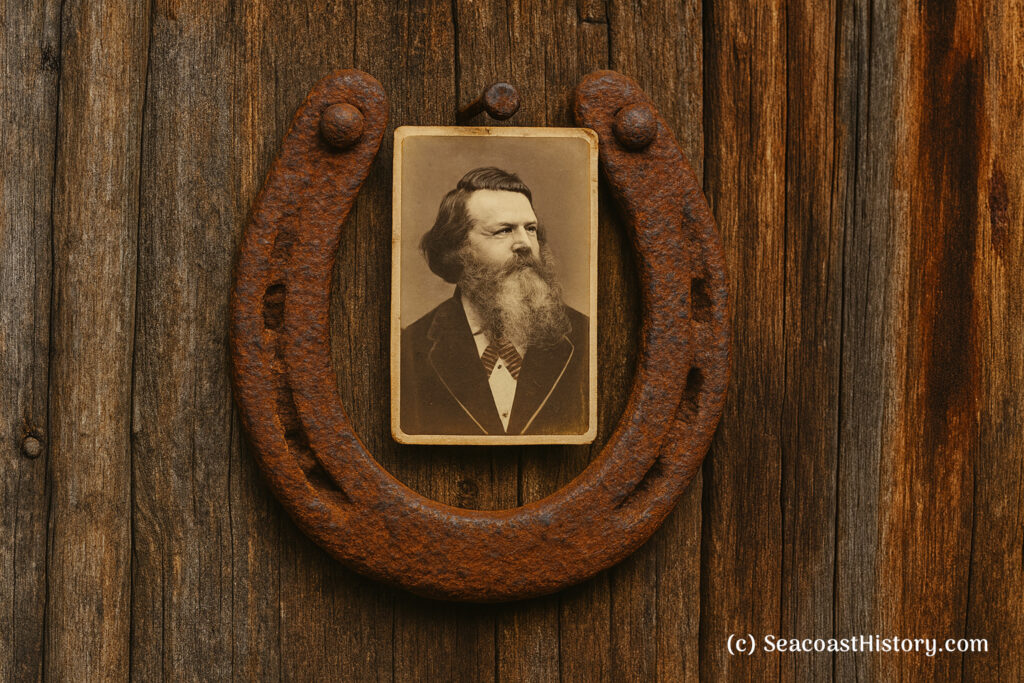
Another Portsmouth boy makes good. James T. Fields (1817-1881) had a pretty lucky life. His publishing company did well in Boston. He married the vivacious Annie Fields and hung out in the best literary company. And he retained his Northern “yankee” humor as seen in this poem from 1880.
Although Portsmouth, NH faded as a commercial and social capital soon after 1800, it survived as a literary legend thanks largely to a few influential men. Amazingly, three of the first four editors of the popular Atlantic Monthly had local connections. James T. Fields, a Portsmouth native, took the reigns of The Atlantic in 1861 from James Russell Lowell. Fields handed the post to William Dean Howells, who summered at Kittery Point. Howells passed it on to Portsmouth-born “Bad Boy” author and poet Thomas Bailey Aldrich.
So I’ve always imagined JT Fields (1817-1881) to be one of those stuffy literary types. Like our friend BP Shillaber, he moved to Boston as a teenager and entered the publishing business. Fields had an uncanny ability to tell which authors had commercial potential. As a partner in the firm Ticknor and Fields (later Houghton & Mifflin), he published and befriended top British writers like Dickens, Wordsworth, DeQuincy and Thackery. In the United States he was friendly with Hawthorne, Longfellow, Holmes, Stowe, Emerson, Twain, Whittier, and just about everybody who made it big in American letters.
Yet according to the accounts I’ve read recently, James T. Fields was a vivacious, approachable and downright funny guy. He had every reason not to be. His father, a “much respected” Portsmouth shipmaster died at sea when James and his brother were young. His mother forbade them from going near the docks, and banned James from attending a Sunday sailing trip with a group of his Portsmouth classmates. The students and his teacher were all killed on the field trip. Later Fields was engaged to a Boston girl who died. When he married her sister, she died soon after.
Somehow Fields, a dedicated Unitarian, kept his sense of balance. He once wrote that his literary aspirations started when, after the death of another friend, he was loaned a box of books belonging to the deceased boy. Fields said he spent many of his early days reading in a window seat at the Portsmouth Athenaeum. Financially successful, he eventually married his soul mate Annie Fields, also a writer and editor, who was an intimate friend of Seacoast poets Celia Thaxter and Sarah Orne Jewett.
Loulie Albee, the daughter of New Castle, NH, historian John Albee, recalled Fields and his partner William Ticknor visiting their home when she was a girl. The two men were known to rummage through trunks in the Albee attic and, dressed in women’s clothing, perform hilarious skits.
Financially successful, Fields retired from editing and spent his twilight years writing and lecturing. Thumbing through old copies of Harper’s New Monthly magazine the other day, I bumped into the following poem published in 1880, the year before Field’s death. It appears that the affable Mr. Fields kept his humor right to the end. — JDR
HE LUCKY HORSESHOE
By James T. Fields (1880)
A FARMER travelling with his load
Picked up a horseshoe in the road,
And nailed it fast to his barn door,
That Luck might down upon him pour,
That every blessing known in life
Might crown his homestead and his wife,
And never any kind of harm
Descend upon his growing farm.
But dire ill-fortune soon began
To visit the astounded man.
His hens declined to lay their eggs;
His bacon tumbled from the pegs,
And rats devoured the fallen legs;
His corn, that never failed before,
Mildewed and rotted on the floor;
His grass refused to end in hay;
His cattle died, or went astray:
In short, all moved the crooked way.
Next spring a great drought baked the sod,
And roasted every pea in pod;
The beans declared they could not grow
So long as nature acted so;
Redundant insects reared their brood
To starve for lack of juicy food;
The staves from barrel sides went off
As if they had the hooping-cough,
And nothing of the useful kind
To hold together felt inclined:
In short, it was no use to try
While all the land was in a fry.
One morn, demoralized with grief,
The farmer clamored for relief;
And prayed right hard to understand
What witchcraft now possessed his land;
Why house and farm in misery grew
Since he nailed up that “lucky” shoe.
While thus dismayed o’er matters wrong
An old man chanced to trudge along,
To whom he told, with wormwood tears,
How his affairs were in arrears,
And what a desperate state of things
A picked-up horseshoe sometimes brings.
The stranger asked to see the shoe,
The farmer brought it into view;
But when the old man raised his head,
He laughed outright, and quickly said
“No wonder skies upon you frown—
You’ve nailed the horseshoe upside down!
Just turn it round, and soon you’ll see
How you and Fortune will agree.”
The farmer turned the horseshoe round,
And showers began to swell the ground;
The sunshine laughed among his grain,
And heaps on heaps piled up the wain;
The loft his hay could barely hold,
His cattle did as they were told;
His fruit trees needed sturdy props
To hold the gathering apple crops;
His turnip and potato fields
Astonished all men by their yields;
Folks never saw such ears of corn
As in his smiling hills were born;
His barn was full of bursting bins—
His wife presented him with twins;
His neighbors marveled more and more
To see the increase in his store.
And now the merry farmer sings
“There are two ways of doing things;
And when for good luck you would pray,
Nail up your horseshoe the right way.”
From Harper’s New Monthly magazine Volume 62, Issue 367
 The Last Poems of Esther Buffler
Leave a Reply