


(The Virginia Histoical Society)
New Hampshire almost missed the boat during the gigantic Jamestown Exposition. At the eleventh hour, the state’s most patriotic mansion was copied, timber by timber, in Virginia. The duplicate Gov. John Langdon mansion (1784) still stands as a strange footnote to the founding of Jamestown, VA.
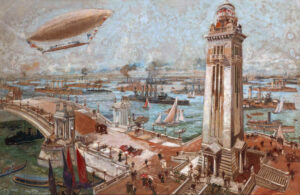
Virginians continue to complain that the 1607 settlement at Jamestown often plays second fiddle to the pilgrims of Massachusetts who arrived 13 years later. In 2007, Jamestown finally got its due during a 400th anniversary media blitz. There was a new Hollywood film about Captain John Smith, a cover story in National Geographic magazine, and a visit by the Queen of England.
Early 20th-century New Hampshire historians, jealous of both Plymouth and Jamestown, awarded themselves the bronze medal as the third permanent British settlement here in 1623. Yankee scholars pointed out that Captain John Smith, after being hustled out of Jamestown, VA, in shackles, later staked his claim on the Maine and New Hampshire seacoast. Smith mapped and named the region “New England” and attempted, without success, to found a colony here.
There is another strange bond between Portsmouth and Jamestown. In 1907, there was not a single historic museum in Portsmouth. There were many grand colonial houses, but none were open to the public. That year, a duplicate of the 1784 John Langdon mansion opened to the public. The reproduction was not in New Hampshire exhibit opened in Norfolk, Virginia.

Jamestown 300th
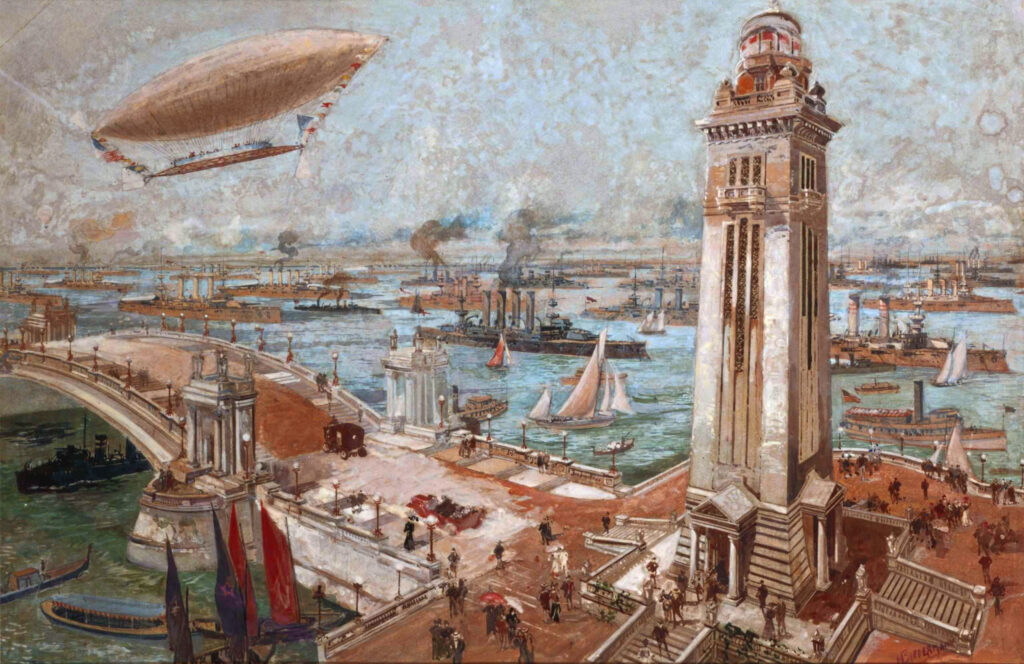
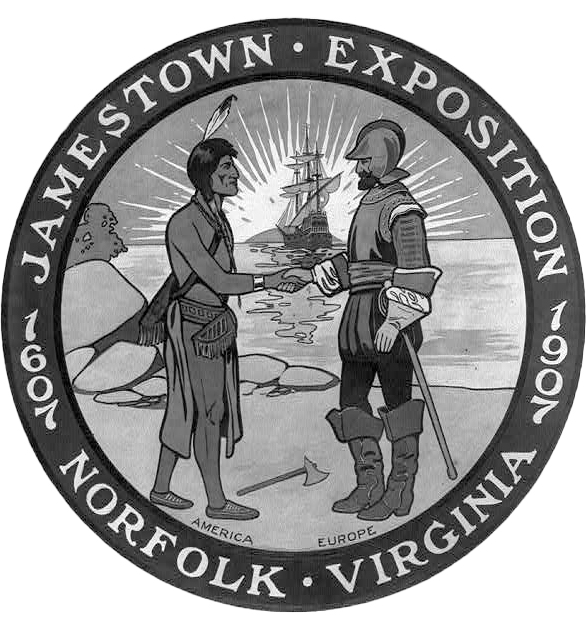
In 1907 Jamestown Exposition was enormous. In 2007, not so much. Jamestown today is often associated with the first battles between English settlers and Indigenous People and he first enslavement of Africans. The “Ter-Centennial Exposition,” by comparison, made few apologies. It followed the equally huge 1876 anniversary of the signing of the Declaration of Independence at Philadelphia and the 400th anniversary of the landing of Columbus held in Chicago in 1893.
The 1907 event was held, not at the historic Jamestown site, but on a 340-acre campus near Norfolk. Three million visitors paid 50 cents (half price for children) to explore the campus with scores of hastily constructed buildings that included a 1,600-room hotel. The grand auditorium was illuminated by 100 electric lights.
Exhibits included a Wild West show, a wild animal menagerie, a 120-foot relief map of the Panama Canal in concrete, a massive haunted house called Hell Gate (with a precipitous indoor waterfall and live snakes), a reproduced Yukon gold mining town, an Eskimo village with real Eskimos, and a reconstruction of the devastating San Francisco Earthquake of 1905. A Negro Building showcased African American achievements, although critics described it as a “Jim Crow affair.”
The most popular event was a live re-enactment of the Civil War battle between two famous ironclads, the Merrimac and the Monitor. Dozens of counties and corporations built exhibit halls, as did 21 states. President Theodore Roosevelt used the event to exhibit and launch his Great White Fleet of American battleships.
Granite State almost missing
-At first, New Hampshire ignored the invitation to participate in the Jamestown event. But with the growing emphasis on naval power and patriotism, could the self-elected third-oldest city in America with the oldest naval shipyard afford not to attend? Wasn’t Portsmouth, Virginia, the seat of the Norfolk Navy Yard? What’s more, a Concord, NH businessman pointed out, wasn’t Yorktown near to Jamestown? And didn’t New Hampshire soldiers bravely fight at Yorktown during the Revolution, leaving heroic men like Alexander Scammel dead and buried in the Virginia soil?
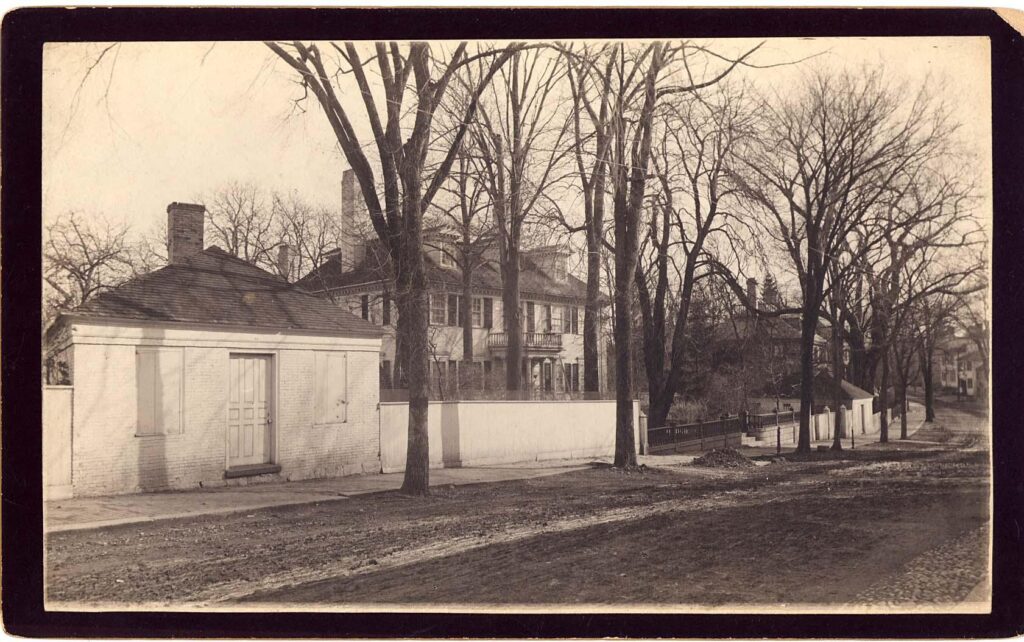
In February 1907, only three months before the exhibit opened, New Hampshire legislators quickly voted a budget of $10,000 to build a exhibit at Jamestown. They quickly decided to reconstruct what a newspaper of the day called “one of the finest examples of colonial architecture in America.” The model selected was the Governor John Langdon mansion on Pleasant Street in Portsmouth.
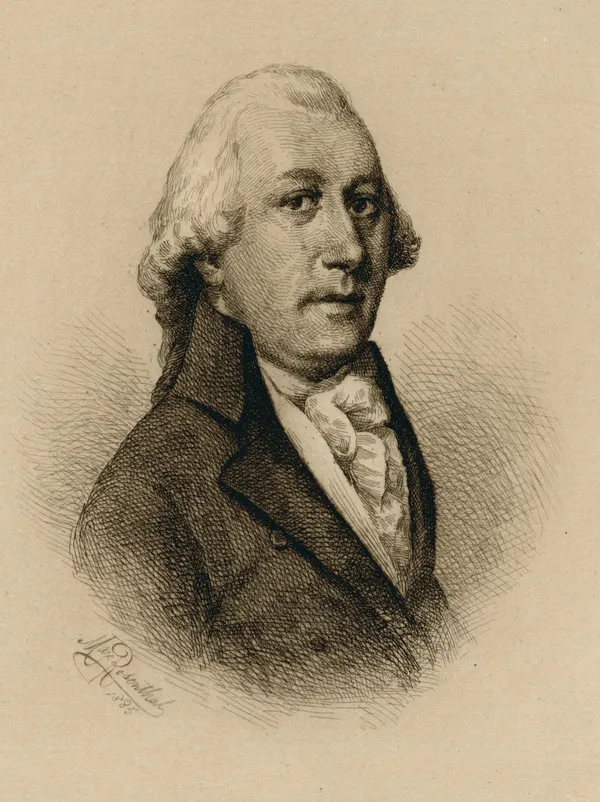
Built in 1784, the grandest house in town, as George Washington described it, was the showplace of New Hampshire’s pre-eminent citizen. Langdon helped organize the 1774 raid on the British fort in New Castle and, as agent for the Continental Navy, built the frigates Raleigh and Ranger. Twice governor of the state, Langdon had served on the Continental Congress, worked on the Constitution, and served as the first president pro tem of the United States Senate. He later turned down offers to be Secretary of the Navy and Vice President of the nation.
According to one 1907 magazine, no house in America besides Mount Vernon more accurately mirrored the august nature of the man who built it than Langdon’s Portsmouth mansion. The statement wasn’t true, but it helped raise funds needed to build the copycat mansion in distant Virginia. Woodbury Langdon of New York, who summered in his ancestral home with his wife Elizabeth, contributed funds to reproduce the furnishings. Local residents contributed a dollar each ($125 total) to equip a Portsmouth Room and each was listed in the Portsmouth Daily Republican. John Hancock, Henry Knox, Lafayette and a future King of France reportedly dined in the original room.

A quick copy of the Langdon Mansion
The duplicate Langdon Mansion was constructed in record time. Timing was so tight that early postcards from the 1907 Virginia celebration show the original Portsmouth building. On September 5, 1907 the entire Jamestown Exposition celebrated “New Hampshire Day.” The governor of the Granite State and a small local delegation were on hand. A note in the Portsmouth newspaper reads: “The Governor’s party will be expanded by ladies on the trip and a delightful time is anticipated.”
Despite a $3 million budget, the Jamestown Exposition was a financial bomb. The project remained in debt for years. The New Hampshire exhibit was the first of the state buildings to be purchased for use as a private residence after the exposition closed. In 1934 the Navy bought the duplicate Langdon Mansion and moved it by barge where it served, for a time, as a barracks. Today it is the home of the Commander of the Naval Air Force U.S. Atlantic Fleet at Norfolk.
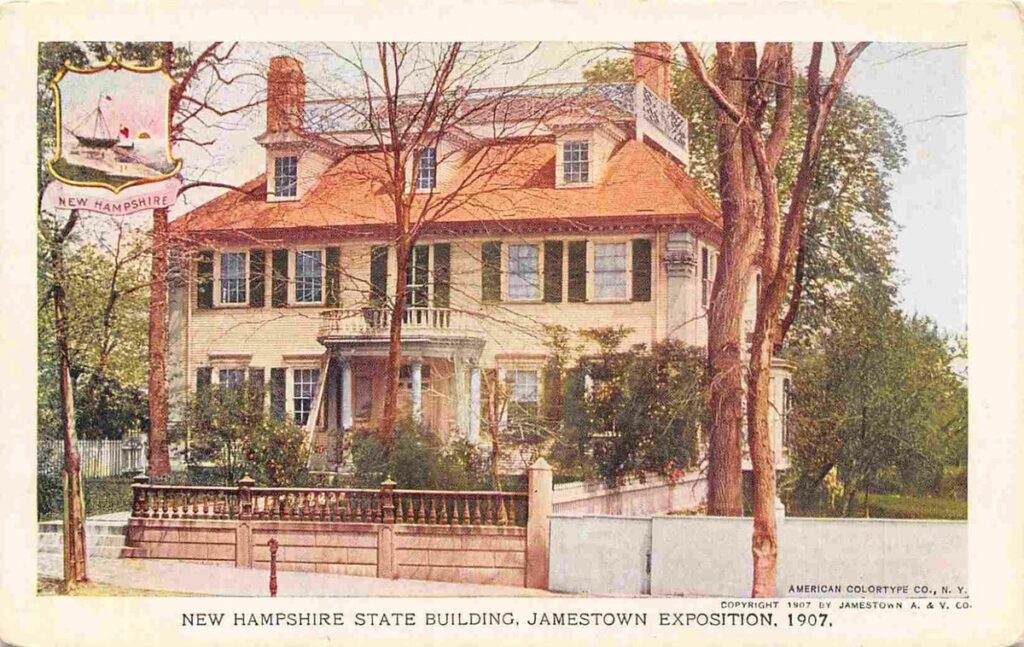
So what goes around comes around. A rear admiral and his family now live in the house designed by the man who built a warship for John Paul Jones, the so-called “Father of the American Navy.” The admiral recently sent some photos to Historic New England, the organization that owns the Portsmouth original today. The Virginia building has been renovated and no longer looks like its twin. The portico is plain and square. There have been renovations inside and out.
Over a hundred years later, even the copycat mansion is an antique, but few people remember or care. But there is a footnote to this footnote too. After rebuilding the Langdon Mansion, Portsmouth started saving houses for real.
In 1908, the year after the Jamestown Exposition, Portsmouth got its first history house museum. The Thomas Bailey Aldrich Memorial opened just a block away from the Langdon Mansion on Court Street. Then another 18th century house, home of William Whipple, was saved and opened to the public. Then came the Wentworth, Lear, Warner and Jackson house museums. In 1920, Elizabeth and Woodbury Langdon gave $10,000 to save the John Paul Jones House. In 1947 Elizabeth donated the John Langdon Mansion and its formal gardens as a public memorial. It has been restored and is maintained by Historic New England. Ten years later in 1957, the modern-day reconstruction of Jamestown opened to the public in Virginia. That same year Portsmouth residents began the process that would preserve up to 40 colonial buildings at Strawbery Banke Museum.
Today Portsmouth is one of the best-preserved cities in the nation. Original buildings, dating to 1664, are sprinkled all around town and open to public view. In 2023, which will be upon us momentarily, Portsmouth will celebrate its own quadricentennial. Then maybe Jamestown will finally send us a building in return.
Copyright © 2007 by J. Dennis Robinson. All rights reserved.
 Two Inland Noodles at the Sea