


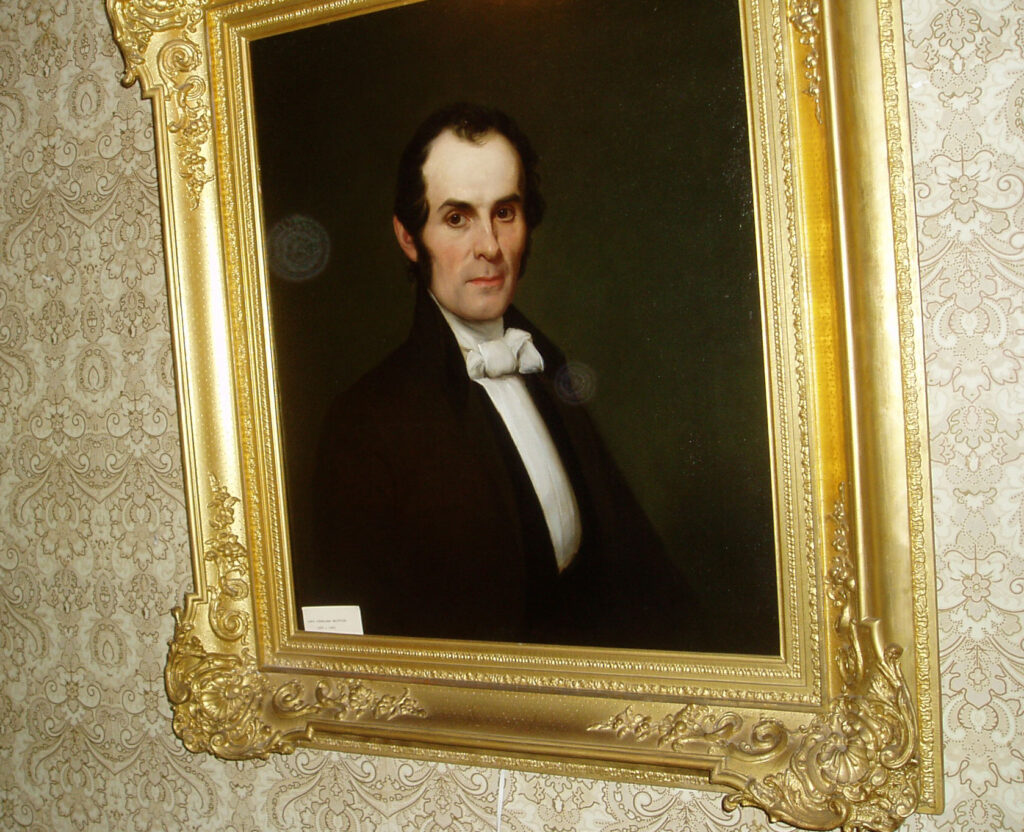
In 1846, young poet and activist JG Whittier called New Hampshire “one brave state” for its stand on the Abolition issue. But was New Hampshire brave? Or was this Yankee state, in many ways, as confused and caught up in the slavery movement as its southern cousins? Read the poem and see what you think.
Abolitionism in New Hampshire
John Greenleaf Whittier wrote his short poem “New Hampshire” to honor the Granite State’s bold unique stand against slavery in 1846, decades before the Emancipation Proclamation. The final couplet, often quoted, is a stirring call to arms against human bondage with New Hampshire leading the battle:
Courage, then, Northern hearts! Be firm, be true;
What one brave State hath done, can ye not also do?
The reality is less glorious. In fact, New Hampshire’s early track record in opposing discrimination, like most of the industrialized Yankee north, wins no gold metals.
Like its southern cousins, NH started as a slave state. Some of its stately seaport homes were built from slave trade profits. By the Revolution, enslaved African-American served white Seacoast owners in most prestigious families: the Cutts, the Whipples, the Ladds, the Lears, the Langdons, the Wentworths. Slave owning, North and South, was a sign of affluence and power. Although the “business” of slavery was outlawed in NH soon after the Revolution, no formal emancipation was ever issued.
Throughout most of the 1800s, NH’s anti-slavery efforts were tepid. Many early abolitionists were clergymen opposed to the immorality of bondage, rather than the inequality of racism. The state had its own abolitionist newspaper, two of them in fact, but the issue was mired in politics and infighting. Whigs, Federalists, anti-Federalists, Independents, Democrats, Democratic Independents and Democratic Republicans tossed the abolition issue around like a hot potato, defining and redefining themselves around this key issue.
Meanwhile, abolitionists argued over just what they wanted to abolish. Slavery was sometimes clustered with issues of temperance, women’s suffrage, state’s rights, even the possible abolition of all federal government. When a New England abolitionist group allowed women to cast votes, the NH Abolition Society simply formed a separate group without female members. Although the state counted 2,000 abolitionist voters, only 126 NH men voted for their own Liberty Party candidate for President in 1840. NH was the only eastern state that did not send candidates to a Buffalo abolitionist convention in 1843.
Economics and deep-rooted discrimination all too often reigned in the Granite State. As the Industrial Era evolved, politicians did not want to offend Seacoast merchants who did a lively shipping trade with the South. New expanding textile factories in the Granite State needed cheap slave-picked cotton. Despite the simplistic modern image of open-minded Northerners, whites and “coloreds” were unofficially segregated at restaurants and hotels in New Hampshire, in some cases, well into the middle of the 20th century.
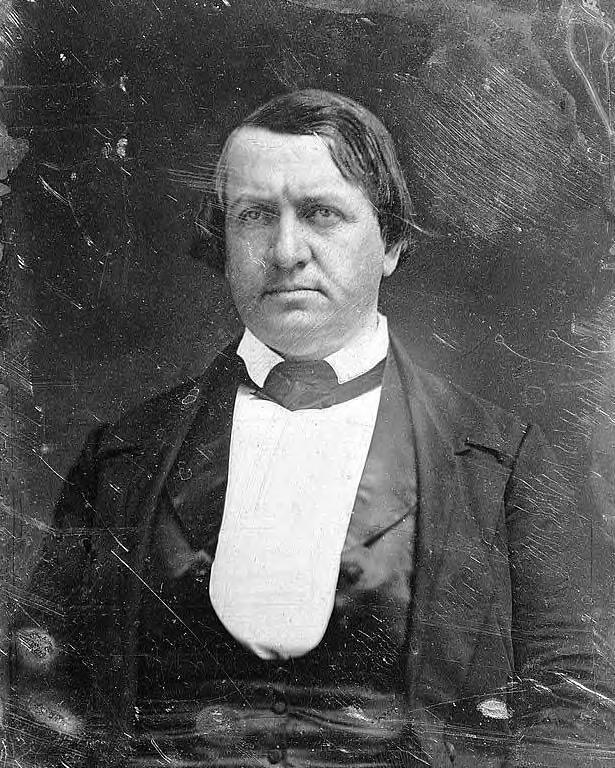
So what made Whittier, a staunch white abolitionist, praise NH so highly in his famous poem? The answer is Senator John P. Hale of Dover. Hale is remembered today as the first US Senator with an openly anti-slavery platform. Hale eventually even ran for President as the candidate for the Free Soil Party, which advocated the creation of no more slave states.
Already 20 years into his own personal battle against the “peculiar institution,” John Greenleaf Whittier saw Hale’s arrival in the Senate as a resounding victory for the anti-slavery movement which was finally gaining popular support among whites after only 200 years of black bondage. Hale’s arrival also widened the rift between North and South that would lead the country into its horrific Civil War. But in 1846, there was still hope that the problem would be solved without bloodshed.
Hearing of Hale’s election, Whittier wrote to a friend: “He [Hale] has succeeded, and his success has broken the spell which has hitherto held Democracy in the embrace of slavery.”
If only Whittier had been right. African-Americans would wait another two decades for a legislated end to slavery. In fact, Hale’s abolitionist-like position, brave and bold as it was. shows how hopelessly confounded Americans were over the issue of slavery toward the middle of the 19th century. Hale and his “Hale men” really started out opposing, not slavery spreading, but the spread of slavery due to the annexation of Texas. They could not reconcile the American takeover of what was then a foreign land for the avowed purpose of creating another slave state.
Hale first made headlines as a NH legislator when he had the courage to defy the infamous “Gag Rule” (created, ironically, by a New Hampshire legislator) and discussed the topic of slavery openly. In a political campaign that foreshadowed the famous Lincoln-Douglas debates, Hale took on soon-to-be-President Franklin Pierce, another New Hampshire man. By even talking about slavery, Hale became a magnet for praise and a target for hatred. Later, one of his southern colleagues even issued Hale a death threat while on the floor of the US Senate.
As our expanding nation moved westward, East Coast politicians struggled to define the country, its political parties, and its freedoms. Thanks to Whittier and Hale, for a moment in history, all eyes were on New Hampshire. Still, for blacks, all the poems, politics and promises added up to a lot of talk and very little action.
NEW HAMPSHIRE
By John Greenleaf Whittier (1807-1892)
Published 1846
God bless New Hampshire! for her granite peaks
Once more the voice of Stark and Langdon speaks.
The long-bound vassal of the exulting South
For very shame her self-forged chain has broken;
Torn the black seal of slavery from her mouth
And in the clear tones of her old time spoken!
Oh, all undreamed of, all unhoped for changes!
The tyrant’s ally proves his sternest foe;
To all his biddings, from her mountain ranges,
New Hampshire thunders an indignant No!
Who is it now despairs? Oh, faint of heart,
Look upward to those Northern mountains cold,
Flouted by freedom’s victor-flag unrolled,
And gather strength to bear a manlier part!
All is not lost. The angel of God’s blessing
Encamps with Freedom on the field of fight;
Still to her banner, day by day, are pressing
Unlooked for allies, striking for the right!
Courage, then, Northern hearts! Be firm, be true;
What one brave State hath done, can ye not also do?
Sources: (1) Historical New Hampshire, John Meyer, “The Beginning of Antislavery Agencies in NH, 1832-1835, Fall, 1970; (2) Historical New Hampshire, Irving Bell, “One Hundred Years Ago in NH,” Sept. 1946; (3) Historical New Hampshire, “The Liberty Party in the Granite State 1840-1848. Original text copyright © 1998 J. Dennis Robinson, all rights reserved
 A Song for the Sons of Liberty (1766)