

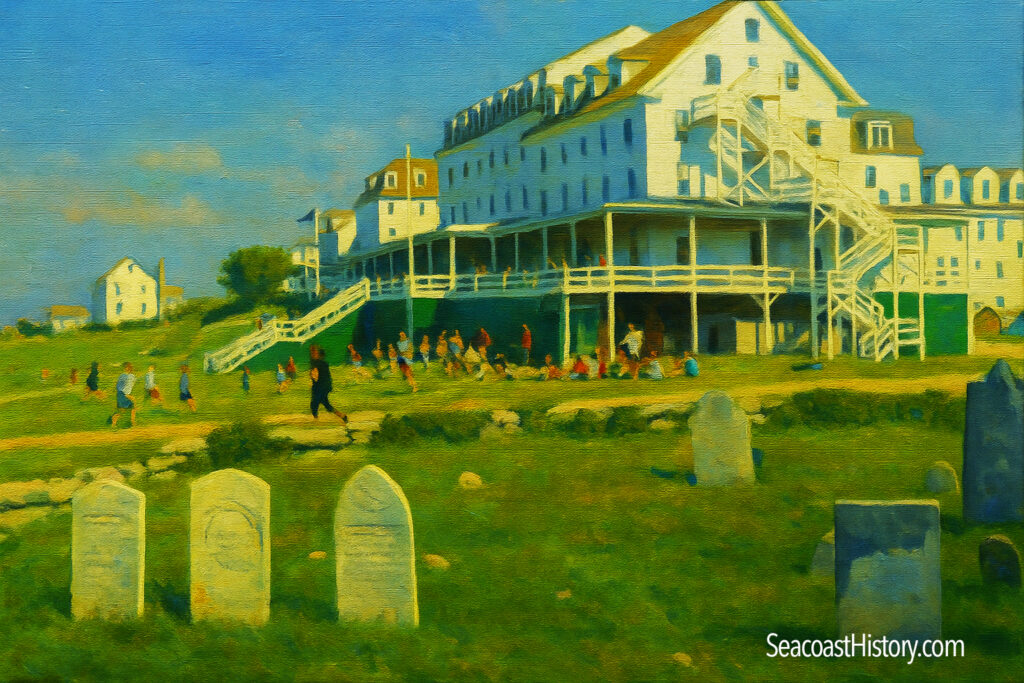
On Star Island, the Caswell family dominated the harsh fishing village in the 19th century. Hardworking and hard-drinking, they scraped out a living on the Isles of Shoals for generations. Then, in 1873, the Caswells and all the citizens of Gosport Village, NH disappeared./
From Thomas Laighton’s arrival as lighthouse keeper at White Island in 1839 until the death of his son Oscar a century later, the Laighton name reigned supreme in the annals of the Isles of Shoals. Laighton built the sprawling hotel on Appledore in 1847 and spawned a tourist industry. Daughter Celia Laighton Thaxter popularized the region with her poetry, books, and literary salon. Oscar and brother Cedric Laighton eventually expanded their island empire to include the Oceanic Hotel on Star Island.
But long before the Laightons came the Caswells. In 1711, the first Caswells joined a hard-drinking, hard-working Shoals’ fishing community that was already a century old. But unlike many seasonal fishermen who commuted from Europe, the Caswells stayed. They survived the dangerous fishing trade and the brutal winters on the windswept rocks. Although patriot forces cleared the feisty Shoalers off the islands during the Revolutionary War, many Caswells came back. They grew wealthy by island standards. By 1866, a hand-drawn map of Star Island shows that at least a third of the homes belonged to Caswells, with others owned primarily by the Randall, Robinson, Downs, Berry, Haley, Beebe, and Newton families.
Today, a dozen Caswells rest in a rock-walled family cemetery on Star Island near the Oceanic Hotel, the last surviving Victorian hotel of its size in the region. The Oceanic is a cluster of Caswell family buildings joined by a long wooden veranda. When the first Oceanic burned in 1875, two years after it was built, owner John Poore reconfigured the surviving buildings into a second Oceanic Hotel. The largest structure, the former Atlantic House, had been run by Lemuel Caswell. Another, the Gosport House, was once managed by Lemuel’s brother Origen Caswell.
Whispered voice rose from the Caswell cemetery in the summer of 2008. A hotel staff member found a 1853 penny while weeding one of the island gardens. Meanwhile, a team of carpenters uncovered the date “1868” chalked inside a renovated wall at Orgen Caswell’s former Gosport House. The construction crew then found a heavy metal bar built into the floor. This artifact may finally explain how the massive building was lifted, moved to a new foundation, and a floor added underneath.
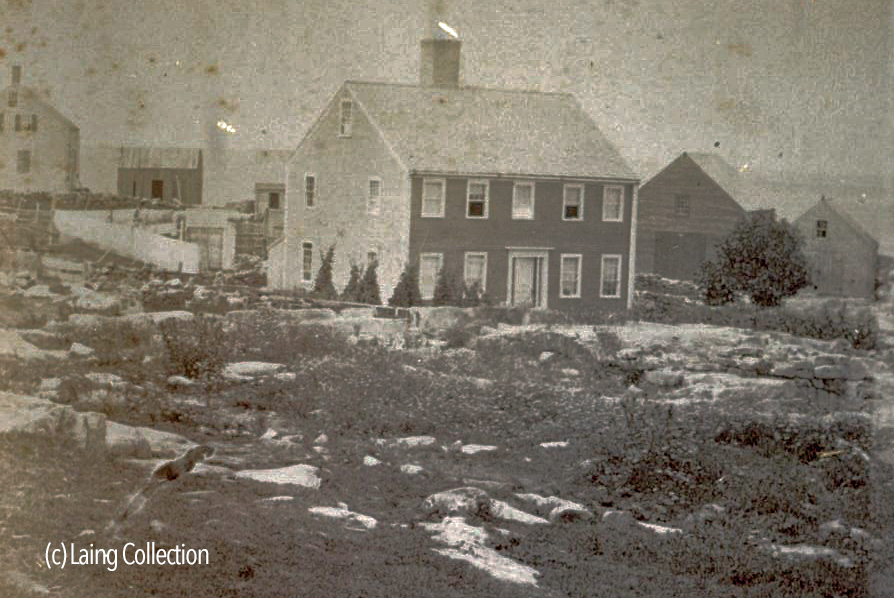
We get a sense of the Caswells’ success, and of their fecundity, from a 1828 probate record. In his will, patriarch John Caswell meticulously distributed his holdings, including garden plots, potato cellars, fish-drying areas, and pathways among his six children and island relatives. His will divided his house, room by room, even assigning ownership of hallways, closets, and entranceways to different people.
Like the Haley family of nearby Smuttynose, the Caswells were the royalty of Star Island, then the town of Gosport, NH. It was not much of a kingdom–an island reeking of stale fish and covered in ramshackle huts and upturned dories. Back then, as the joke goes, there were only two types of Shoalers: the heavy-smoking, hard-drinking, fish-smelling, tobacco-spitting, foul-mouthed heathen type–and their husbands. Island women, Celia Thaxter tells us, did most of the labor and grew old before their time. When the men were not fishing, they were drinking or lounging upon the rocks. A bill from one Star Island fisherman shows he could polish off four gallons of rum in a single month.
We can cobble together a picture of the Caswells from early documents and written impressions left by island missionaries and the first tourists. Richard Henry Dana, author of “Two Years Before the Mast,” stayed at Joseph and Sally Caswell’s earliest island guest house in August 1843. Dana’s first impression was wading up the beach through heaps of stinking fish heads and fish bones. But he came to enjoy the Caswell hospitality and the dramatic rocky island.
Another early anecdote comes from none other than novelist Nathaniel Hawthorne, who spent 10 days at the Appledore House in the summer of 1852. Hawthorne visited Star with his college friend Franklin Peirce, who was about to become the nation’s next president. Hawthorne described Joseph Caswell in his journal as “being very drunk” and dressed like a typical fisherman in “red-baize shirt, trousers tucked into large boots.” Joseph Caswell was also the Gosport town clerk, manager of the island school, and Gosport town policeman.
But it is from the Laightons, the family that ultimately ruled the Shoals, we get the most colorful and often comic view of the Caswells. In his autobiography, “Ninety Years on the Isles of Shoals,” Oscar Laighton offers an affectionate story of fisherman Asa Caswell, who rarely spoke to anyone. Oscar recalled the day Asa stopped by the Laighton hotel to sell a fresh 28-pound halibut at a nickel per pound. One of the hotel guests asked Asa where he/ had caught the big fish. Asa ignored him. When the guest took the aged fisherman by the sleeve and insisted that he reveal his secret fishing spot, the old Shoaler replied: “Look here, young feller, when I was of your age, I kept my mouth shut. Then nobody knew I was a cussed fool.”
Another often-told story comes from Cedric Laighton, who sent letters rich with island gossip to his sister Celia when she was married and living in Massachusetts. Netty Caswell, wife of Lemuel, the story goes, was missing a few “webs” of cloth from her home at the Atlantic House. Netty was famous for her elaborate meals at the rooming house and was not fond of the island preacher. When the cloth showed up at the house of Rev. George Beebe, the island minister, Netty Caswell confronted the cleric’s wife as a small crowd watched. Cedric wrote:
“Nett rushed upon Mrs. Beebe and commenced to slap her in the face. The town clerk (Origen Caswell), unwilling to leave without an honorable scar, rushed at Rev. Beebe and slapped him in the face. And Aunt Sally (Caswell), seeing everyone so pleasantly employed, determined to have her share and so commenced to slap Beebe’s baby. After the slapping was over, the trio marched slowly and majestically away from the parsonage amid the tears and groans of the House of Beebe.”
Origen Caswell, depicted in the Beebe slapfest above, had an otherwise flawless reputation. Named for an early missionary to the Isles of Shoals, Origen walked like a saint on rocky Star Island. William Leonard Gage, a Harvard graduate and summer visitor, described Origen as “one of the bravest, truest men I ever met.”
“At a time when drinking and brawling were universal among the Shoalers,” Gage wrote in 1875, “Origen was an example of temperance and quietness; trusted by all and loved by all.”
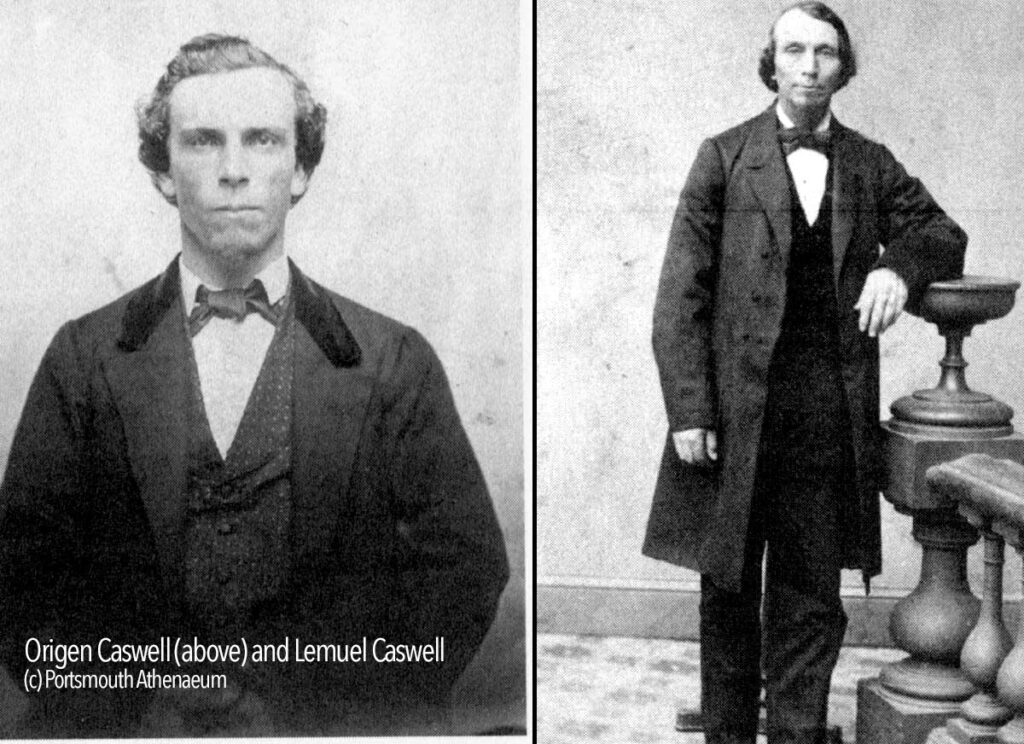
Origen and Lemuel Caswell built their rooming houses before the Civil War to handle the overflow of guests coming to the Laighton hotel on Appledore. According to one report, that meant as many as 2,000 overflow guests in a single year. When both the Atlantic House and Gosport House burned in a series of fires around 1866, the Caswell brothers rebuilt them. But it was the success of the Laightons that ultimately ended the Caswell reign. Hoping to trade on the tourism boom at the Shoals, a Boston developer named John Poore bought up almost every scrap of Star Island property in 1872, including that owned by the Caswells.
Many of the Shoalers, it has been suggested, were deeply in debt after the Civil War, having bought their way out of military service. This may account for the mass sale of the island and the end of Gosport Village. With the exception of two households, the entire population moved to the mainland in 1873 as the first Oceanic Hotel was being built. The hardscrabble village of huts and fish flakes was replaced by a monolithic wooden hotel with its grand halls, billiard rooms, and a bowling alley. Fashionable Bostonians, instead of ragged fishermen, lounged on the ancient rocks. Origen died just after selling out, but his brother Lemuel lived to rue his decision to leave the island.
“Nearly all the Gosportians left have been over here lately,” Cedric wrote to his sister Celia from Appledore in November of 1873, “and they one and all say that they bitterly regret having sold their homesteads. ..Lem (Caswell) was up in mother’s room talking to her for two hours and she did nothing but laugh! Lem says if he don’t get a place on the Shoals to live, he shall be crazy.”
Lemuel Caswell did get another place on the Shoals. He briefly revived the old hotel on Smuttynose Island, formerly run by the Haleys and the Laightons. Lemuel also opened a grocery store there. Years after the grisly 1873 ax murderer at Smuttynose, he was the landlord of the infamous Hontvet House there. When tenants complained that tourists were cutting out pieces of the woodwork to take blood samples as souvenirs, Lemuel wryly noted that he was making more money off the tourists than his tenants.
Unlike generations before him, Lemuel Caswell died on the mainland in 1898 and was buried in Portsmouth. Only his Atlantic House remains, part of the Oceani Hotel that towers above the fading tombstones of his ancestors. An epitaph on one of the Caswell stones sums up nicely. It reads: “Death is a debt to nature due. I’ve paid the debt, and so must you.”
PRIMARY SOURCE: “Gosport Remembered: The Last Village at the Isles of Shoals” edited by Peter E. Randall and Maryellen Burke, Portsmouth Marine Society, 1997. Copyright © 2005 by J. Dennis Robinson, revised 20225. All rights reserved.
 Wentworth By The Sea: The Life and Times of a Grand Hotel