


Hey, Boomer. No one wants your stuff. And with good reason. The heirlooms passed down from past generations had real value, emotional and commercial. Today’s disposable goods just pile up in storage units as their value plummets.
Atlantic reporter Ellen Ruppel Shell says Americans have been seduced into
getting less for less money. Her book, Cheap: The High Cost of Discount Culture,
offers a “lively and terrifying” look at our cycle of consumption, according to a review in
Salon.com. What we think is clever bargain-hunting on our part, Shell says, may just be
clever marketing, deceptive pricing, and our cultural loss of what quality really is.
We care more about the price than the product, it seems, which has driven corporations to
hire cheap foreign labor. The real winners, she says, are not the consumers, but a few
very wealthy owners. The former CEO of Wal-Mart, Shell points out, received more in
his weekly paycheck than his average employee could earn in a lifetime.
Little Harbor luxury
Our ancestors loved bargains too, but they also had an eye for quality. Portsmouth’s
Cushing family, for example, preferred the finer things in life – furniture, artwork,
silverware – items that have survived the test of time. You can see for yourself in the
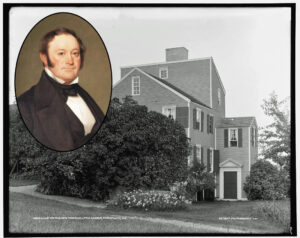
items they donated to the Portsmouth Athenaeum. Two years ago while cataloguing the collection, curator Elizabeth Aykroyd noticed that a large number of items at the Athenaeum had come from the Cushing family who lived at Little Harbor in the 1760-era mansion once owned by colonial governor Benning Wentworth. John Templeman Coolidge of Boston bought the rambling 40-room mansion in 1876 as a summer home. The Wentworth-Coolidge Mansion is now a museum owned by the state of New Hampshire.
Much is known about the Coolidge family who turned the mansion into a summer colony
for Boston-area artists. But until Aykroyd’s research, little was known about the
Cushings who bought the house in 1816 from Martha Wentworth. Charles Cushing, the
son of a Boston senator, married Anne Shaefe of Portsmouth in 1805 and their family
owned the mansion for 70 years before selling it to the Coolidges. The Cushing are,
therefore, the anonymous “hyphen” in the Wentworth-Coolidge Mansion. And they
might have stayed unknown, except for the artwork and furniture they bequeathed to the
Athenaeum.
Aykroyd says she knew nothing about the Cushings until she began her deep research
into the many items they gave, beginning as early as 1828. Their Portsmouth mansion, she says, is the only American Royal Governor’s house still standing, and the Cushings were the first family known to open their doors to public visitors as early as 1846. Because the house was so large, they acquired a great deal of artwork and furniture. Early photographs of the house show the same items now archived at the Athenaeum.
An eye for history
In 2010, the one-room Randall Gallery on the third floor of the Athenaeum was packed
with paintings, documents, and a rare “pier” table which reportedly belonged to the
famous William Pepperrell of Kittery. The exhibit includes a portrait by John Singleton
Copley (1737 – 1815), one of America’s most respected artists. To assemble and
document the collection Aykroyd spent two years sifting through deeds, letters, wills,
probate inventories, Athenaeum records, newspaper notices, and genealogy charts.
The Cushings had an eye for quality,” Aykroyd says, “but more important, they had an
eye for history. They surely understood that the Copley portrait of Dorothy Quincy
Hancock was not only a very fine painting but also a document of our history.”
Owning paintings by the best artists of the day was a way for families to show their own
importance and social status. Local writer Thomas Bailey Aldrich once noted with a wink
that “to live in Portsmouth without possessing a family portrait done by Copley is like
living in Boston without having an ancestor in the Old Granary Burying-Ground. You
can exist, but you cannot be said to flourish.”
“The Cushings preserved three 18th-century letters: from John Adams, John Hancock,
and Alexander Hamilton,” Aykroyd says. “Most of the paintings, the Pepperrell furniture,
and the Wentworth House itself were saved because the extended Cushing-Shaefe family
thought that they were important for their history.”
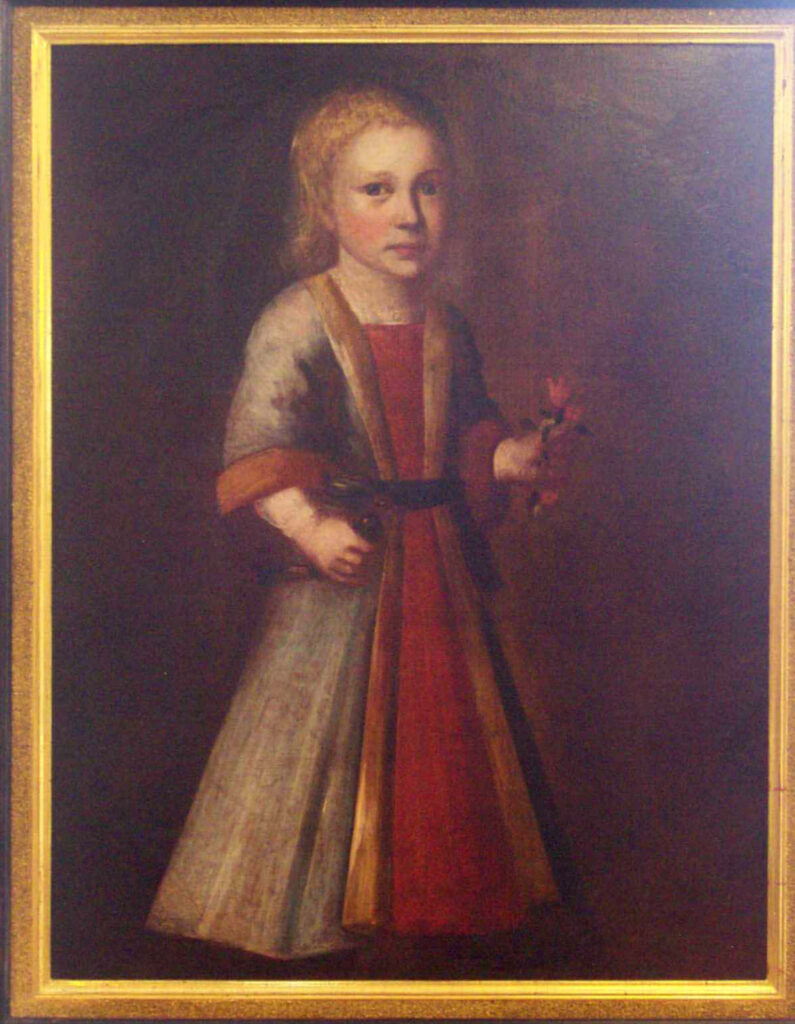
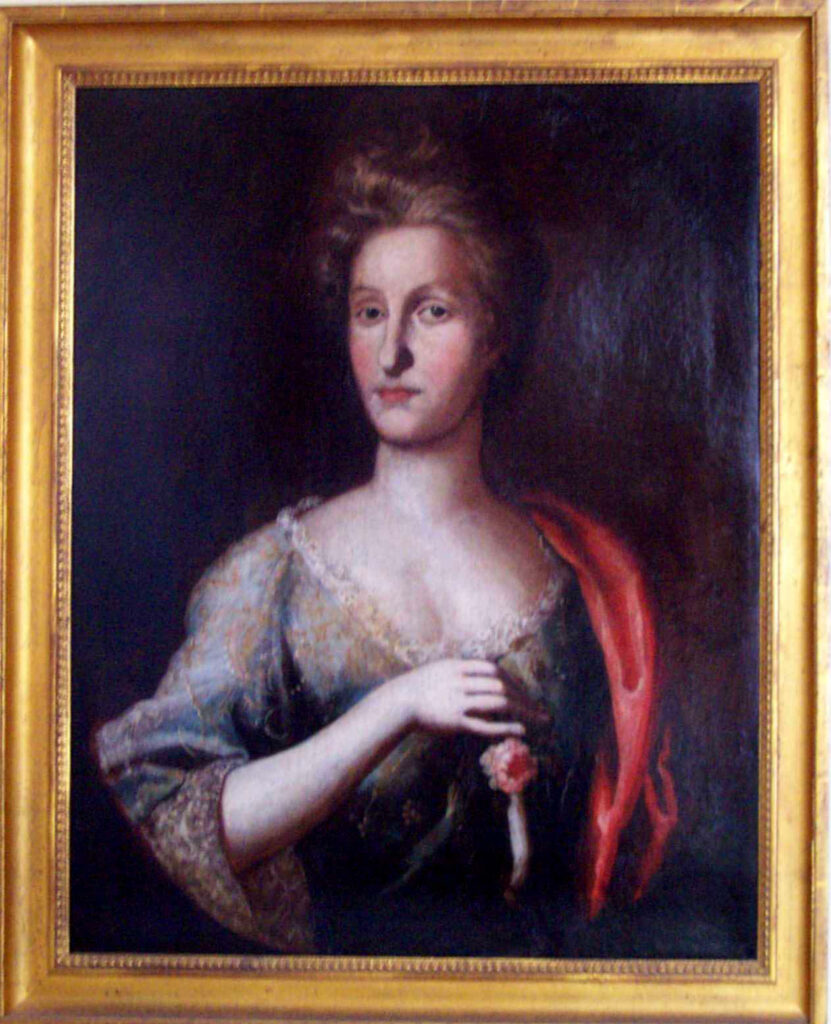
The curator proudly points out her favorite items – two small portraits of an unidentified
mother and son. Local legend says they were painted in America, but Aykroyd’s
scrupulous research now shows they were brought from England. They were painted
some time between 1710 and 1720.
“I particularly like the little boy,” she says, “who seems about to strangle the bird he is
holding.”
Who took Queen Christina?
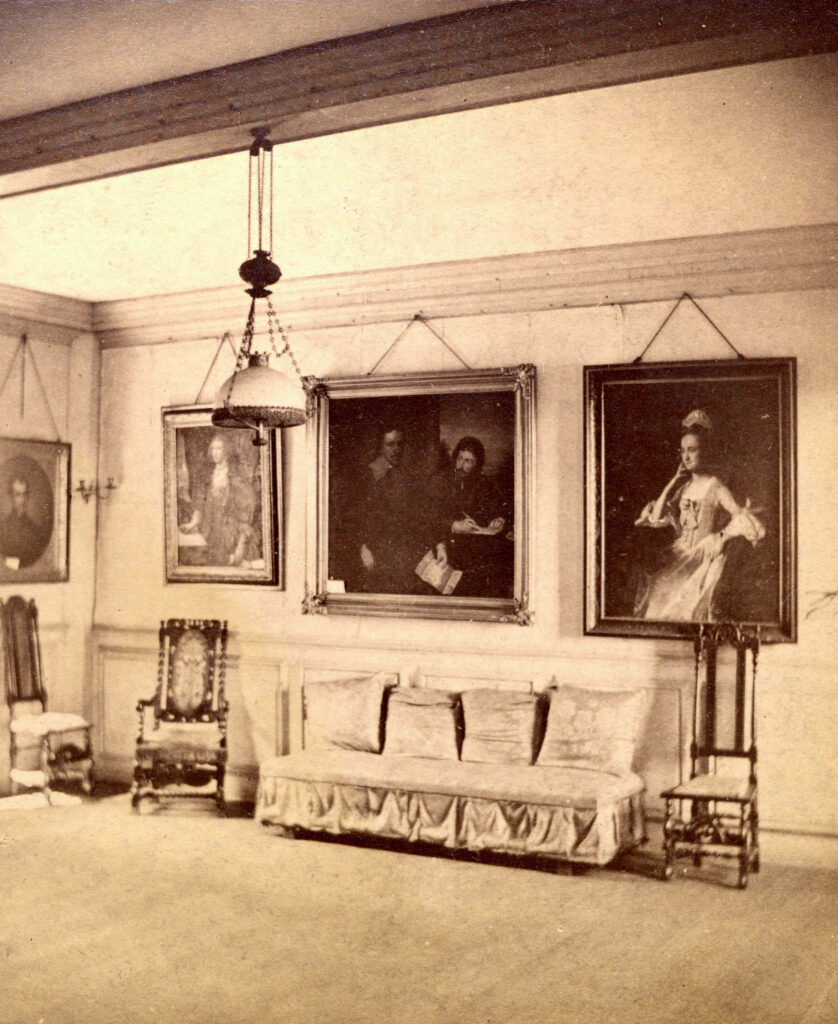
Elizabeth Aykroyd is mystified by one painting that never found its way into the
Athenaeum collection. It appears hauntingly in one of the stereoview souvenir cards
photographed in the 1870s. Visitors to the gallery can look through an ancient stereo
viewer that is part of the exhibit. Many of the images seen in the photo are now hanging
on the walls of the Randall Gallery.
“We believe that this is the supposed portrait of Queen Christina, Queen of Sweden in the
early seventeenth century,” Aykroyd says. “This seems to be an unusual subject for a
New England house, but in this household of mainly women, there may have been some
admiration for the independent queen known as the champion of her people.”
Attempts to locate this early painting have led only to blind alleys. It seems to have
vanished. These are the mysteries that keep curators awake at night as they weave
together family histories by tracking the treasures left behind.
Those treasures, Aykroyd notes, were all preserved by women. In every case the
surviving items were handed down the female line of the family and were donated to
museums like the Athenaeum by women, not men. Family wills often left real estate to
male heirs and the contents of the houses to the female heirs, who in the case of the
Cushings and the Shaefes, chose to preserve their lineage by presenting their prized
possessions to institutions like the Museum of Fine Arts in Boston, the houses of
Historic New England and the Portsmouth Athenaeum, rather then putting them up for
sale.
“The family connections were very important to them, and they took pains to preserve
and pass on that knowledge,” Aykroyd says.
The donors wanted their wealthy and prominent families to be remembered by the public
many generations into the future. But times change. Portsmouth’s early families – from
Pickering and Vaughan and Sherburne to Shaefe and Ladd and Wentworth are fast
fading. And the Cushings might be forgotten entirely – except for the treasures they
passed along in their name – and for the research of one curious curator.
“These paintings are not only dead people’s stuff,” Aykroyd reminds us. “They belong to
us now; they are ours — so it behooves us to understand why we have them and what they
mean to us today.”
Copyright © 2010 by J. Dennis Robinson. All rights reserved. Robinson
 Remembering Daniel Webster in Portsmouth