

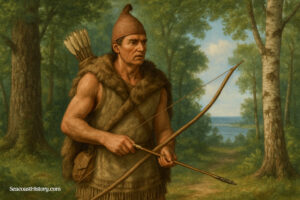

He was peace-loving, wise, magical, tactful, powerful and beloved by the Penacookx. Passaconaway ruled New Hampshire for its first half century. So why do we know so little about this Indian emperor? Here is the story with three legends about his mysterious death.
The wisest of the wise men
For half a century the fate of fledgling New England lay in the hands of one man. Historians generally agree that an Indigenous leader known as Passaconaway held the power to rebuff the first European coastal settlements from New Hampshire to Massachusetts. By Contact, as many as 90 percent of Native Peoples along the seacoast had died of diseases brought by Europeans, a period from 1616-1619 called The Great Dying. Despite depleted forces, researchers suggest Passaconaway had the men, the military skill, and clearly the motivation to obliterate the weak British colonial experiment here. Instead he chose to wage peace with the whites, yet Passaconnaway has earned scarcely a nod in American history books.
He was called Bashaba, or perhaps not, since white historians often misinterpreted Indian language and customs. They guessed that this Native word meant the “chief of chiefs,” a term corresponding to a European emperor. More likely, the historical “Bashabez” of the Penobscots died before 1615 when he was killed by warring tribes. But the comparison is apt. Like Passaconaway, Bashabez was a Sagamon, both a political and spiritual leader with enormous sway over his followers.
Passaconaway was respected as the wisest of wise men among Natives at the very moment when British settlements appeared at Plymouth, Wessagusset, the territory of Maine, and along the Piscataqua near modern Portsmouth, New Hampshire. Since the Indians moved with the seasons to fish, farm, and hunt, Passaconnaway’s central “home” is often depicted as near modern Concord or along the Amoskeag River in Manchester. But he appears in local legends from Ipswich and Newbury, Massachusetts to the isolation and safety of the White Mountain region. The first European to see Passaconaway may have been Maine explorer Christopher Levett. While staying a month with New Hampshire founder David Thompson at Little Harbor (Rye) in 1623, Levett reported seeing a gigantic Indian leader.
A born leader
Born as early as 1555 (or as late as 1580), it was Passaconaway who consolidated at least a dozen local tribes under the Pennacook leadership. Their names, spoken aloud even today, offer a haunting view of this region in an era before maps, boundaries, walls, fences, and land ownership: Wachusetts, Agawams, Wamesits, Pequawkets, Pawtuckets, Nashuas, Namaoskeags, Coosaukes, Winnepesaukes, Piscataquas, Winnecowetts, Amariscoggins, Newichewannocks, Sacos, Squamscotts, and Saugusaukes. Both action-hero and politician, Passaconnaway wove these depleted tribes together through marriages with his many children, through war, and through the sheer force of his argument, character, and legendary skills. The story of one tribal marriage was popularized with great exaggeration by poet John Greenleaf Whittier in “The Bridal of Pennacook.” A more accurate account by Thomas Morton, published in 1638, details the marriage of one of Passaconaway’s sons into a powerful tribe near Boston.
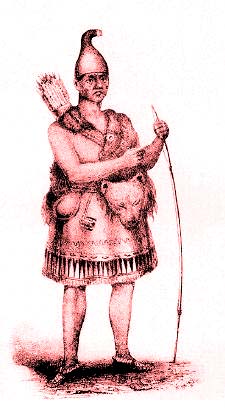
The little we know of Passaconaway comes to us almost exclusively through white colonial writers. Yet, if half of what they wrote is true, he was among the most incredible men in American history. The great Sagamon was, by all accounts, at least six feet tall. Local Indians believed he could swim the width of the Merrimack River under water and shoot an arrow with such force that it could penetrate a deer and land yards away. An accomplished magician, he baffled audiences by making water burn, trees dance, ice appear in summer and green twigs rise out of burned leaves in winter. He could charm poisonous snakes and transform a dead skin into a living writhing reptile.
Passaconaway, by all accounts, lived a long life, possibly 100 years, legends claim 120. During his “reign,” despite the bloodshed to follow, his biographers record only two instances in which an Indian under his influence killed a white man. In the first, Passaconaway delivered his warrior up to European justice. In the second case, in 1631, two Natives were given alcohol by a Dover merchant, instead of the goods due to them. In a drunken brawl, a white man was killed. Again the Sagamon turned in his kinsmen, who were summarily executed by white authorities. Passaconaway continually asked his people to keep peace despite endless slurs, mistreatment, exploitation, vilification, and even murder by white settlers.
The “son of the bear” was no pacifist by nature. When called to war, the Pennacooks were able fighters. Passaconaway’s tent was reportedly hung with many enemy scalps. Any claim that Passaconaway was warlike is wholly unsupported, says ethno-historian David Stewart Smith, an expert on the Penacook Confederation. Passaconaway was a negotiator who used diplomacy first when holding his confederation together.
“Among Natives, Passaconaway is thought of as a holy man with quite spectacular supernatural powers,” Smith says. An authentic historical figure who rose to great importance during critical times, Smith compares the mythology surrounding Passaconaway to a New England version of King Arthur.
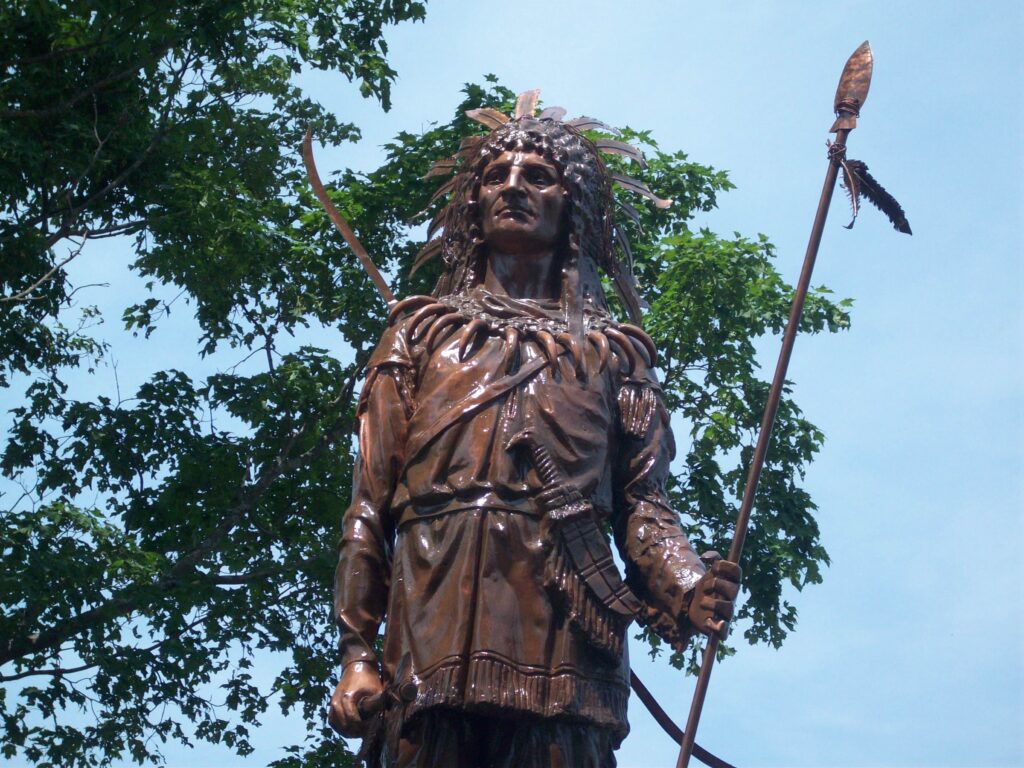
A vision of peace
But in 1620, the great leader had a vision. Upon the arrival of the Mayflower at Plymouth, Passaconaway and other respected medicine men reportedly prayed for the white settlers to be destroyed. They called upon their spirits to wipe out the encroaching settlers by tornado, by famine and plagues of locusts and by hurricanes. When no divine intervention occurred, legend says, Passaconaway received a vision that the white settlers were unstoppable and that they would eventually dominate the lands of what they called “New” England.
Whether Passaconaway really sold the land around Exeter, New Hampshire to Rev. Wheelwright, an outcast from Plymouth, is unknown. The authenticity of the 1629 deed bearing his signature is likely a forgery according to the latest scholarship. Historians have long suggested that the Sagamon may not have understood the European concept of land ownership. Perhaps he wanted the white settlers with their formidable mechanical weapons to share the space and protect his people, in return, from the encroaching Mohawks, enemy to the largely peaceful Pennacooks.
In the 1660s, the aged Passaconaway made a formal public entreaty to his people to remain in harmony with the colonists. Six whites in attendance attested to the eloquence of his lengthy and emotional speech during which the Bashaba named his son Wonaloncet as his replacement. The great leader was then reduced to begging the governor of Massachusetts for a small piece of land as a home for the Pennacook people. By 1677, as Indian uprisings were finally provoked in King Phillip’s War, the last 139 survivors of the Pennacook nation left New Hampshire for permanent residence in Canada. Their penance for a continued peace was permanent expulsion from their homelands. Even the small piece of land granted to them and paid for with 25 English pounds, was taken back and sold to white settlers.
Americans, it seems, are more fascinated by war than by peace. Our heroes are mostly doers, not thinkers. Yet Passaconaway was both. As emperor of the Pennacook tribes during the “Contact Period”, he very actively prevented racial warfare. His 1620 vision of the futility of resistance came true. His people were not assimilated, but driven from the land and waterways they had traveled for at least 12,000 years, according to archaeological evidence.
Three death legends, no facts
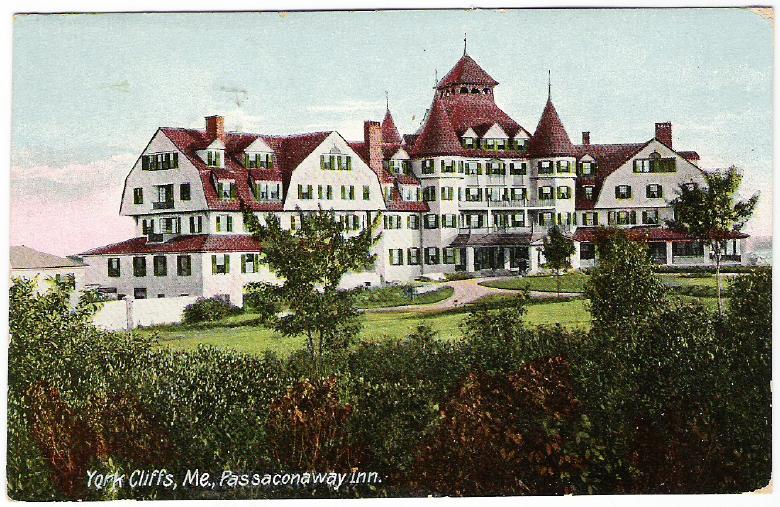
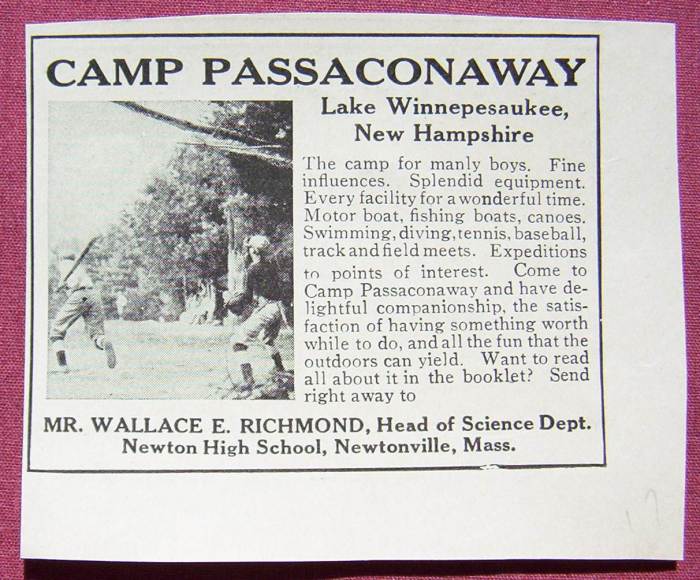
His legacy, named in his honor, is a single peak in the New Hampshire White Mountains, a Victorian hotel, a golf course, a Boy Scout summer camp, and a Masonic lodge. According to one report, the Indigenous leader’s bones lie in a display case in a French museum, the ultimate indignity.
More glorious than history are the legends of his death. Passaconaway, according to early missionary John Eliot, converted to Christianity. True or not, the story is sometimes equated with the figure of St. Aspinquid, a “praying Indian” evangelist of the 17th century. St. Aspinquid, the story goes, traveled as far as the Pacific Coast preaching the white man’s religion. The vague dates and whereabouts for St. Aspinquid do not coincide with the few facts we have of Passaconaway. The saint is said to be buried at the top of lowly Mt. Agamenticus in nearby York, Maine. In one version of the unlikely lore, over 6,000 wild animals were sacrificed at his funeral.
Only in the Pennacook narrative does Passaconaway get his due. According to the story, in his final days, the Sagamon longed to attend a meeting of the greatest Native leaders in heaven. He set out in winter in a sled pulled by two dozen wolves. Shouting against the winds, he commanded the animals to whisk him from Pennacook, across frozen Lake Winnipesaukee, to the White Mountains. At enormous speed, he ascended New England’s tallest peak and, bursting into flames, flew into the sky.
Copyright J. Dennis Robinson, all rights reserved.
 Save the Seal, Keep the Ship