



It is a grim scene. Two women hang from the branch of a sturdy tree. Despite the cold and the previous night’s snowfall a large crowd, some from as far away as Hampton, has gathered on the outskirts of central Portsmouth. The audience watches silently, young and old, as the two convicts sway for hours in the winter wind before their bodies are cut down and buried in unmarked unhallowed graves.
Sarah Simpson and Penelope Kenny did not die quickly. On Dec. 27, 1739, the first executions in New Hampshire history were horrific events. There was no sudden snap of a trap door. The condemned, instead, stood on a cart that was withdrawn from beneath their feet, leaving them to struggle and strangle, often for minutes, as the noose tightened.
This could be a grisly Halloween story, the kind recounted with mock horror on spooky walking tours or in books of so-called “haunted” happenings. It is, instead, the starting point of a serious, carefully written book titled “Granite Gallows” about the complex history of capital punishment in New Hampshire.
Granite Gallows
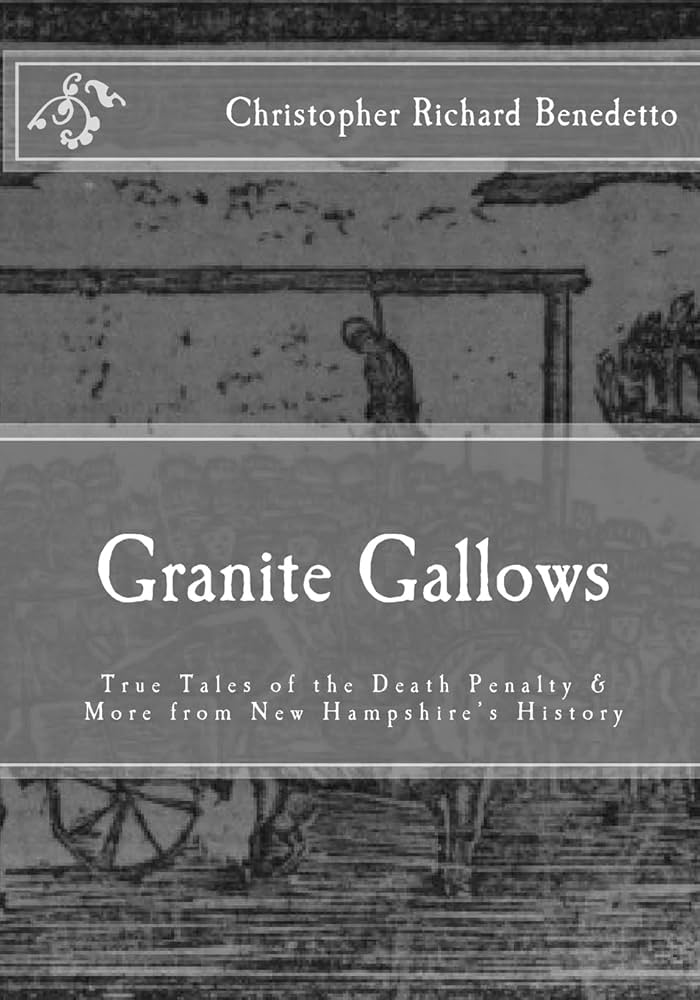
“When I started my research,” says Granite Gallows author Chris Benedetto, “I was shocked how little had been written about the events of 1739. The executions have been almost completely forgotten in Portsmouth and New Hampshire history.”
“In my lectures for NH Humanities,” he adds, “I have had people doubt Sarah and Penelope were the first executions because few have heard of them. Most people are just stunned because it is an unfamiliar and troubling story.”
Benedetto lives in Rollinsford and teaches classes at Granite State College. He teaches history, he says, “because it is my passion. It is part of who we are as humans and as Americans.”
Finding scant mention of the executions, Benedetto dug into the original sources including reports in the Boston News-Letter and the “execution sermons” delivered by two Portsmouth ministers on the day Penelope and Sarah were hanged. The author combed through archives from Worcester, Massachusetts, to Concord, New Hampshire. He studied the writings of Rev. Jabez Fitch (1672-1746), a minister at the North Church, who was an eyewitness to the executions. Fitch’s house still survives on “The Hill” in the city’s North End.
A tragic tale
On Aug. 11, 1739, the body of a newborn female was discovered floating in a well in Portsmouth. A 27-year-old widow named Sarah Simpson, formerly of Durham, was charged with the crime. Although Sarah had managed to conceal her pregnancy, she admitted to having given birth. She then led officials to a site on the banks of the Piscataqua River where she had buried the baby.
Officials then accused 20-year-old Penelope Kenny who, after being examined by a team of “expert” women and spending a night in jail, also admitted to recently giving birth. Penelope confessed she had put her child in a tub of water in the cellar of a house and later cast it into the river. Neither was the mother of the baby found in the well.
Both women were jailed, likely on Prison Lane, the site of The Music Hall today. Each denied killing her child. One baby was reportedly “dead born” and the other died soon after its birth, either by fate or neglect. Sarah and Penelope were judged guilty by a jury of 12 men. Chief justice Henry Sherburne scheduled the hanging for Nov. 21, but the executions were delayed until Dec. 27, 1739.
On their last morning the condemned women were transported to church. Rev. William Shurtleff of South Church delivered his execution sermon to Sarah Simpson. Rev. Arthur Browne addressed his words to Penelope Kenny at Queen’s Chapel, now the site of St. John’s Episcopal Church. Both sermons were a stern warning to those in attendance that the wages of a sinful life was certain death – followed by an eternity of suffering in Hell.
Exactly where the hanging tree stood, or if indeed a wooden gallows existed, is unclear. Historians have suggested it was likely near the intersection of Middle Road and South Street where the colonial town pound was located.
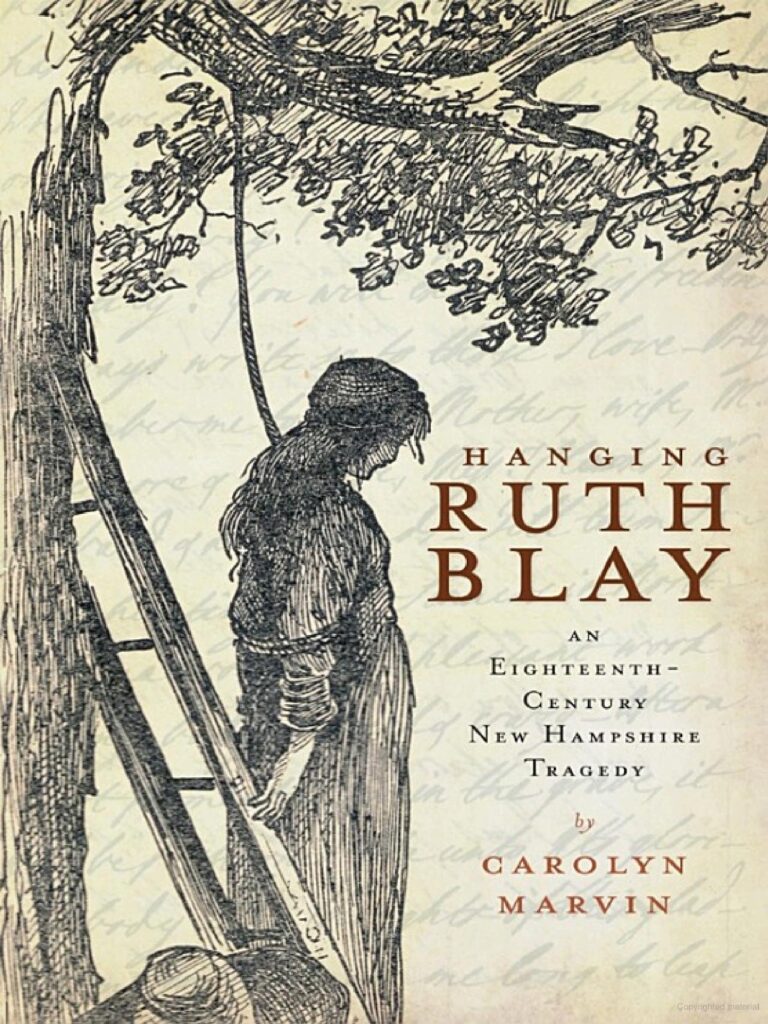
“But I’m not so sure,” Chris Benedetto says. He suspects it may have been at the South Street Cemetery, then known as Cotton’s Burial Ground. This was adjacent to a militia training field, Benedetto notes, where a large crowd of people could have gathered. It may be the same spot where, 29 years later, a school teacher named Ruth Blay was also hanged for what Rev. Browne called ”the most unnatural murder.”
Suffering unto death
But Sarah, Penelope, and Ruth were not hanged for committing murder since, without a witness, it was impossible to know whether their babies had been stillborn, killed, neglected, or died naturally soon after birth. To that end, in 1714, the New Hampshire General Assembly had passed “An Act to Prevent the Destroying and Murthering of Bastard Children.” The law began: “Whereas many lewd women have been delivered of bastard children, to avoid shame and escape punishment, do secretly bury or conceal the death of their children.”
Sarah Simpson, Penelope Kenny and Ruth Blay were executed for the crime of “concealment,” not infanticide. As shocking as this crime appears today, it is important to remember how different life was in provincial New England under Puritan influence. Back then, capital crimes could include murder, rape, homosexual acts, abortion, bestiality, burglary, counterfeiting and treason. Punishment for women convicted of fornication or bearing an illegitimate child was harsh. Victims were sometimes beaten in public, humiliated, and scorned.
In Granite Gallows, Benedetto provides historical context for the tragic hanging of three women. In 1727, the author notes, an earthquake rocked the region. Rev. Jabez Fitch interpreted the quake as an evil omen. God, he told his Portsmouth congregation, was displeased with their sinful lives. Bad things were coming.
In 1735, as many as a thousand New Hampshire residents died of a virulent disease, perhaps distemper. Children were especially vulnerable and 80 children under the age of 10 died in Portsmouth. The death toll was devastating in an era when infant mortality was extremely high. Could this plague, too, be a message from an angry God? Jabez Fitch warned that parents needed to be especially protective of their children. The idea that a mother might harm her own child under these conditions, Benedetto theorizes, may have been “particularly heinous.”
The capital question
Despite these grim details, it is worth noting that by 1739, as New Hampshire hanged its first two prisoners, the province of Massachusetts had already executed 137 people. To date the Granite State has executed 24 people, while the state of Texas dispatched 23 last year alone – for a total of 1,310 individuals executed there since 1819.
Ruth Blay was the last woman executed in New Hampshire, one of 30 states (according to Wikipedia) that maintain the death penalty. New Hampshire remains the only New England state that has not abolished capital punishment. And while still hotly debated, New Hampshire has not committed “capital murder” since storekeeper Howard Long was hanged on July 14, 1939, for molesting and fatally beating a 10-year-old boy. Only one person remains on death row in this state.
In Granite Gallows, Benedetto offers a highly readable and well researched overview of this thorny subject. But in his public lectures, he keeps coming back to the tragic tale of Sarah and Penelope.
“To me,” he says, “in the minds of 18th century people, simply concealing the death of a child immediately made it more suspicious, and for them abandoning an infant was essentially the same as physically taking its life.”
“There is nothing downtown to tell you the first executions happened in Portsmouth,” he notices, “and how would the city react to that? We seem to revel in some aspects of our history, while others are conveniently neglected. My goal has been to have a state historical marker put up, but they are expensive if paid for privately.”
History is about people, Benedetto says, and about the human passions that seem to remain unchanged over the years. This story, he concludes, is as relevant today in the #MeToo Era – and while the debate over capital punishment continues – as it was almost three centuries ago.
For additional information on the colonial crime of “concealment” see “The Hanging of Ruth Blay: An 18th Century New England Tragedy” (History Press, 2010) by Carolyn Marvin.
Copyright 2018 by J. Dennis Robinson, all rights reserved.
 Lost at Sea