


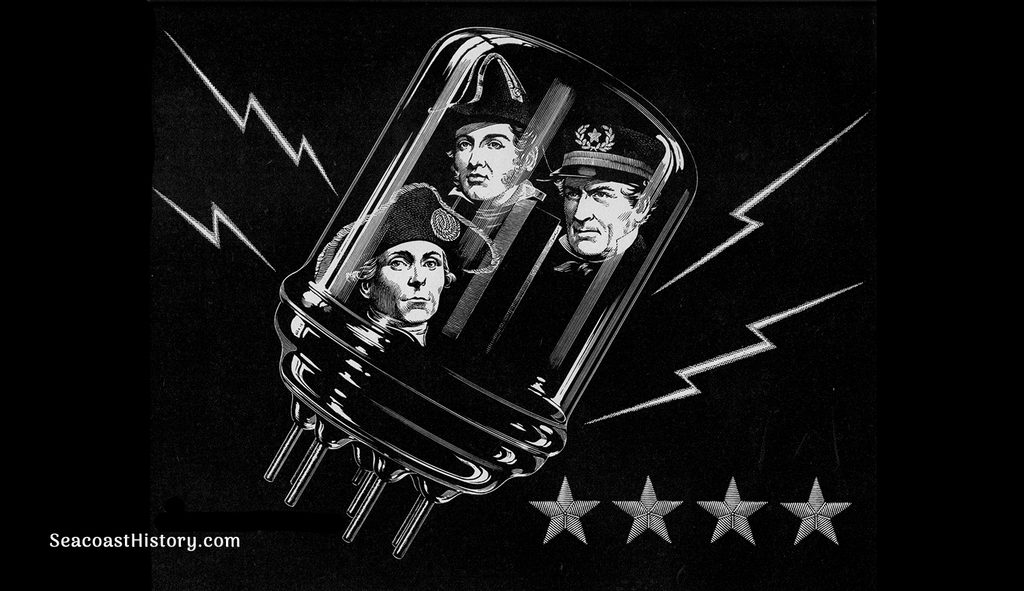
Yes, this image shows the heads of three US Navy heroes floating around inside a vacuum tube. And yes, all three men have a deep Portsmouth, NH, connection.
Readers under 50 may never have seen a vacuum tube. Early TV sets and radios used these devices to control the flow of electricity. The metal electrodes sat inside an airless glass bubble. My father, who had studied electrical engineering during World War II, was the go-to neighborhood TV repairman. He never charged a nickel. He had a large case filled with tubes of every size, each in its own colorful cardboard box. My old rock and roll amplifier still has tubes, but hot, fragile tubes were largely replaced following the invention of the transistor by Bell Labs.
What, you ask, does that have to do with Captain John Paul Jones, Commodore Matthew Perry, and Admiral David Glasgow Farragut? Not much. This intriguing illustration appeared in a magazine ad for York Refrigeration and Air Conditioning in the 1940s. According to the ad, the Radio Corporation of America (RCA) was currently building a new plant to manufacture advanced electronic tubes in a special dust-free environment. The high-tech process required the expertise of the York company, “the headquarters for mechanical cooling since 1995.” Companies wanted to show their patriotic work during the war years. These super tubes were being developed to improve communication and navigation among US warships.
We know all about John Paul Jones, the frigate Ranger, and their Piscataqua connection during the American Revolution. Commodore Perry (1794-1858) is best known for opening Japan to Western trade. His flagship was a sidewheel steam frigate christened USS Powhatan, built at the Portsmouth Naval Shipyard. The tall ship SSV Oliver Hazard Perry, named for the commodore’s brother, has been seen here as part of the annual SailPortsmouth celebration.
Portsmouth’s Farragut School takes its name from a Civil War hero of a battle at Mobile Bay in Alabama. A former Rye, NH, hotel was also named for Admiral Farragut (born 1801). In a twist of fate, Farragut died here on August 14, 1870. He was visiting his brother-in-law, who was a commander at the Kittery Yard. Having survived a series of heart attacks, the naval hero was weakened by illness. He and his wife Virginia were staying at the historic Quarters A. Following a funeral service at St. John’s Church, the admiral’s body was stored in a vault “in a tomb that faces the street,” according to a contemporary news report. His remains were transferred the following month with great pomp to a service in New York and a burial with military honors at Woodlawn Cemetery in the Bronx.
© 2026 by J. Dennis Robinson. All rights reserved.
 Indigenous History is American History
