


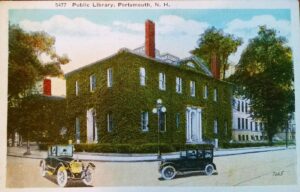
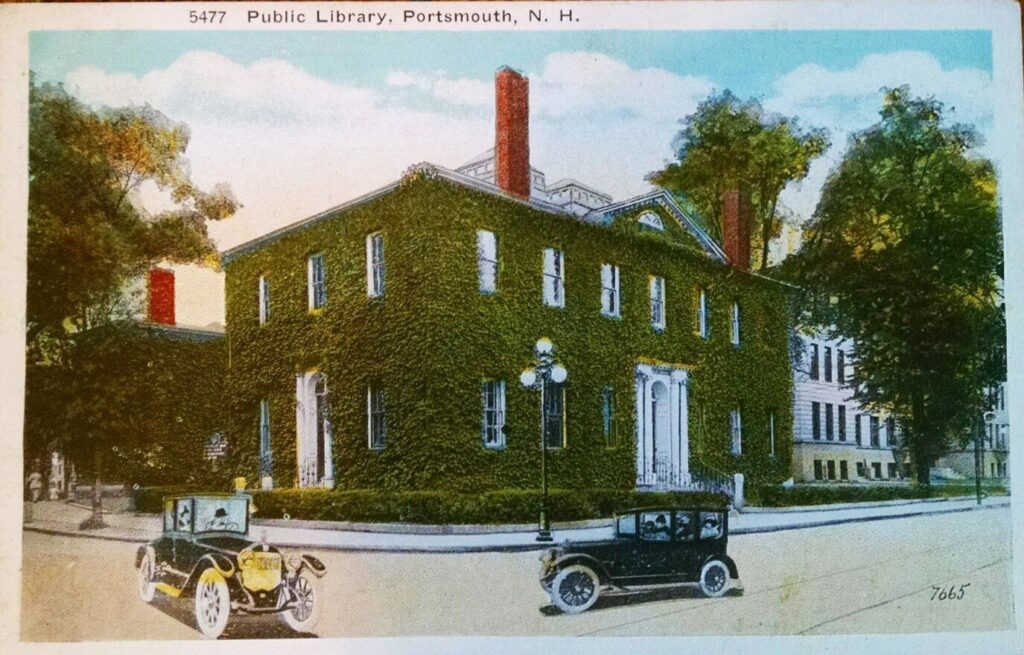
Portsmouth loves to recycle its architecture. The old high school is now elderly housing. The even older high school on Daniel Street is office condos. The old hospital on the hill houses the city offices.
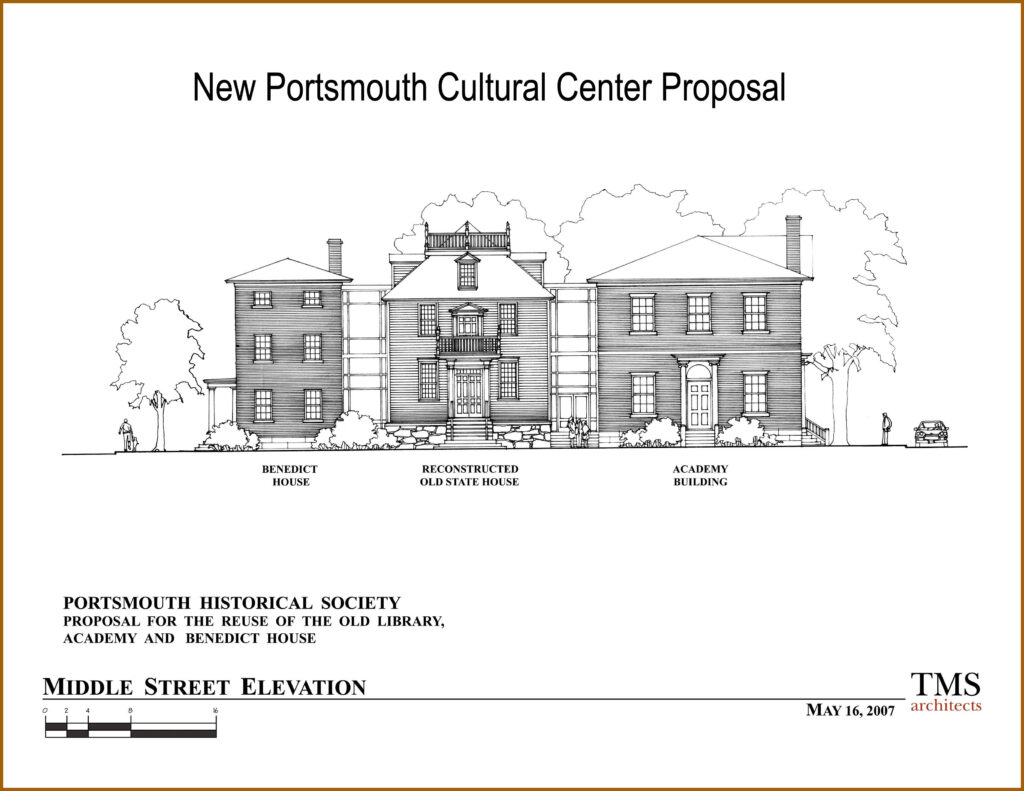
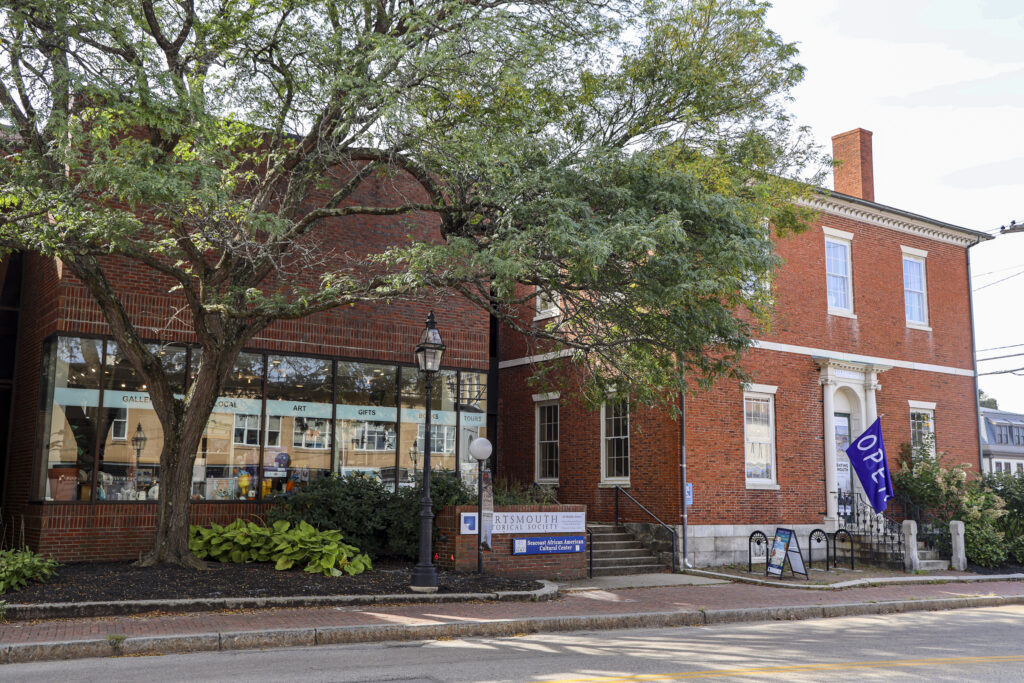
In the waning days of 2007, city councilors voted 8-to-1 to green light the Portsmouth Historical Society’s plan to transform the old public library on Middle Street into a seacoast Cultural Center. Initially, the plan called for a three-year trial. If the new “hub” benefited the city, it could stay. If not, the city planned to sell off the conjoined 1810-era buildings. It wasn’t long before Discover Portsmouth proved its value. The nonprofit organization replaced the failing HVAC system, repaired the roof, installed new carpets and lighting, and gave the interior a fresh coat of paint. The City was pleased and the lease was extended for another 30+ years. Reverting to its old name, the Portsmouth Historical Society, as hoped, has become the go-to downtown site for tourist information, walking tours, lectures, art and history exhibitions, a gift shop, family events, and more.
What locals still call the “old library” is really two separate Federal Style buildings – a private home and a school – both built around 1810. The former Portsmouth Academy and the Morton-Benedict House were linked by a brick connector in 1954. Both have a fascinating history. Let’s quickly track these buildings through the last two centuries.
The Tale of Two Buildings
The concept of free public lending libraries is relatively modern. Private libraries began in Portsmouth as early as 1750. The original all-male membership library had 33 subscribers and was open only two hours each week. The Portsmouth Athenaeum, a membership library established in 1817, is still in operation in Market Square. Dozens of private subscription libraries, including the Mercantile Library (Est. 1853) opened and closed in the region during the 19th century.
There were public schools in Portsmouth as early as 1735, but wealthy families, then as now, often opted for private education. Portsmouth Academy was established in 1809 as an elite tuition school with two rooms downstairs and two upstairs. It opened in 1810 with 25 children and quickly doubled its enrollment. Water was supplied by the Portsmouth Aqueduct Company through an elaborate system of hollowed-out logs. The famous Daniel Webster was among the founders and, legend says, authors Thomas Bailey Aldrich and James T. Fields attended the Academy, now the Academy Gallery.
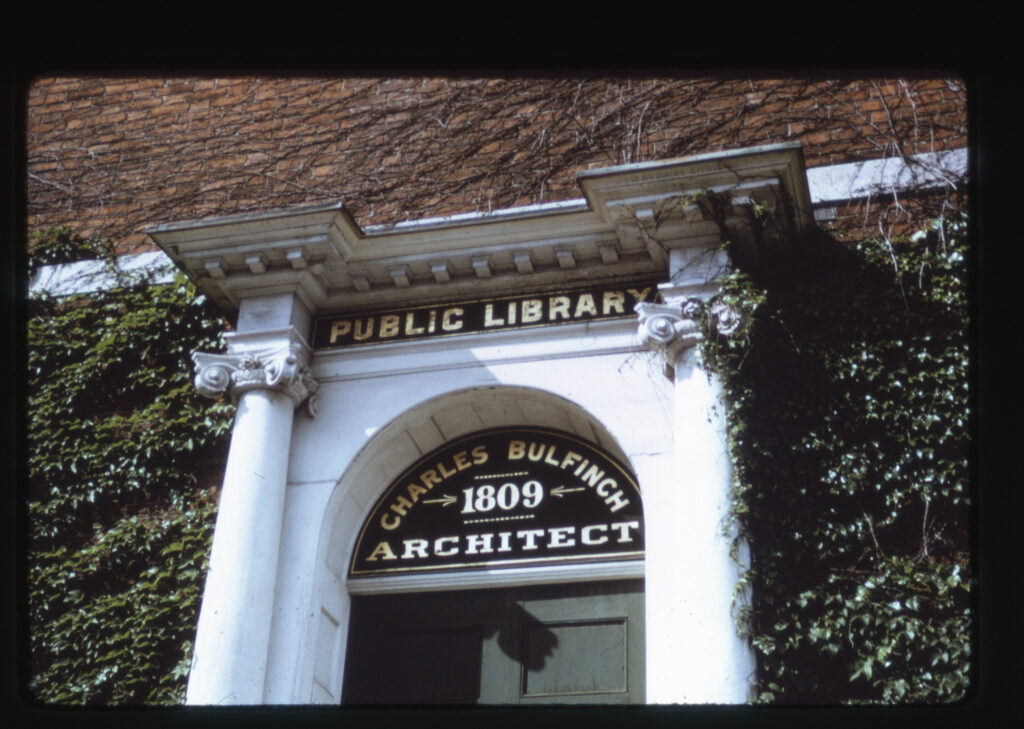
Don’t let the sign fool you. It was long rumored that the Portsmouth Academy was designed by Charles Bulfinch of Boston, best known as the architect of the Massachusetts Statehouse and the Capitol in Washington, DC. In fact, a local man from Newington named James Nutter, a house carpenter or “joiner” and later a Methodist minister, was paid $20 to design the building in 1809. He based his plan on a building at Phillips Exeter Academy in Exeter that no longer stands..
The year the Portsmouth Academy opened in 1810, Thomas Morton built a fashionable brick residence next door with a well and a stable. Morton ran a store downtown selling groceries and goods from the West India Trade that was at its peak in 1810. Only two years later, as America entered the War of 1812 and the economy began to falter, Morton advertised the house for sale in the NH Gazette. The house had twelve more owners and a number of additions before it was purchased by the city and officially became part of the Portsmouth Public Library in 1951. The interior, amazingly, remains much as it did in 1810.
The City of Portsmouth first leased the Academy building in 1868 and used it as the Jones Grammar School. Frank Jones, the “ale tycoon,” was then mayor. Jones, a millionaire, also donated his $500 salary as mayor as seed money to create a public library for the city, and challenged others to build up a fund of $5,000. It was one of the few times Jones, the city’s richest man, kicked in to a public project.
A few years later the Jones School was condemned as unsafe and unsanitary. Curiously, Dr. Henry E. Clark, who forced the closure of the school, lived right next door in the brick house built by Thomas Morton in 1810.
In 1871, inspired by a sermon at the South Church, the Young People’s Union was created to provide a library and youth center for local teens. Three rooms were set aside at the corner of Vaughan and Congress streets. Technically, this was the birth of the Portsmouth Public Library. When the group folded a few years later the books were stored, temporarily, in the basement of the Unitarian Chapel.
In 1881, the books from the Young People’s Union were made available to the public in one room on the top floor of the old Custom House. The city took responsibility for the collection and hired a librarian to catalog the books. The collection was moved twice more before finding a permanent home in the old Academy building. Hon. Frank Jones’ $500 bequest grew, with contributions, to over $10,000. A number of private book collections were donated to the growing library shelves.
While the public library was evolving elsewhere, a group of Civil War veterans and friends leased the old Academy. The Storer Post of the Grand Army of the Republic (G.A.R.) planned to create a Memorial Hall. Almost immediately, the city began to negotiate with the Storer Post about taking over their lease and sharing the building as both a library and an exhibit hall. When the city was slow to renovate the building, the GAR sued the city and won $5,000 to break its lease.
After paying off the Storer Post, the city took over the lease on the Academy for a library. They gutted it, and rebuilt the interior for about $5,500. A glass skylight was added to illuminate the interior. The PPL occupied the building in 1896, purchased it officially in 1906 and stayed until the new library building opened on Parrott Ave. in 2006. There were only six city librarians in that entire time.
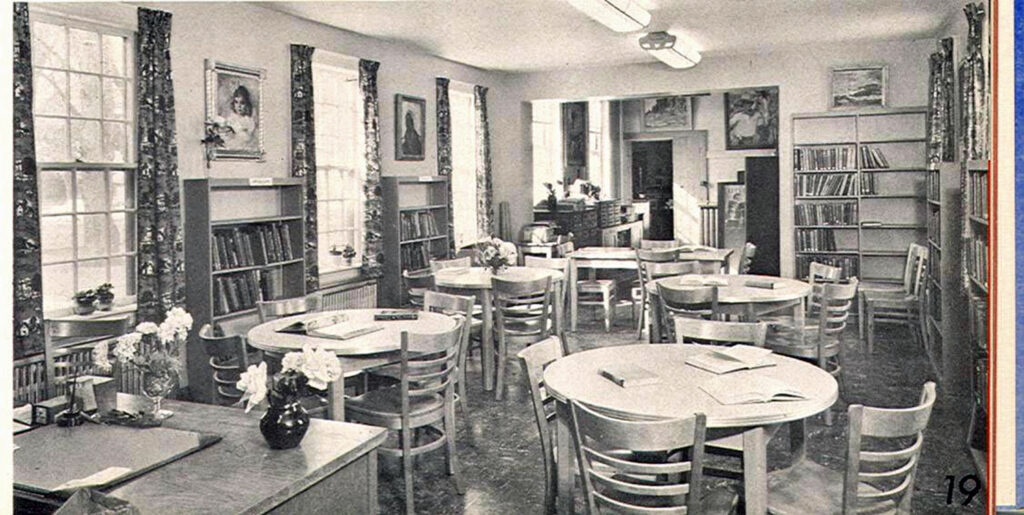
Meanwhile, one doctor after another occupied an office that had been added to the old Morton house next door. By the early 20th century, after many owners and many tenants, the house was purchased by the Benedict family. One of their renters turned the doctor’s office into “Mirriam’s Tea Room” in the 1920s. The house included a dentist’s office in the 1930s.
In 1949 the Morton-Benedict House was sold at auction and by 1950 the ivy-covered brick residence was unoccupied. By this time the library next door was severely overcrowded and looking to expand.
In 1951 the city purchased the Morton-Benedict House as the library “annex” and a few years later linked it to the Academy building with a one-story brick addition. The architect also created an opaque glass floor in the center of the Academy building that allowed light from the skylight to filter down to the first floor of the library.
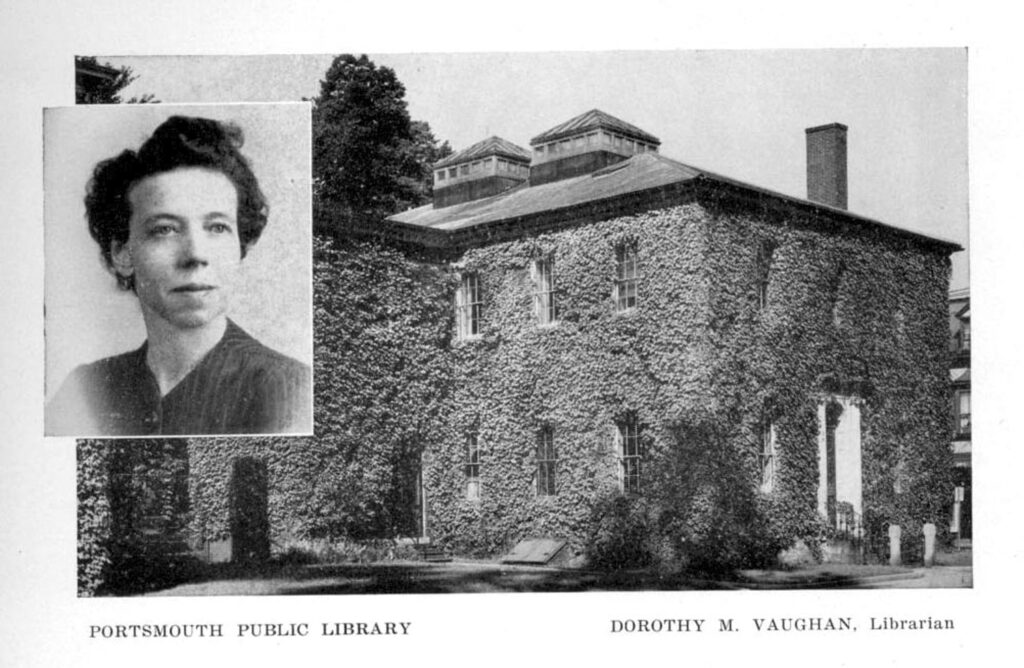
In 1966 a local historian discovered evidence that the Portsmouth Academy was not designed by the famous architect Charles Bulfinch. The story was front-page news. Librarian Dorothy Vaughan continued to insist that Bulfinch might have visited Portsmouth or inspired the design. The documents proving that Nutter designed the building were presented to the city librarian, but later disappeared from the library collection. Luckily, the evidence had been photographed by architectural historian James Garvin, who became curator of Strawbery Banke Museum. When the gold-leafed Bulfinch sign finally came down in the 1980s under city librarian Sherman Pridham, journalist Ray Brighton praised the act as the killing of a “sacred cow” and the end of “one of Portsmouth’s most carefully nurtured delusions.” The missing Nutter documents were discovered in 2007 among the items donated to the NH Historical Society by the late Dorothy Vaughan who died in 2004 just shy of her 100th birthday.
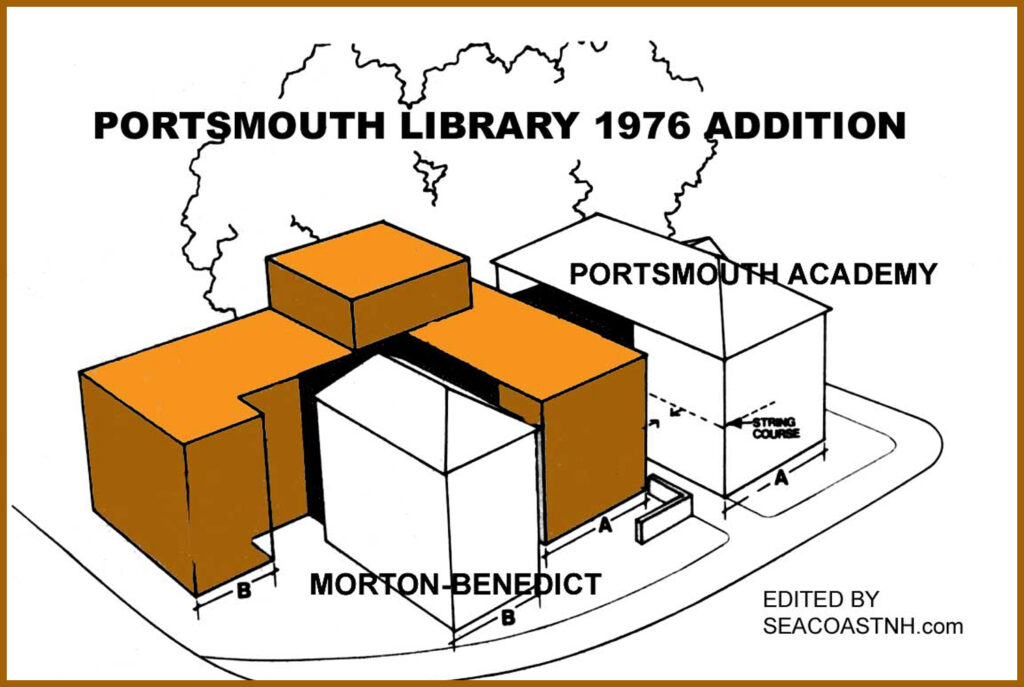
In 1973 plans to expand the library proposed tearing down the two old buildings and replacing them with a new modern library. Instead in 1976 a $660,000 renovation doubled the size of the connecting building, added 10,000 square feet, created offices and a children’s room, restored a circular staircase, and opened up the second floor balcony. The short-lived glass floor was removed and the 19th century skylight closed off. The redesign was largely supported by federal funds that required the city to abide by preservation guidelines during any future changes to the two historic buildings.
Soon the library was overcrowded again. Local readers will recall the long, sometimes contentious search for a new library site. Plans to repurpose the 1895 Cottage Hospital near the renovated City Hall fell flat in the mid-1990s. Then, despite a small vocal group of protestors, the city built an expansive new high-tech Portsmouth Public Library near the South Mill Pond. The historic move to the new location after 110-years opens a world of possibilities for the proposed Cultural Center. If the energy and dollars can be found, these two historic buildings will serve the community once more.
SOURCES: Vertical files at Portsmouth Public Library, private interviews and draft copy (January 2008) of “Historic Site Report for the Portsmouth Academy Building and Morton-Benedict House,” by Laura B. Driemeyer, Ph.D., Architectural Historian, Preservation Company
Copyright © 2008 by J. Dennis Robinson, all rights reserved.
 Turkeygate: A Thanksgiving Scandal