

If you want people to read your post on Facebook, be sure to include a picture of a cat. If a cat photo is unavailable, a picture (or better yet, a video) of a dog, a pot-bellied pig, a cockatoo, or a moose will suffice. Actually, any animal, bird, or reptile will draw reader attention, especially if it is acting like a human. We love that. Walt Disney made a fortune animating animals. And Portsmouth author Thomas Bailey Aldrich wrote the memo back in 1878.
Aldrich is best known around here for his groundbreaking novel The Story of a Bad Boy (1869), a slightly fictionalized memoir of his childhood days in Portsmouth prior to the Civil War. The hero, Tom Bailey, got into all sorts of mischief but, unlike most moralistic tales of the era, Tom never got caught or punished for his misdeeds. Aldrich later wrote a lively history of Portsmouth entitled The Old Town by the Sea. (1894).
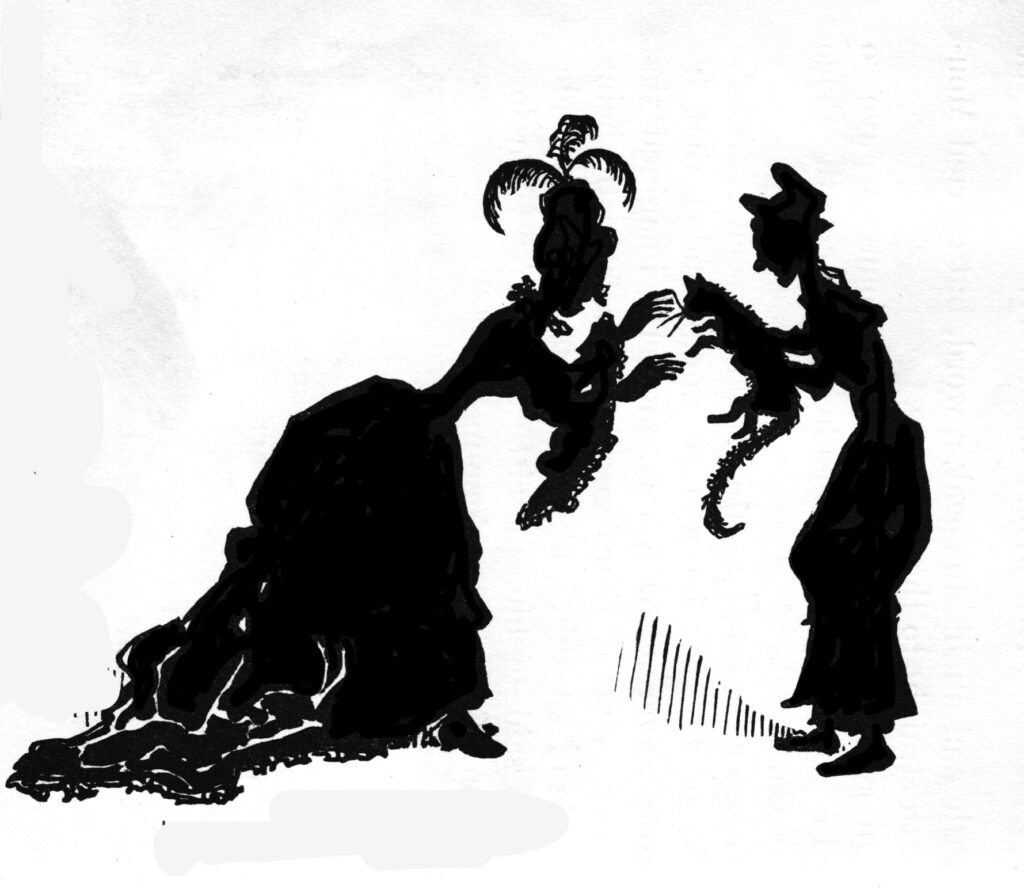
Aldrich cleverly included a monkey and a horse in his tale of Tom Bailey. Then in 1878 he released a strange children’s book, The Story of a Cat. I just bought a vintage copy and, I confess, I haven’t read it. But I looked at the pictures. There are 95 of them by my count, roughly one per page. The illustrations are all black and white silhouettes by the artist L. Hopkins.
Despite his credit as the author, Aldrich did not write the cat book, but translated it from a French book by Émile Gigault de La Bédollière (1812-1883). Turnabout is fair play, I guess, because Emile, a lawyer and songwriter, was known for his translations into French of classic English language works including Uncle Tom’s Cabin and novels by Charles Dickens and James Fenimore Cooper.
In a brief preface, Aldrich explained that he translated the “charming story of Mother Michel and her cat” for the entertainment of his twin sons whom he read to by the fireside. Aldrich, an early editor of the Atlantic Monthly, published his translation in a popular children’s magazine before it was picked up for a hardcover version by Houghton-Mifflin, a company originally owned, in part, by Portsmouth writer and editor, James T. Fields.
Aldirich referred to his translation as “so slight a performance” when compared to the “the ingenious and spirited series of silhouettes” by Hopkins. You can view a copy in the History Room of the Portsmouth Public Library or see a digital version online as part of Project Gutenberg. And while the cat appears to suffer tough times at the opening of the story, the feline protagonist, Monmouth, looks happy and well with his partner and six lively kittens in the final illustration.
Copyright J. Dennis Robinson.
 Where Have All Our Grocers Gone?