


A Brief History of Enslaved Portsmouth, NH
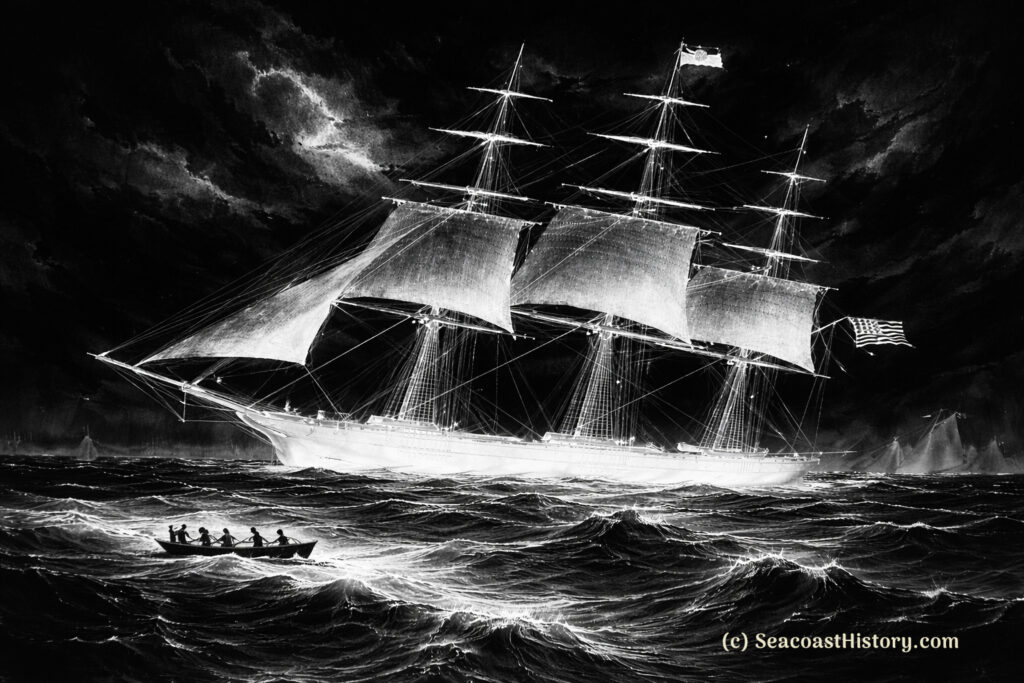
NOTE: Visitors to Portsmouth, NH still express surprise when they discover that this northern town was intimately tied into the “triangle trade” from the earliest days of settlement. Ships that became slavers like the NIGHTINGALE were built here and ships like EXETER delivered slaves for sale. Prominent white merchants profited from these enterprises and kept slaves in town. Some, like John Moffatt, even traded in enslaved Africans. The independent work of historian Valerie Cunningham continues to shed light on African-American life in Portsmouth, New Hampshire only seaport This page is part of series on slavery drawn from research that evolved into the book Black Portsmouth by by Valerie and Mark Sammons. (JDR)
Early Days
From an early date Portsmouth merchants actively participated in the slave trade. In 1682 William Fitzhugh of Virginia corresponded with members of the Cutts family regarding prices he would pay for slave boys, girls, men and women (3,000 to 5,000 pounds of tobacco each).
The trade continued. By 1708 Governor Dudley reported to the British Board of Trade and Foreign Plantations that there were 70 Negro slaves in New Hampshire (the cluster of towns on the coast and around Great Bay). He also said there was no New Hampshire involvement in the slave trade at that date. Through the next several decades Portsmouth ships carried many slaves between Africa, Portsmouth, Virginia, and the West Indies. Between 1728 and 1745 Samuel Morse, Dickerson, John Major, Joseph Bayley and John Odiorne were captains of ships owned by Pierce Long, Joshua Pierce, John Rindge, J & S Wentworth, bound for Africa, Guinea, Virginia, and Barbados, carrying cargoes which included from one to a dozen slaves. The trade could be risky; Captain Dickerson was murdered by Africans who boarded his ship off the coast of Guinea.
Sixty-one Slaves Arrive
Ships passing through Portsmouth usually had only one or two on board. An impressive exception occurred in 1755 when John Moffatt’s ship the “Exeter” carried a larger number:
An Inventory of Sundrys belonging to the Cargo of the Snow Exeter Benjamin Russell Late Master Deceased. Presented to our view & Taken by us ye subscribers, September ye 6th 1756. Twenty Men Slaves Seven More Boy Do (abbreviation for ditto) Ten Boy Do Fifteen Women Do Two Women girl Do Seven girl Do — Sixty one Slaves
After listing these 61 men, women, adolescents, and children, the inventory goes on to enumerate coins, cash, clothing and effects apparently of the deceased ship master (captain), food items, and some cargo including tobacco, wine, beef, rice, corn, rum, pitch, tar, and turpentine.
Such large cargoes were probably destined for sale by ones, twos, and threes along the eastern seaboard, or for wholesale at ports with high demands. Consistent bodies of customs records from the colonial period do not survive to tell us whether this large-scale instance was a one-of-a-kind venture or one of many.
Knowing the Value
Portsmouth merchants knew that money could be made in slaves elsewhere than in Portsmouth’s limited market. This was implicit in a local newspaper article in 1758, which mentioned that the riches taken from Senegal in Gum, Gold, Slaves and other effects is supposed to be worth near £70,000. A subsequent article expressed the local hope of gaining control of the island of Goree, a little Eastward of Gambia which we have strong hopes of, by the Advices, sent Home by Commodore Marsh, by the Nassau, the most valuable port of the coast of Guinea will be open to us only, that is,
The Gum trade.
No doubt these Portsmouth merchants intended to trade in slaves as well as gum, for Goree was a major slave processing location. Local merchants who ventured in the slave trade meant to exchange slaves for other valuable commodities for the local market.
Patterns of Slave Purchase
While southern and West Indian buyers were eager to buy mature men who could do heavy agricultural work, New England buyers preferred youths, who could be trained in the ways of the buyer’s household or trade. In 1779 twenty slaves mentioned they all were born in Africa and brought here as children. Males were preferred to females and imported to Portsmouth in greater numbers.
Slave Tasks and Roles in Colonial Portsmouth
Slaves were assigned to many roles in Portsmouth. Among the wealthy elite, slaves were useful house servants and status symbols. For craftsmen, merchants, ship owners, or farmers, enslaved men served as skilled craftsmen, heavy laborers on the waterfront, seamen, and agricultural workers. Women served as household servants and probably did gardening and other outdoor and agricultural work typically performed by women in New England’s Euro-American culture.
Numbers of Africans in Early Portsmouth
Portsmouth population records from before the Revolution are few and scattered, but through them we can get glimpses of the local black population. In 1707, there were 70 enslaved Africans in New Hampshire, which consisted of the handful of towns on the coast, the Piscataqua River, and Great Bay. Slave numbers peaked on the eve of the Revolution. In 1775 there were 656 slaves in New Hampshire, mostly in the south eastern part of the state. Throughout New Hampshire’s history the black population has been below 1% of the state total. Their concentration in the Portsmouth area has made the local black population about 4%, both in the days of colonial slavery and today.
Copyright © 1999 Valerie Cunningham. Published online by permission.
 Things You Never Knew About Old Portsmouth Library