


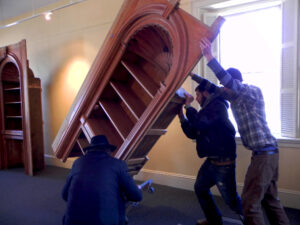
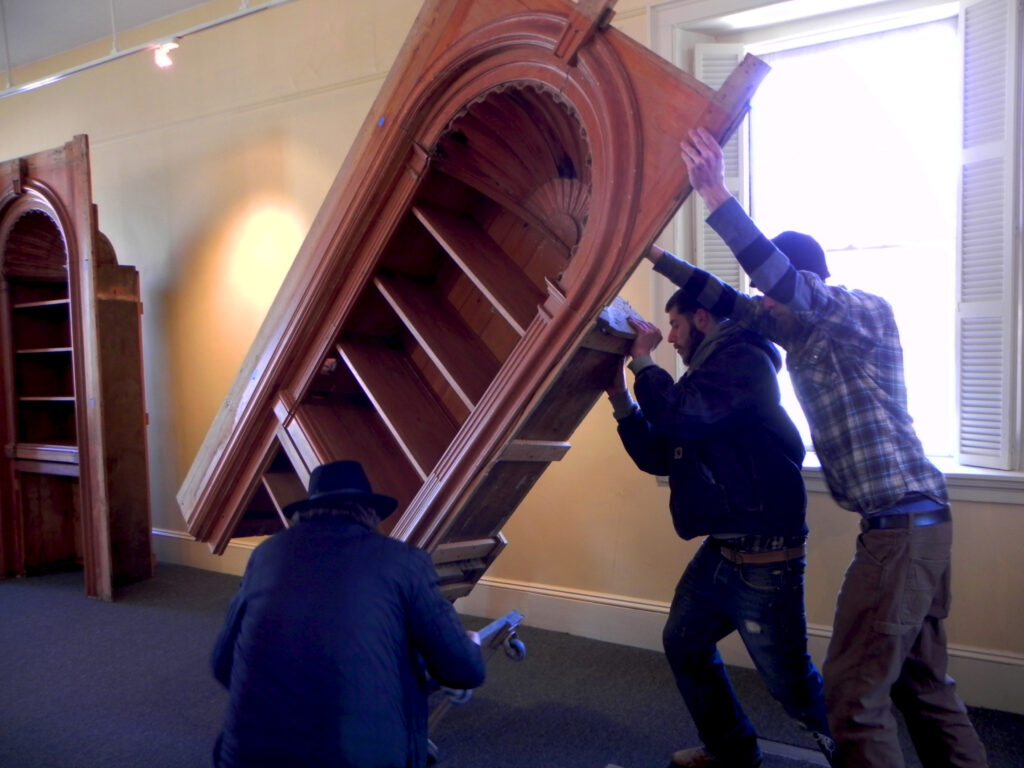
Among the fascinating wood carvings pictured in Jim Craig’s new book American Eagle is not an eagle at all. It is an intricately carved cupboard with a shell design, salvaged from the parlor of one of the seacoast’s most historic colonial mansions.
The grand Sparhawk Hall, built in 1742 in Kittery Point, was burned in 1967, according to a witness, “like an old worn flag.” But two exquisitely carved cupboards still survive. They were briefly on display in 2014 and have since been installed in a distant private home.

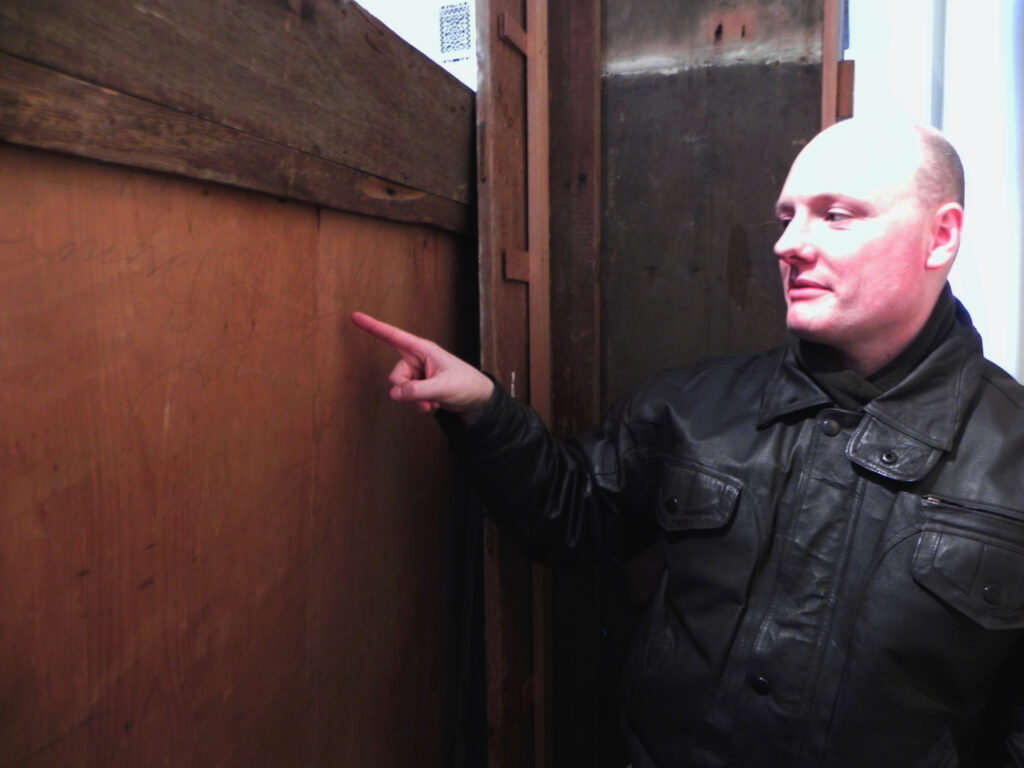
“You can see the father’s signature here,” author Jim Craig says, squeezing behind the panel on exhibit at Discover Portsmouth. The name Charles G. Bellamy of Kittery Point, 1868″ is clearly visible.
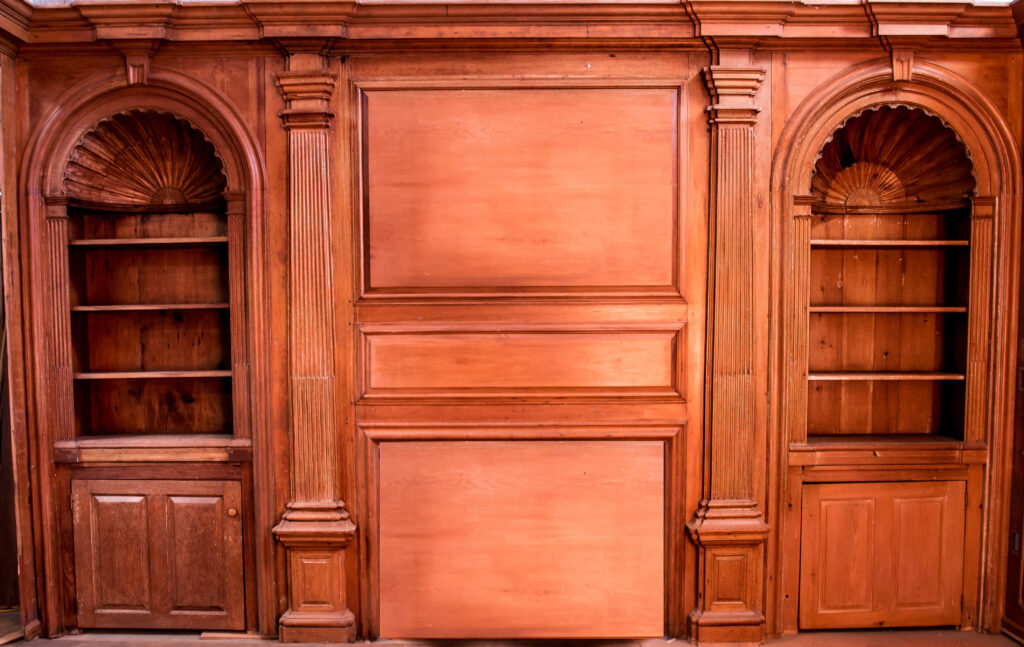
The wooden panel connects two beautiful cupboards that were saved from destruction in 1953. The cupboard to the right, Craig points out, was part of the original Kittery Point mansion built as a wedding gift for the daughter of Sir William Pepperell. She married Nathaniel Sparhawk in 1742.
A super-wealthy merchant, William Pepperrell had his own mansion just up the road in Kittery Point. He would become famous three years later for leading 3,000 New England men in a successful raid on the French fort at Louisburg, Nova Scotia in 1745.
The Sparhawk Mansion, with its 13 spacious rooms and a grand stairway, passed through several hands. It was purchased in 1866, sight unseen, by a British-born “gentleman” and banker from Toronto named Walter Brown. Brown and his wife were possibly the first people to “restore” a colonial American home, returning it to its pre-Revolutionary splendor, while adding a few features along the way. It was the Browns who hired George Bellamy (who was living in the ancient William Pepperell house nearby) to restore the wood-paneled parlor.
“And that’s when his son, John Haley Bellamy, built the second shell cupboard,” author Jim Craig says. He points to the nearly identical fan-shaped carving on the left at Discover Portsmouth.
The Browns opened their restored mansion (probably used as a summer home) to select members of the public soon after the Civil War. This was the dawn of heritage tourism in the Piscataqua region. The “Colonial Revival” interest in early American architecture, furniture, and artwork had begun and would soon sweep the nation.
After the death of her husband, Mrs. Brown went insane. She lived with a guardian until her own death in 1899. The Sparhawk Mansion was sold to Horace Mitchell of Kittery in 1902. Mitchell was a local newspaperman, politician, and hotel owner. and a Sparhawk descendant. A fire damaged the fading mansion in 1932. After World War II the house was used as the backdrop for a grand party scene in the groundbreaking “race” film Lost Boundaries by producer Louis de Rochemont. Horace Mitchell played a bit part in the controversial movie.
Much of the decorative woodwork inside the once-grand Sparhawk Hall was sold off piece by piece. Luckily the two surviving cupboards and the connecting panel were sold to the Woolworth family of Monmouth, Maine in 1953. Careful observation at this time proved that the two features were made by different craftsmen almost 150 years apart. The surviving cupboards and mantelpiece panels have since been moved and restored. Recently resold, they are on their way to a new location in Rhode Island, far from the Piscataqua Region.
An attempt to save the historic Sparhawk Hall from destruction failed in the mid-1960s and the grand colonial mansion, stripped of its inner beauty, was razed in 1967. John Haley Bellamy is best known today as a carver of eagles.
Copyright J. Dennis Robinson

Leave a Reply