


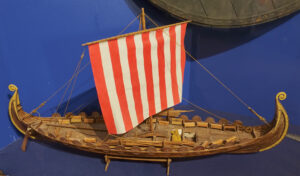

NOTE: I thought I put this hoax to rest over two decades ago, but it lives on. A 2022 article in the local daily reported that scratches on a granite boulder in Hampton, NH “could be… hand-carved in the rock by a Viking visit to Great Boar’s Head in 1004 ca AD.” The article added that there have also been “Viking ship and ghost sightings.” Oh, well. Here’s my original story. – JDR
Sorry folks, Thorvald’s Rock in Hampton is a fake. The famous old rock never marked the grave of Thorvald, brother of the famous Viking explorer Leif Eriksson and son of Erik the Red. For a century, local historians and reporters tiptoed around the truth. I’m compelled to be a little bolder — and simply call a stone a stone. One good hoax, however, can often tell us more about human nature than a boatload of facts.
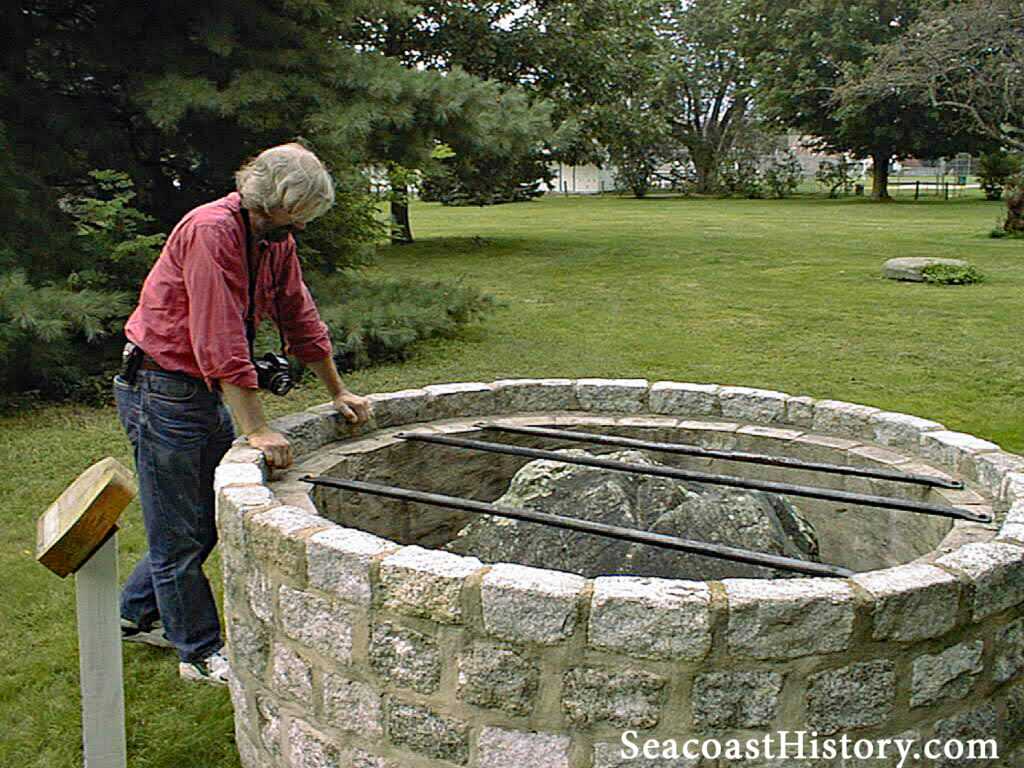
The rock resides today on the campus of Hampton’s Tuck Museum, just across the street from a lot more rocks in Founder’s Park. It is encased in a concrete well beneath a row of iron bars to protect the famous stone from pickaxe-wielding tourists in search of a souvenir. Like Plymouth Rock, Thorvald’s Rock is just a stone that, although not part of any real historic event, has become a symbol all the same.
The faint gouges on the surface of the stone were once considered Viking runes. Early in the 20th century, some “historian” determined that they were letters from the Viking alphabet. That report made its way into a lot of tourist brochures, books and magazine articles. Since then, scholars agree the theory that Thorvald was buried near Boar’s Head, New Hampshire in 1004 AD is hogwash. Legends, however, attract much more ink while Truth has a lousy press agent.
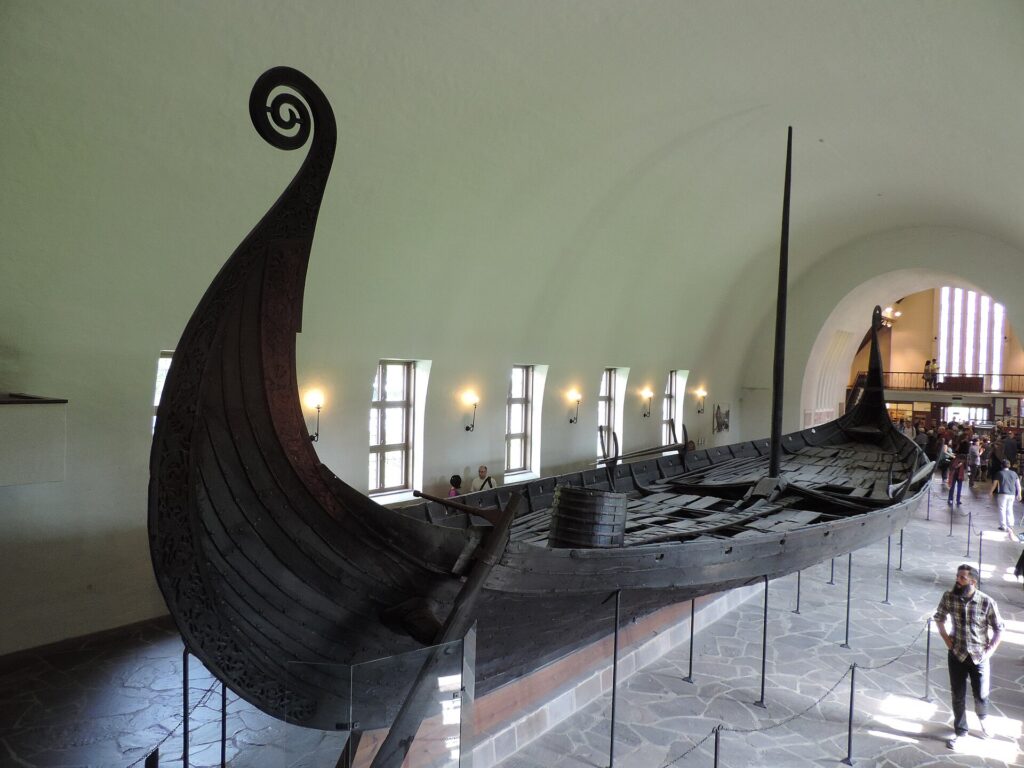
Vikings did visit North America, a place they called Vinland. They traveled in open boats through seemingly impossible seas on ships with a central blazing fire pit, livestock, and dozens of oarsmen. From Russia to Great Britain, past Iceland and Greenland, they came. Exactly where in America they landed is the question. Vinland, researchers tell us, was likely Nova Scotia, maybe Quebec or as far south as New York City.
Viking fever
Claims of Viking artifacts have come from across the United States and as far south as Florida. As a kid growing up in Massachusetts, my cousins and I used to play in a “Viking” cave. This underground stone igloo was probably a colonial root cellar, but not to us. Being a Viking, especially for a blonde little kid, was a license to commit mayhem. None of us ever wanted to be Pilgrims.
That’s likely how Hampton District Court Judge Charles A. Lamprey felt when, as a child, he heard stirring tales of brave and ferocious Vikings. The legend of Thorvald especially intrigued him. According to the saga, Thorvald was retracing his brother Lief Erickson’s discovery of Vinland when he found a stunning rock outcropping that reminded him of the fjords back home. (Hint: When you read what someone was thinking1,000 years ago, you’re already in fantasy-land.)
Those rocks, Charles Lamprey reasoned, must be Boar’s Head, not far from Hampton Beach. According to the saga, Thorvald and his men came ashore and found three canoes owned by “skerlings” or Natives. The Vikings slaughtered eight Indigenous people, then were pursued back to their longboat. In the ensuing sea battle, Thorvald took an arrow in the armpit and, dying, requested to be buried ashore with a cross at his head and a cross at his feet.
Runic codes
On July 4, 1902, Charles Lamprey submitted a piece to the local Hampton newspaper explaining his theory about Thorvald’s death site. As proof of his claim, he pointed to markings on an old stone that had been on his family’s land since the mid 1600s. The land, now Surfside Park just shy of Boar’s Head, was also being considered for development into beach cottages. The colonists had called the amazing stone Witch’s Rock and Indian legends reported the stone marked the grave of a white god. No evidence was offered for these legends besides the mysterious markings themselves.
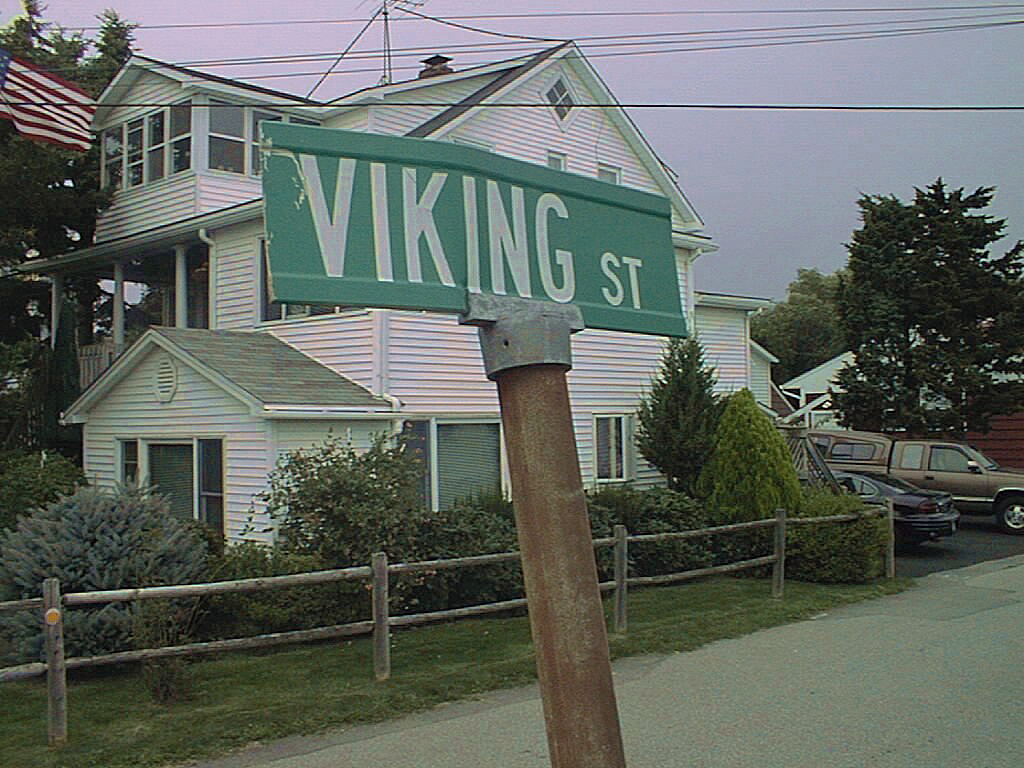
Watch closely now, because this is how local legends are born. Without a shred of proof, other publications picked up the tale of the Hampton judge’s Norse Boulder. A developer wanted to build a park around the rock and charge admission to the growing number of Hampton Beach tourists. New houses cropped up on what is now Thorvald Avenue, just shy of Viking Road.
Seacoast real estate prices began to climb. Hampton’s “rock star” got a public relations boost in the mid-1930s when a local group did a little amateur excavation. According to The Hampton Union, the diggers were about to unearth the celebrated boulder when a bolt of lightning struck the rock, “wrenching the tools from the volunteers’ hands and causing a general retreat.” Nothing enhances a Viking legend like a bolt of lightning.
The Vinland Map
The proposed Viking boulder was featured, along with Hampton “witch” Goody Cole, in the town’s 300th anniversary guidebook in 1938. In 1948, a runic expert, Olaf Strandwold, said he could read a message in the rock. He listed it among a catalog of “Norse artifacts” from North America. New Hampshire writer Eva Speare popularized the story in her books of Granite State lore.
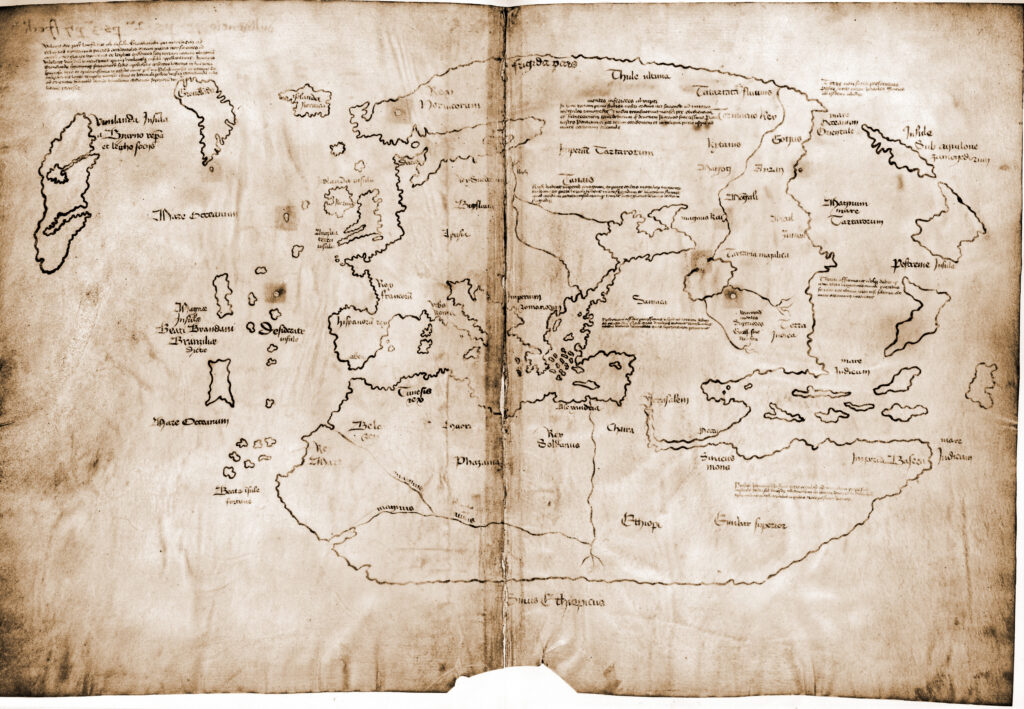
Adding a touch of authenticity, Yale scholars around this time suddenly came up with a medieval drawing. It appeared to prove that Vikings knew where they were traveling and had mapped America. The authenticity of the “Vinland Map” has been hotly debated for decades. Was it real or a clever forgery? True or false, the map boosted the Hampton legend. If Thorvald was not buried in this tourist town within walking distance of the commercial boardwalk, business owners claimed, he should have been.
An endangered boulder
The map turned out to be a forgery. But history is as much about fame as fact.. In the 1950s, the rock was moved to make way for a sewer main for a housing site. Tourists began chipping off pieces for souvenirs. A Massachusetts man attempted to carry the whole thing away in a truck. In 1973, ,amateur archeologists searched for Thorvald’s burial remains and came up empty. Finally, in 1989, Thorvald’s Rock was moved to the Tuck Museum, where it rests in one piece.
Members of the Hampton Historical Society museum began to pull back on the Thorvald legend. Those ancient runes, one critic suggested, may have been made by glacial movement and enhanced by the teeth of a steam shovel. Perhaps the markings were created by the hands of someone hoping to raise the value of his waterfront property.
Fake news
“It’s a fake,” said Elizabeth Ackroyd, then head of the museum’s collections committee, told this writer. “You know that, don’t you? Apparently Mr. Lamprey thought this up on his own. Various people have looked at it since, and you can safely say, they did not come away impressed.”
Despite the vivid imaginations of Hampton real estate agents and beach promoters, Thorvald did not die while visiting the 18-mile New Hampshire seacoast. His crew did not pause in the middle of a deadly battle with the Natives to carve a message on a 600-pound granite boulder. And let’s not forget that Boar’s Head, scientists estimate, has eroded some 300 feet back from the Atlantic Ocean in the last millennium.
Where were the Vikings?
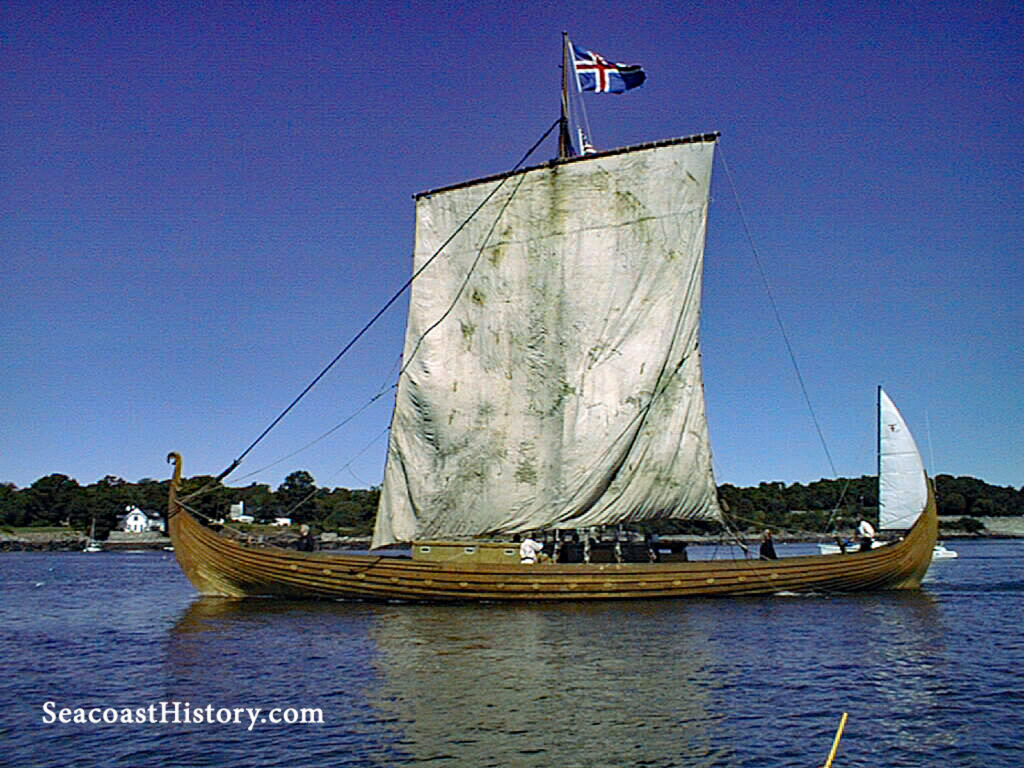
When a 75-foot replica Viking longship, Icelander, visited Portsmouth Harbor at the dawn of the 21st century, I called the event publicist. Magnus Bjarnason, Icelandic Consulate General, coordinated the visit. The Icelandic sagas, he told me, have proven to be very accurate historical documents.
So, how far South did they come? I asked. Deferring the question to a higher authority, Mr. Bjarnason passed on the phone number of Jon Baldvin Hannibalsson, the Icelandic Ambassador to the United States. I placed the call to Washington, DC.
“You want to ask the ambassador if Leif Eriksson’s brother is buried in Hampton Beach, New Hampshire?” Mr. Hannibalsson’s secretary seemed dubious. But she admitted that the ambassador had a fascination with history, and she put me through.
“History is the national pastime in Iceland,” the ambassador told me enthusiastically. “Everybody there has a genealogy to the year 1,000 AD and beyond.”
The enthusiastic response to the touring replica ship, Icelander, the ambassador said, showed how incredibly popular Viking history has become among Americans. If half the people who requested travel information on Iceland since seeing the ship actually visited the island nation, he noted, there would be no room to accommodate them all. A concurrent Viking exhibit at the Smithsonian in Washington, he said, attracted a million visitors a month.
I explained about our fake Viking rock in Hampton. Thousands of Americans appear to be obsessed with Vikings, we agreed. I tried to pin him down as to how far south he thought the Vikings traveled, but an ambassador is a politician after all.
“You should talk to Pall Bergthorsson,” Ambassador Hannibalsson said. And so I found myself dialing the author of the book, The Vinland Millennium. I reached the 77-year-old scientist at his home in Iceland and repeated the fake Thorvald grave story once more. (This was back before cell phones and free international dialing.)
“I cannot see that it is likely that Thorvald went so far as to Hampton Beach,” Bergthorsson said, and I believe he was smiling. He agreed that the carving of a rune stone under the threat of Indian attack was also unlikely. Hastily fashioned wooden crosses, he said, would have been more appropriate burial markers — and would have disappeared centuries ago. The legend is doesn’t hold water, the scholar agreed, and he had his own theory of Thorvald’s grave site.
“I think I have found this place, traveling around in Nova Scotia, that matches the saga on the east coast of Cape Breton Island. The saga leads me to this,” he said. And yet, legends are hard to kill.
Pall Bergthorsson was convinced Vikings may have passed by future New Hampshire shores during later voyages. A Viking coin was recovered at nearby Penobscot Bay in Maine. He said the first-millennium explorers likely found their way to New York City, too, landing in future Brooklyn. The first European child born in America, he theorized, was a Viking girl, not a Pilgrim.
The only authentic thing named Thorvald in Hampton is a little street off Surfside Park. But do not mourn, brave Seacoast tourists. Hampton may have lost a Viking gravestone, but it has regained a good-sized boulder in the bargain.
Copyright © 2005 by J. Dennis Robinson. All rights reserved.
 Silent Film Actor William Haddock Was Born Here