

I don’t normally comb through ancient newspapers, letters, diaries and records searching for facts. That’s the work of real historians. They’re like Sherlock Holmes. I’m more like Dr. Watson, the storyteller.
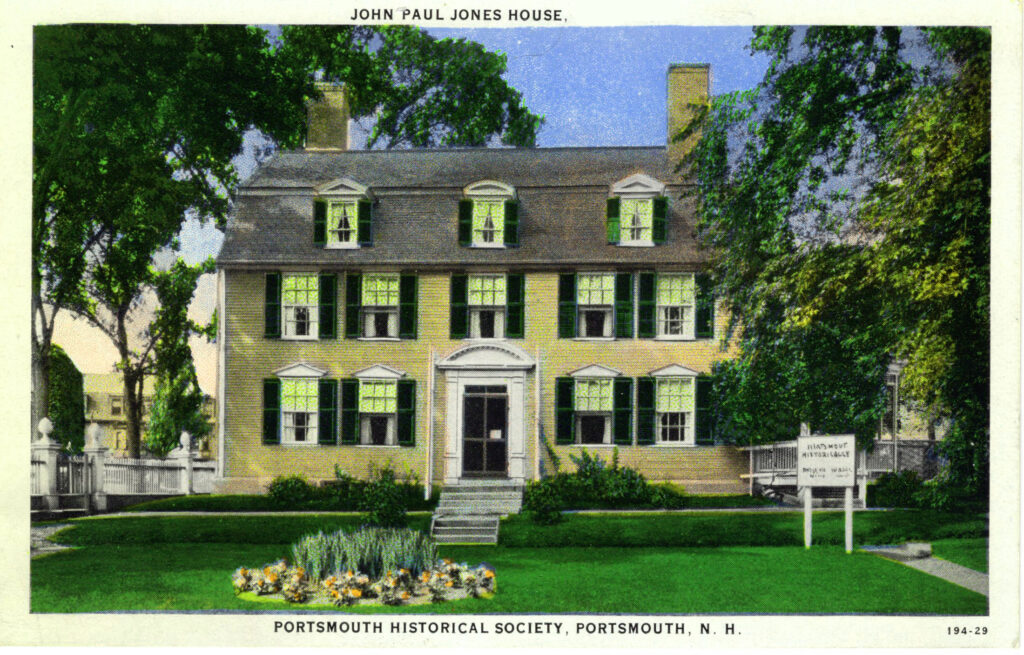
We do not know with certainty if naval hero John Paul Jones ever stayed in the John Paul Jones House in Portsmouth, NH. Legend says Jones bunked there twice when readying two warships for sea. Key Jones’ biographers including Smauel Eliot Morrison, have accepted the legend despite any documentation.
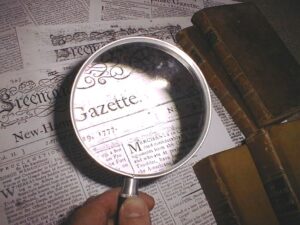
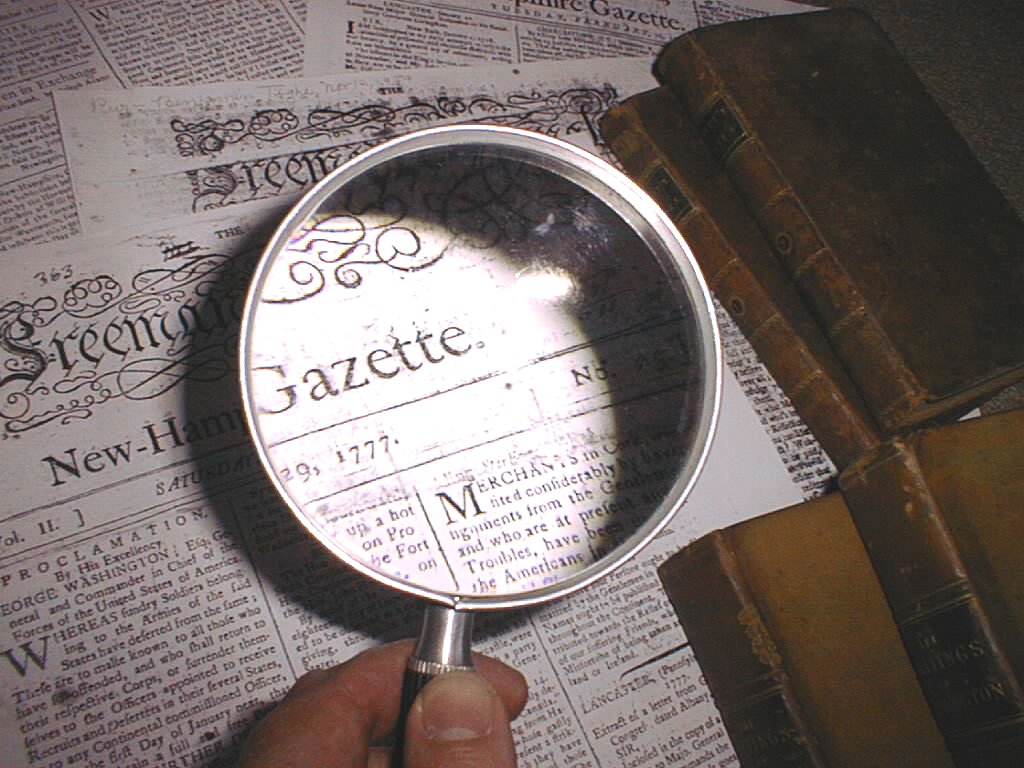
One day back then I put on my Sherlock Holmes hat, grab my magnifying glass, and looked for evidence that Jones had been there. I skimmed the complete known letters of Jones on microfilm at the Portsmouth Athenaeum, sharpening my focus to Jones’ first visit to Portsmouth from July to November 1777. He wrote often while in town, but I couldn’t detect a hint of where or with whom he was boarding at the time. The Athenaeum has a wonderful collection of early Portsmouth newspapers, but alas, the bound copies of the New Hampshire Gazette from that year are missing from an otherwise complete series.
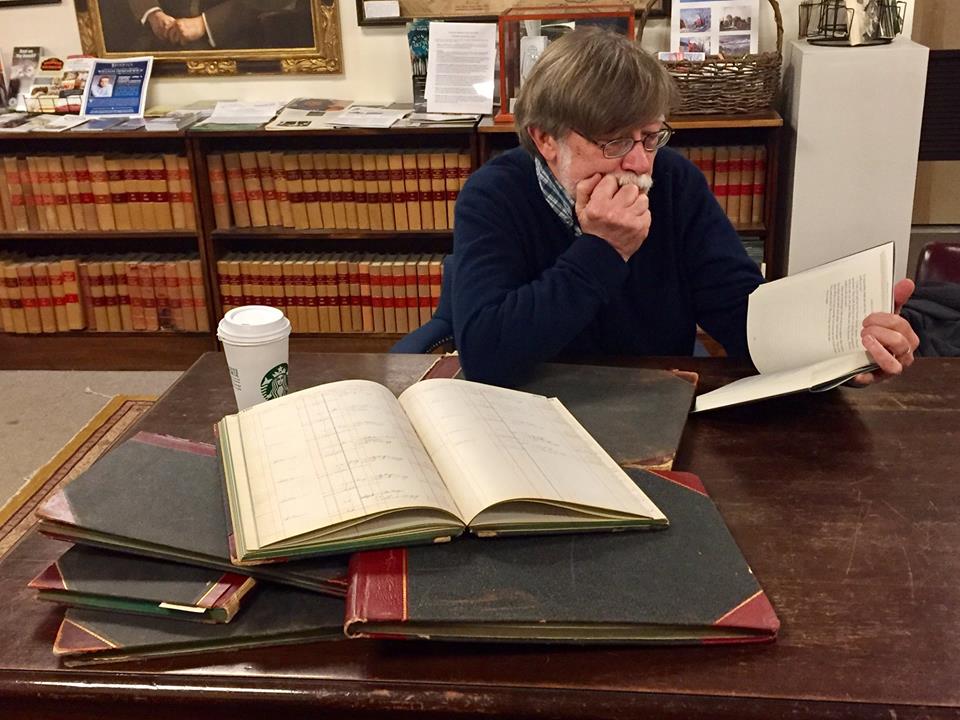
That drove me to the Portsmouth Public Library, where I wrestled with the microfilm machine. It’s not a perfect technology. Early newspapers photographed onto microfilm can be hard to read. The image onscreen is gray and fuzzy, even when magnified. Many of the NH Gazette issues from that era have pieces torn away or are shot with holes. Scrolling rapidly through the pages makes me seasick. I get a slamming headache after an hour.
It gets worse.
Three out of every four issues from late 1777 are missing from the microfilm itself — most of the period Jones was here in town. Possibly, a local historian told me, the Gazette wasn’t published at all for those months of the Revolutionary War. Paper was scarce. Ink was scarce. The weekly Gazette was often reduced from four pages to two. Printer Daniel Fowle used smaller type to fit more words on the page, sometimes even printing sideways to fill in the white space in the margins with added details and ads.
Newspapers were very different back then. Published once a week in 1777, the Gazette was filled mostly with world news, often weeks out of date, plus reports on Gen. George Washington’s progress against the British in the American Revolution. For a short time, at the birth of the Revolution in 1776, Fowle did suspend publication altogether, possibly fearing for his safety. Then in 1777, Fowle renamed the Gazette to The Freeman’s Journal and moved his printing office to Exeter where he also hoped to create a paper mill. These were the missing issues I hoped might offer clues to where John Paul Jones stayed.
“Have you checked the American Antiquarian Society In Worcester, Massachusetts?” Steve Fowle suggested. Fowle publishes the NH Gazette today, now approaching its 250th year. He’s the resident expert on old Portsmouth newspapers.
I hadn’t heard of the AAS that archives the largest collection of American newspapers published before 1830. I called. Research librarian Donald Lampi checked his records and dropped the news like a bomb.
“There is ONE surviving set of the Freeman’s Journal from late 1777,” he said. “It used to be at Massachusetts Historical, but now it’s here.”
I was beginning to feel like Sherlock Holmes in “The Case of Paul Jones Bedroom”. Maybe historians had missed the evidence because they had simply not searched in the right places?
“I’ve got to see those missing issues,” I told Donald Lampi.
“That’s easy,” he said, “since they are all on microfilm.”
“Not on OUR microfilm!” I explained. “I checked two different copies here in Portsmouth. Those months in 1777 are blank.”
“You’ve got the wrong microfilm,” the researcher said. And it was true. It had never occurred to me that different microfilm companies might be copying different archives. ReadEx, a Vermont-based company, had tracked down the only surviving copies of the Freeman’s Journal and included it on their reel. The competing microfilm company — the one I’d been searching at the library and the Athenaeum — had not. Portsmouth librarian Mike Huxtable was kind enough to order the ReadEx version and a few days later he called. I waited like a kid waits for Christmas.
“It’s IN,” was all he said on the phone days later. I was on my way. Sure enough, roughly 25 issues I’d never seen appeared on the microfilm screen. Would they mention Jones?
Remember, newspapers in 1777 were different. There were no pictures of any kind, just text. There were no headlines, no topical sections like sports, editorial, or home and garden. Articles simply bled from one topic to the next like a stream of consciousness novel. One minute you’re reading a battlefield letter by George Washington, or an excerpt about the flying island of Laputa from a hot new novel called “Gulliver’s Travels”. Then suddenly, the next line is about a missing horse in Portsmouth, a shipment of oranges from South America, or an escaped slave. In 1777, slaves were advertised like items in a yard sale. It can be chilling research. In one issue from the “lost” newspaper series, the owners of a recently closed Portsmouth orphanage noted that readers wanting a child could stop by and pick one up–first come, first served.
Portsmouth, NH home to John Paul Jones (Author’s Collection)
For hours in the library, hunched over the dull gray machine and squinting into the dimly lit screen, I inched the microfilm ahead, watching the weeks roll by as the American Revolution played on. I read through every newspaper Paul Jones must have read during his first five months in Portsmouth. I imagined his frustration, stranded on land as the British campaign raged. I imagined his jealousy as Captain Thomas Thompson of Portsmouth captured enemy prize ships in the Raleigh, sister ship to Jones’ Ranger that had been launched, but still languished across the river in Kittery without its crew, its provisions, cannon and sails.
One front page article decried the inflation of war in which a Continental dollar wasn’t worth a tenth of its value the year before. And worse, traitorous counterfeiters were working to undermine the fledgling economy altogether. Yankee troops stationed in Portsmouth camps were badly in need of food, ammunition and clothing. Loyalists, it was feared, were attempting to introduce smallpox into the troops, perhaps the earliest chemical warfare in American history — except, of course, when early New Englanders did the same to Native Americans.
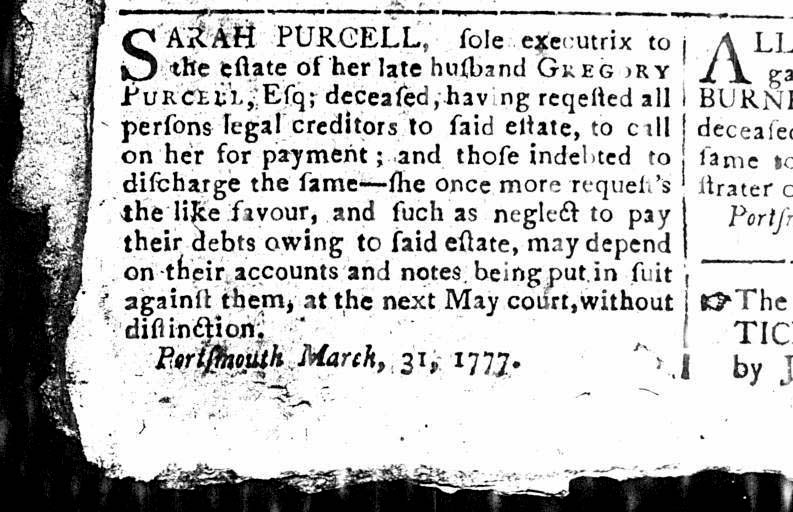
I practically fell off my chair when Sarah Purcell’s name appeared in a small advertisement in the Freeman’s Journal. She is the woman who, legend says, rented Jones a room in the yellow gambrel-roofed colonial that still sits on the corner of State and Middle streets. Mrs. Purcell, it read, regretted that she could not currently repay all the debts she owed since her husband’s untimely death just months before. But she would get the money, somehow she promised, and repay all. The theory, often told at the Paul Jones Museum across the street from Portsmouth Library, is that widow Purcell rented rooms to Jones and his steward in order to pay her debts and support her eight children. Was this what the notice implied?
John Paul Jones’ name appears in the Freeman’s Journal three times during his period in town. Twice he placed a lengthy letter in search of recruits for the Ranger. His rousing note, already well known from other newspapers, offers “encouragement for seamen.” In it, Jones promises to pay a decent wage and to treat his men fairly. The third mention, which was new to me, comes from a sailor from an earlier ship captained by Jones. The man wanted to sue Jones for nonpayment of a debt. Close, but no cigar. The mystery of whether Jones slept in the house named for him is still an open case. If there’s evidence in the 25 rediscovered copies of the Freeman’s Journal, I didn’t find it.
By November 1777, Jones and 145 men from the Piscataqua region had finally set sail for France. The story of his famous raid on England is well known. What isn’t known, still, is where he stayed while in town. Donald Lampi sent me four more scattered copies of the Freeman’s Journal by mail, ones that do not even appear on the ReadEx microfilm. I consumed them, word-for-word, but to no avail.
The “Case of Paul Jones Bedroom” is still open. The evidence is out there somewhere, perhaps in an old desk drawer or deep in a dusty archive. Rest assured, Sherlock Holmes never gives up.
Copyright J. Dennis Robinson, all rights reserved.
 Unknown Celia Thaxter Portrait Discovered