


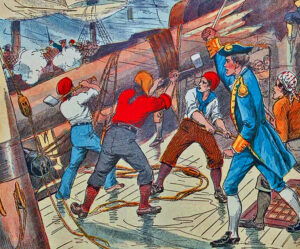
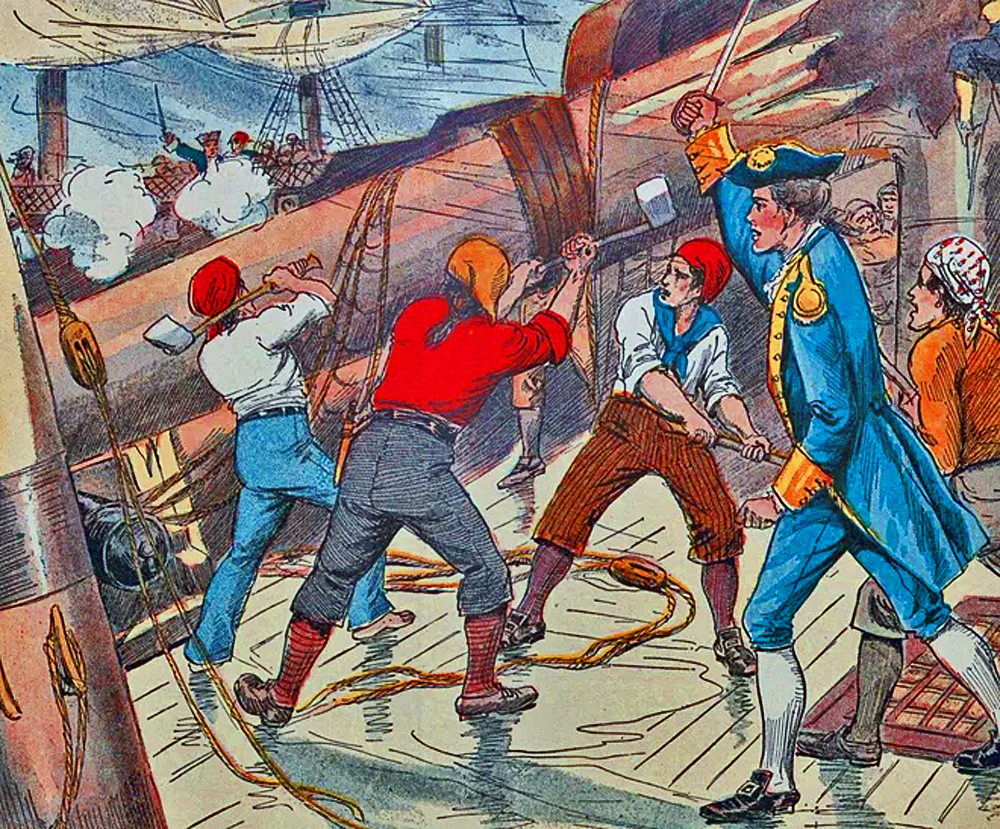
Drawing his pistols from his belt and grasping one in each hand, Paul Jones suddenly kicked open the door and entered the robbers’ rendezvous. There were three men there and they were gallows birds, every mother’s son of them, as ripe for murder as for drinking a glass of grog.
“Who might you be?” queried one, hoarsely. “Capt. Paul Jones,” was the airy reply. “Now, flat on the floor, the three of you!” “Ye’re the very devil, Paul Jones!” said one robber. “Thank you for your high opinion,” Capt. Paul replied.
—Adapted from “Paul Jones Weekly,” Number 10, December 2, 1905
Despite a wealth of historical data about John Paul Jones, we can never really know Portsmouth, NH’s most famous resident. Fully half of the 95 books about Jones that I have collected over the years are rich with exaggeration, imagination, mistakes and fake news. He has been depicted as a hero, a traitor, a pirate, a womanizer, a warrior, a murderer, a blowhard and a military genius. And for 19 weeks at the dawn of the 20th century, he was the star of his own pulp magazine.
Beloved by French aristocrats, but largely unheralded in America, John Paul Jones did not become a national hero until well after his death in 1792. And he didn’t become a superstar until his body was exhumed from its Paris grave and shipped with great pomp to the United States in July 1905.
President Theodore Roosevelt, whose agents had been hunting for Jones’ remains for years, used the occasion to promote his plans for a costly renovation of the U.S. Navy and the launch of his Great White Fleet of warships.
Adventure for boys
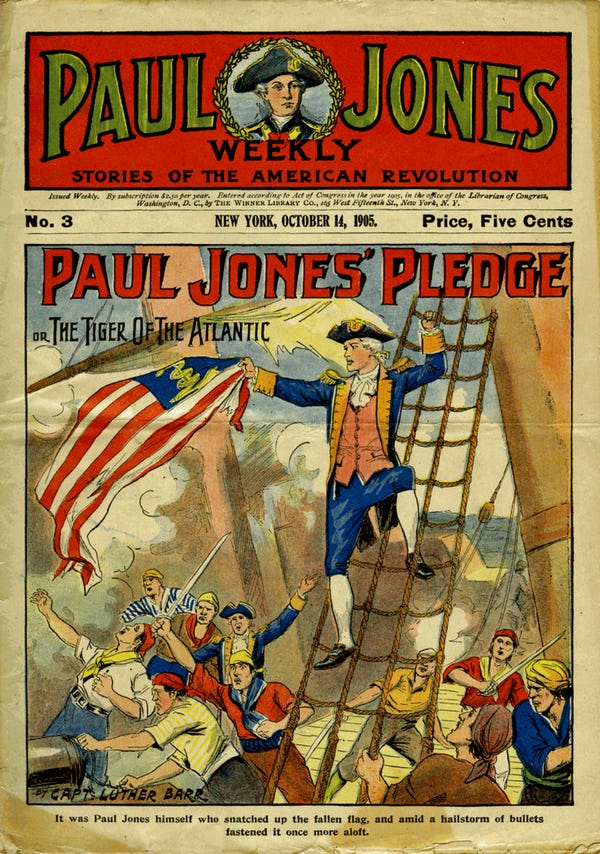
Two months after Jones’ mummified body arrived at Annapolis, Maryland, the first issue of Paul Jones Weekly hit the newsstands. There’s no question who snapped up copies of the 32-page magazine with its brightly colored cover. “Boys,” the editor announced in bold letters, “if you want a rattling good tale of stirring Revolutionary days, don’t pass the Paul Jones Weekly by.”
Adventure tales for impressionable American boys had been around for a century. Originally designed to provide moral, patriotic and uplifting models, the genre took a sudden turn just after the Civil War with “A Story of a Bad Boy” by Thomas Bailey Aldrich. His novel about a really bad boy growing up in Portsmouth along with his friend Mark Twain’s books about Tom Sawyer and Huck Finn were a game-changer in the field of juvenile fiction.
While the works of Aldrich and Twain were called “literature,” the second half of the 19th century was quickly flooded with “dime novels,” cheaply printed and often badly written. Considered trashy if not dangerous by many parents and educators, these magazines fictionalized the often violent exploits of Davy Crockett, Buffalo Bill Cody, Jesse, James and Daniel Boone – turning real people into mythical and cartoonish figures.
It is interesting to note that Paul Jones Weekly replaced the popular Red Raven Library. Created by New York City publishers Street & Smith, the Red Raven series focused on bold tales of plundering pirates. Although the main characters were three boys who set out to capture the notorious Captain Kidd, it was clear who the readers were rooting for.
“A true American boy likes tales of brave deeds accomplished by lads on the free, rolling ocean, especially if there is a dash of spice added in the shape of vigorous combat between right and wrong,” the publisher wrote.
“Remember, boys,” the publisher added, clearly for the benefit of parents, “these stories do not glorify piracy and are not harmful in any way.” Then switching back to the target buyer, Street & Smith delivered the pitch: “Your news dealer has the latest number on hand. For interesting reading, we advise you to get it.”
From dimes to nickels
The first “dime novels” were the brainstorm of Erastus and Irwin Beadle. They were initially filled with content recycled from newspapers and reshaped into cheap pocket-sized volumes of 100 pages that sold for a dime. The only illustration was on the cover. Beginning in 1860, the Beadle brothers produced over 300 titles during the next half century, spawning a industry of imitators.
Topics shifted with the times, but western, romance, history, railroad, maritime, gold-digger, and sports themes remained popular. Stories of cave dwellers, orphans, Indians, pirates, and circus performers appeared. Detective stories and early science fiction would follow. By the 1870s, a larger comic-book sized format, roughly 11 by 8 inches, appeared with only 32 pages, but with a dramatic full-color cover. Many of these, including the later Paul Jones Weekly, sold for only a nickel. They were, therefore, not dime novels, but “nickel weeklies.” Stories became more original and the writing, and arguably, got better.
The evolution from dime and nickel publications to the pulp magazines and then comic books is easy to follow. By World War II, the early genre publications had become highly collectible even as the cheap paper they were printed on began to deteriorate. The term “dime novel” has since become widely used to cover any vintage publication that was quickly written, sensational and cheaply printed.
From nickels to bucks
The hoopla surrounding the discovery of John Paul Jones’ grave was a marketing opportunity for Street & Smith. In one quick move, they replaced a sketchy series about pirates with the heroic and patriotic “Father of the American Navy” as he was being called. That title, as readers of this column well know, had been proposed by “flawed historian” Augustus C. Buell, whose “fraudulent” biography of Jones had appeared in 1903 and was then a huge bestseller.
Buell’s biography provided two volumes worth of rollicking patriotic tales that could be adapted into Paul Jones Weekly. The combination of Buell’s invented facts, plus the full-on imaginary characters and situations in the pulp magazine, when read today, quickly turns its main character into a cartoon.
Even the author of the weekly magazine was fake. The writer of the early series is listed as Captain Luther Barr, perhaps to create a salty sense of authenticity. The writers have since been identified as John DeMorgan, an Irish writer and political activist, and William Wallace Cook, a journalist who also wrote science fiction.
In “Paul Jones Defiance” (Issue No. 10) for example, Jones is presented as a pioneer planter from Virginia who single-handedly takes on a den of robbers. While the southern myth that Jones once ran his late brother William Paul’s tobacco farm persists in some southern states, the facts say otherwise. In the weekly, the Scottish-born Capt. Jones claims he is an American citizen, which he was not. As a plantation owner, he is required to whip one of his enslaved workers to confess the whereabouts of the thieves. His two “negro” companions speak with the mocking slave dialect employed in racist 20th century minstrel shows.
“The stories which will appear in the Paul Jones Weekly will be so fascinating and full of the spirit of patriotism that no real boy can resist the temptation to read them,” the publisher announced. But the “stirring sea tales” of “the gallant American hero” did not captivate its boy audience for long. Only 20 issues were produced and only 19 were published. Another Revolutionary War pulp franchise, “The Boys of 76,” continued through 600 issues.
I bought a slightly battered copy of “Paul Jones at Bay” (Issue No. 2) a few years back for about $25. Its fragile, brown pages, not intended to survive over a hundred years, were difficult to read. I had forgotten about it until, recently, a number of issues appeared in an online auction. I bid on them all and lost every one. But the game was back on.
Last week, I discovered an online ephemera dealer offering the entire set – all 19 issues of Paul Jones Weekly, but no price was listed. I boldly sent an email inquiry and he gallantly responded.
“The Paul Jones series is one of the smallest,” the dealer wrote the following day, “and all are rare. Individual issues in average shape sell for about $85. In great shape, they average $125 or so.” He offered me the “low price” of $1,805 for the set, plus postage. It’s probably a fair deal. I think I’ll wait for the movie.
Copyright 2021 by J. Dennis Robinson, all rights reserved.
 Claire Luce Plays Portsmouth