


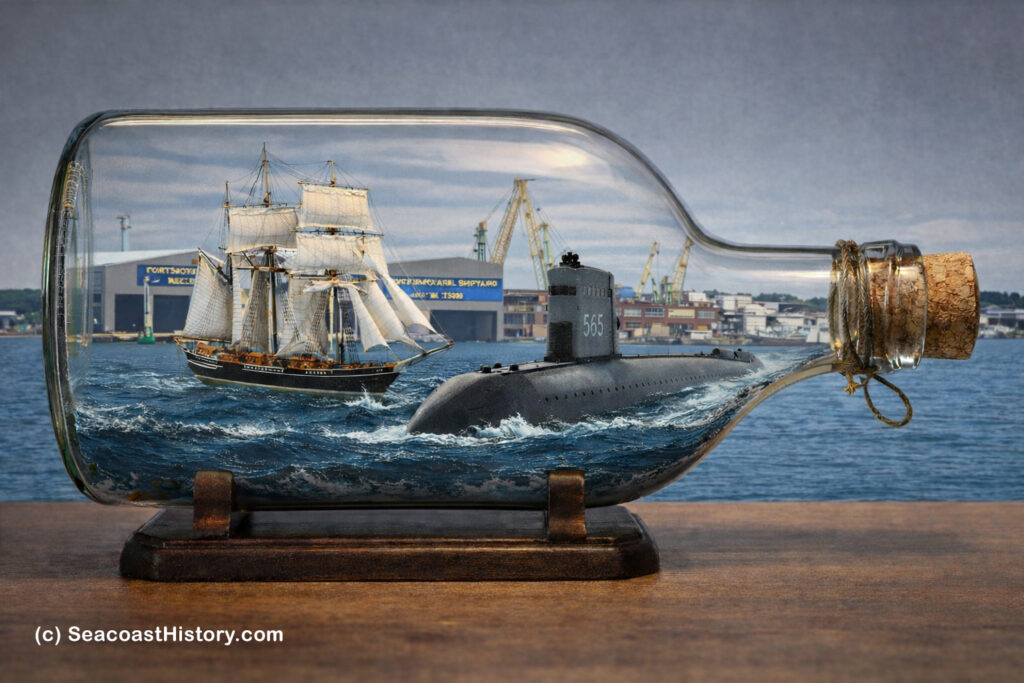
Always beleaguered, the Portsmouth Naval Shipyard is again battling to steer clear of the federal base closure list. While its days may be numbered, its history is assured. One of the longest surviving shipyards in America, PNSY has been making headlines and working hard for America since 1800.
Around here, people just call it “The Yard.” It was built on islands once used for drying fish. Today, over 225 years old, the Portsmouth-Kittery Naval Shipyard is still pumping iron. Considered by many to be the nation’s very first federal shipyard, PNSY has weathered a turbulent transition from sail, to steam to atomic fuel. Now dedicated to the overhaul and repair of modern submarines, “The Yard” has two centuries of stories to tell.
George Washington visited the spot of the future federal shipyard in 1789. Yet officially, PNS was created on June 17, 1800. Under President Thomas Jefferson, the fledgling United States purchased two islands in the Piscataqua. This was the best spot on the New England coastline, according to the new Navy Department, to build American warships. The bad news: the rocky harbor was subject to fog, possessed a very rapid current, and could be navigated safely only at high tide. The good news: the area was close to the sea, yet could be heavily fortified on both the New Hampshire and Maine sides. Even better, Fernald’s and Dennett’s islands off Kittery cost only $5,500.
Another Piscataqua advantage, according to the official 1798 government report, was the abundance of skilled maritime craftsmen already living in the area. That’s because Piscataqua shipbuilders had already been making warships for the government for over a century the English king, that is.
In fact, the Falkland, commissioned here in 1690 for His Majesty’s Royal Navy, is considered the first British warship built in the colonies. That honor fell to the Piscataqua because it was, at that time, heavily forested with trees ideal for masts and planking. Indeed, it was for the trees and fish that John Smith, one of the most famous New World mariners of all time, suggested settling this region during his visit in 1614.
It was the impending War of 1812 with England that sparked the building of navy yards here and elsewhere. The first ship built at the yard was named Washington, but was not launched until 1815. Yet by this time, Piscataqua shipbuilders had already distinguished themselves in the American Revolution.
xxx
at nearby Badger’s Island was among the first 13 original frigates ordered by the Continental Congress the year before. The private contract went in 1776 to Portsmouth’s John Langdon who had helped lead the successful raid against the nearby British Fort William and Mary in 1774. Langdon was then contracted to build the 18-gun sloop of war Ranger, famous for its 1778 solo raid on Britain under Capt. John Paul Jones. Jones returned to Portsmouth and engineered the launch of America in 1782, then the largest and heaviest ship ever built on this continent.
Piscataqua builders were called on four more times to construct warships for the Continental Navy, among them the sloop Portsmouth and the frigate Congress, both launched before the sale of the federal navy yard in 1800. Congress was a sister ship to the famous Constellation, Philadelphia and Constitution that were contracted to other early American shipyards.
Ironically, the man who became famous as commander of the Constitution, Admiral Isaac Hull, was in charge when enemy cannon balls bounced off “Old Ironsides” in the War of 1812. The very next year, Hull was placed in command of PNSY. Ironsides herself was at Portsmouth Yard in the 1850s for a refit. Photographs of the Constitution here are among the very first images in the U.S. Naval Archives.
The rise and fall of shipyard activity were tied to the nation’s war efforts and appropriation of federal funds. From the Civil War, Spanish-American War, two world wars, through the Cold War, PNSY production rose and fell like a tall ship on a heavy sea, towing the local economy in its wake. Set on what were once rocky islands where locals collected wild berries, PNSY grew and evolved through the 19th century into a serious federal facility. Luxurious officers’ quarters and modern housing for enlisted men sprang up and large buildings, identified only by numbers, dotted the landscape. The gigantic Franklin Building, built in 1828, was the largest wooden shipbuilding structure anywhere.
High-tech in the Civil War era meant the evolution of steam powered battleships, the arrival of the railroad, research into submersible and ironclad vessels and the construction of a massive “floating drydock.”
The Kearsarge, best known of the Portsmouth-built vessels from this time, was half-steamboat, half-sailing ship. Its defeat of the Confederate ship Alabama, said to have attacked 65 “Yankee” vessels, was a key battle in maritime history. Then, as now, The Yard defended itself against civilian attacks and threatened base closures. As the nation geared up for civil war, New Hampshire Senator John P. Hale waged a very public battle against what he considered spiraling graft and inflated military expenses at PNSY.
Still, the yard survived and thrived at times, as the US Congress allowed expansion and modernization. By 1878, PNSY was connected to Portsmouth by underwater telephone lines. By 1882, “Old Ironsides” was back in town for a 15-year stay. Cabbed over and preserved from destruction, the famous tall ship essentially became a floating dormitory for cadets and visiting seamen. As the century and the Spanish-American War ended, 1,300 prisoners were encamped on the federal islands here. Guidebooks published photos and tourists paddled by hoping to catch the Spanish prisoners washing their clothes on the banks of the Piscataqua. And it was about this time that J. P. Holland, an inventor of the modern submarine, was photographed during a test in the same deep river. A new era for PNSY was on the horizon.
The 20th century arrived with a bang. Henderson’s Point blew up on July 22, 1905, in what was then the largest dynamite explosion of all time. The explosion and dredging made the harbor viable for a whole new breed of underwater warships. That same year, Portsmouth became a synonym for “peace” when the long tragic conflict between Russia and Japan ended here. Today the Navy Yard, the Rockingham and Wentworth-by-the-Sea hotel are important historic sites for visiting Japanese tourists interested in the Treaty of Portsmouth.
A few years later, with the completion of the enormous military jail at PNSY, Portsmouth also became a synonym for “prison.” Housing a maximum of 3,000 military prisoners in WWII, the deactivated building still hunkers at the end of the island like a fantasy castle. The Jack Nicholson film “The Last Detail” is the story of one convicted man on a journey toward “the worst place on earth.”
In April 1917, the first submarine built at a naval shipyard was launched at Portsmouth Harbor. Named simply L-8, it was the first and only submarine to serve in World War 1. During the war things were changing at PNSY, too. Photographs show an increasing population of women working as yeoman, and in a wide range of manufacturing jobs. At this time New Hampshire shipyard workers, male and female, were still commuting across the river to the yard by ferry. That changed in 1923 when a memorial bridge, dedicated to those lost in WWI, finally created a connecting roadway between the neighboring states. A 5-year-old girl named Eileen Dondero, whose mother would become the city’s first woman mayor, was on hand to cut the ribbon, opening interstate traffic. That girl, too, grew up to become mayor of Portsmouth, and an ally of the naval shipyard.
Over the next few decades, PNSY experienced its greatest triumphs and tragedies. In 1936, a hellish blaze signaled the end of the massive, century-old Franklin Shiphouse. Two years later, the Portsmouth-built submarine Squalus sank in 243 feet of water five miles off the Isles of Shoals. Using an experimental diving bell system, 33 men were saved, but 26 lost their lives.
Through both world wars, PNSY production was unsurpassed by any other naval submarine facility. Theodore Roosevelt stopped by aboard the presidential yacht for a friendly inspection. Three years later, in 1943, Portsmouth set a record with four launchings in a single day. The durable sub Sand Lance took 100 Japanese depth charges and survived to fight again. In 1945, Seacoast residents spotted German U-boats in the Piscataqua. A number of Nazi subs arrived here to surrender and, as the war ground to a conclusion, many Seacoast citizens got a close look at the enemy for the first time.
The war ended, even as war technology escalated. The age of atomic-powered submarines arrived, epitomized in the early 1950s by the unarmed research vessel USS Albacore. The plucky new teardrop design was fully submersible, set new underwater speed records, and redefined the shape of things to come for modern submarines. Then came Thresher. In 1963, the newly designed submarine was lost at sea in 8,400 feet of water with 129 souls aboard. One-hundred forty nine children were left fatherless by the greatest tragedy in local history.
Another Sand Lance had the distinction in 1969 of being the last of 134 subs built at the Portsmouth-Kittery Navy Yard. Then, with the fear of base closure hovering like a New England storm front, PNSY set about the job of reinventing itself once more. Now a recognized leader in repair of nuclear-powered submarines, the base has downsized to half of what was an 8,000-member workforce.
And so the turbulent ride continues. In a time of tightly-watched military expenditure, the concept of “outleasing” has kept PNS business alive in partnership with private companies. Commercial use of the naval prison building are being explored, but security has been tight since the tragedy of 9/11. New Hampshire and Maine continued to wage a legal battle over which state the navy yard is actually located in, but the Supreme Court recently settled that score. “The Yard” is definitely in Maine. The border controversy that began in the days of British rule is finally over. Despite the squabbles, locals remain proud of a shipbuilding tradition that spans five centuries — and just sails on.
Copyright © 2000 by J. Dennis Robinson, all rights reserved. Updated in 2005.
 Exeter Officer Eugene Bertrand on UFOs