


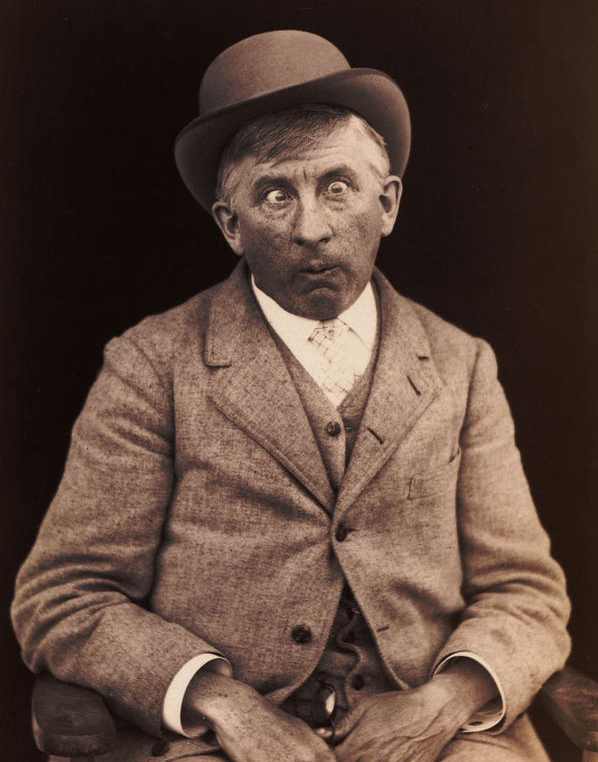
The nation’s funniest man was born and is buried in Portsmouth. No kidding. But that claim is difficult to prove. It came from the actor himself, Henry Clay Barnabee (1833-1917),
Best known as a singing actor in a string of successful comic operettas, Barnabee’s fame was already in decline when he released his autobiography, “My Wanderings,” in 1913. The Oxford University Press remembers Barnabee today as “a horse-faced baritone” who enjoyed a “durable” career on stage. The story of how and when Barnabee’s large private collection of memorabilia ended up in the archives of the Portsmouth Public Library is a tale more obscure than the actor himself.
The unseen collection
According to legend, two large crates appeared suddenly and anonymously on the front steps of the former Portsmouth Public Library building (now Portsmouth Historical) soon after the death of Henry Clay Barnabee. A librarian dragged them indoors. The cache included 21 of the actor’s personal scrapbooks, 23 photo albums, 29 old scripts and thousands of playbills and bits of ephemera from the actor’s lengthy career on the road.
When a distant relative of Barnabee was finally located in New York City, the collection was shipped there C.O.D. But the crates came back, rejected by the family.
That tale, though colorful and often retold, conflicts with reports in an early Portsmouth newspaper. A small notice in the States and Union, eight years before the actor’s death, indicates that Barnabee, not his heirs, donated the rare collection that chronicles the rise and fall of comic opera in the United States. In July 1908, the newspaper notice reads, Portsmouth librarian Hannah Fernald confirmed that “the collection has just now arrived” from Mr. Barnabee.
One year later a headline in the same newspaper offered an exclusive inventory of the collection. Barnabee was in Portsmouth in the summer of 1909, according to the news report, staying with his aged sister Mary Ann French. The actor had apparently decided to donate his extensive collection of books, autographs and photographs to the public library in the town of his birth. It was a plan, “which only a limited few are aware of,” according to the published report.
Barnabee was apparently motivated to pick Portsmouth, despite offers to house his memorabilia in Boston and New York, because local writer Thomas Bailey Aldrich, a close friend of actor Edwin Booth, had done the same at his death in 1907. A “special room” at the library was set aside to display the Barnabee gift, the newspaper announced, and it would soon be open to the public.
In a follow-up front page story in September 1909, the States and Union noted “the venerable actor with his own hand” had inscribed the placards to accompany the planned exhibition in the renamed “Barnabee Room.” Yet, so far, no record of the accession of the original Barnabee items or the opening or closing of the library exhibit has been found.
Clara Barnabee, the actor’s “guiding light and leading lady,” died three months later on Christmas Day 1909. It is possible that the collection was never displayed. Or perhaps the Barnabee exhibition opened at the library in his lifetime. Then, like the large ephemera display in the Thomas Bailey Aldrich House nearby (now part of Strawbery Banke Museum), Barnabee’s mementos were later packed away in storage as his fame dwindled during an era of silent movies and vaudeville shows.
As time goes by
According to the Portsmouth Herald, a Boston scholar searching for the exhibit in 1943 was told by librarian Hannah Fernald that it had been “broken up” long ago. Some of the items were sent to collectors in New York, she told him, and the rest went in the library basement.
The Barnabee collection sat in the basement of the Portsmouth Public Library at 10 Middle St. for almost 50 years. Then it was moved to the attic. In 1980 an enterprising graduate student from Tufts University pulled open the boxes to catalog the contents. Grown valuable with age, the extraordinarily complete archive is now seen as a rare timeline in the history of American comic theater.
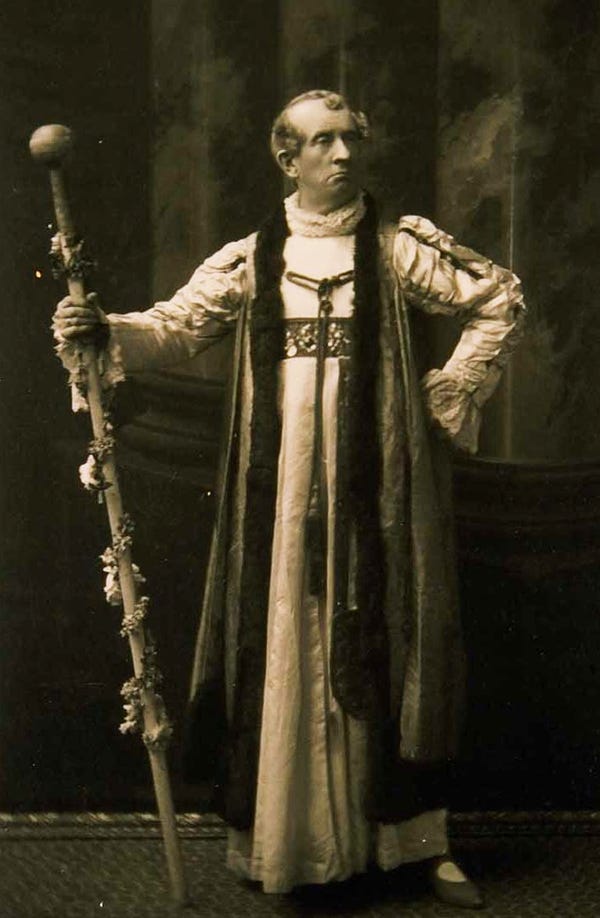
Through the artifacts we see Henry Clay Barnabee as the Sheriff of Nottingham in the comic operetta “Robin Hood,” a role he performed nearly 2,000 times. In dozens of lavish costumes he appears as a wealthy duke, a professor in a top hat, and a thickly bearded Rip Van Winkle. We see Barnabee wearing a kilt, clad in a toga, dressed as a cowboy, a soldier, a sailor, a tinker, a mayor, a nobleman and a fop. One ancient handbill announces boldly and redundantly that Mr. Barnabee “will appear in his new female character, the UNPROTECTED FEMALE, in female costume.”
Barnabee saw himself as the comic equivalent of tragedian Edwin Booth, likely the best-known American actor in the last half of the 19th century. In the opening lines of his autobiography Barnabee points out that he was born just one day after Edwin Booth in November 1833. That fact, he notes whimsically, proves the maxim – “Mirth follows closely on the heels of tragedy.”
Portsmouth boy makes good
In his 1913 memoir, written “from memory” when the actor was almost 80 years old, he waxes nostalgic over his formative years on the New Hampshire Seacoast. His father, Willis Barnabee, drove the Portsmouth stagecoach back and forth to Boston, and once transported General Lafayette himself to town. When the railroad arrived in Portsmouth, eliminating the stagecoach business, Willis ran the Franklin Hotel downtown. Young Barnabee got his first dancing lessons from a French instructor staying at the hotel. He got singing lessons from a voice coach, formed a popular glee club with three talented male friends, and acted bit parts in local plays.
Willis Barnabee, a loyal Whig, named one son after politician Henry Clay and another after Daniel Webster. He supported young Henry’s artistic antics, but refused to consider acting a respectable vocation. So after finishing school at 17, the boy became a clerk in a downtown dry goods store. That same year young Barnabee made his first train trip to the nearby metropolis of Boston. There he attended a performance by the renowned Lucius Junius Booth, who took the stage with his sons Edwin and John Wilkes Booth. According to Barnabee, he decided then and there to become a thespian.
A dutiful son, Barnabee worked four more years in the drygoods store, learning business skills that later kept his life orderly and centered, even in the tempestuous acting profession. He met and courted Clara George of Portsmouth, who became his wife, script coach, costume mistress and lifetime traveling companion.
According to legend, Barnabee made his first smashing appearance on the Portsmouth stage when a local actor was taken ill. Somebody suggested that the funny clerk could perform excellent sound effects and had a powerful singing voice. A star was born. At age 21 he packed his trunk for Boston where he sang, at first, in churches and later helped form the popular “Bostonians” acting troupe.
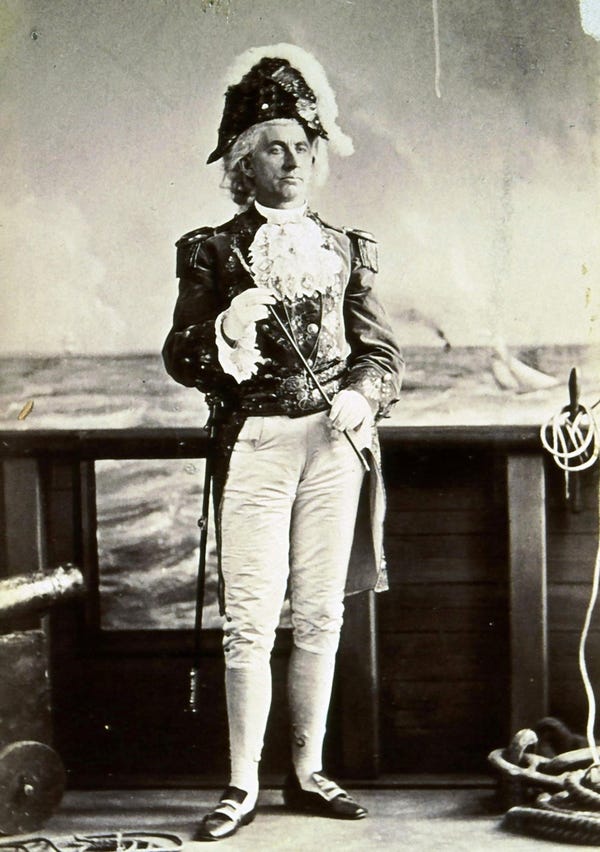
It is difficult for the modern movie-goer to imagine the enormous appeal of the Victorian light comic operettas in which Barnabee excelled. Seen today as stiff, melodramatic, long-winded, and prudish, little evidence of the genre survives. We can best picture Barnabee as Sir Joseph Porter in Gilbert and Sullivan’s HMS Pinafore, still loved for its rich costumes, spectacular scenery, witty lyrics and hummable tunes. The genre, a forerunner of the familiar musical comedy, died away, Barnabee wrote, for lack of good actors and good scripts.
He saw himself, in the end, as the last of the true comedians. He was no stand-up jokester, but among a dying breed of professional actors who could enthrall an audience with a powerfully trained voice, a clever costume, a staged posture, or a grab-bag of facial expressions. He had no need for vulgar language or clownish pranks, he wrote.
After the death of his beloved wife in 1909, Barnabee returned to the Portsmouth Music Hall for a crowning farewell performance. His vigor, critics said, was undiminished. A month before his death at age 84, one witness wrote, he could still belt out a rousing rendition of ‘I Am the Sheriff of Nottingham.” Despite his apparent ease and “virility” in performance, Barnabee confessed, he was plagued by a lifetime of almost paralyzing stage fright.
“It is all I can do, at times, to go on stage,” he told a States and Union reporter in 1909. “I approach it with absolute fear, and sometimes, I fear … I shall never leave it alive.”
Henry Clay Barnabee lies in South Cemetery – gone, but not entirely forgotten. Mementos of his lengthy career, meanwhile, rest safely in the Special Collections vault at the Portsmouth Public Library, where research on his life and work continues. Most of the images in the many photo albums have been scanned and, eventually, the entire contents should be accessible online. A comic comeback, however unlikely, still hovers in the wings.
Sources: “My Wanderings” by Henry Clay Barnabee, (1913); “Henry Clay Barnabee: Change and Stasis in America” dissertation by Paul Mroczka (1993); extensive vertical files at Portsmouth Public Library including research by Richard Winslow.
Copyright 2017 by J. Dennis Robinson, all rights reserved.
 Barnabee Between the Acts Tobacco Card