


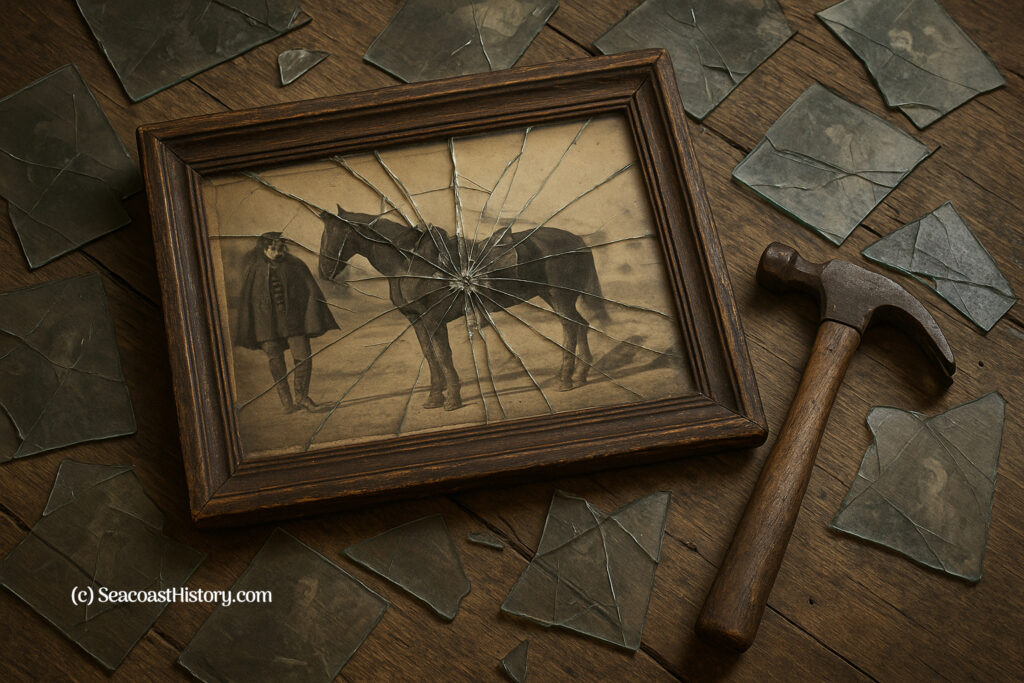
Hundreds of souls lost in minutes
It ranks among the saddest days in Portsmouth’s history. In moments, hundreds of souls were lost, smashed to glittering bits, in an attic on the corner of Bow and Penhallow streets soon after the Civil War. For photographer Lafayette V. Newell, it was the darkest of all his days.
Newell discovered his shattered glass plate negatives some time after 1866. His prized collection of historic portraits filled two heavy wooden trunks. Both had been opened, the locks snapped, the irreplaceable contents broken and scattered.
Newell had transported the fragile collection from his photographic studio at Point Lookout, Maryland. There, through much of the Civil War, he ran a business making portraits of the Union soldiers guarding the 25,000 Confederate prisoners interned there. Newell also photographed the prisoners of war, particularly officers and those who could afford a picture to send to worried families back home in the South.
It was a collection that modern scholars might die for. Fort Lookout remains a key location to the descendents of soldiers imprisoned there. Hundreds died and their memory still rouses Southern anger over “Lincoln’s war”. To these families, especially, the vandalism in Newell’s New Hampshire attic weighs heavily.
We can safely assume that the fastidious owner’s glass negatives were neatly organized and labeled, the chemical emulsion protected from the sun. Photographer Thom Hindle of Dover, whose collection today includes over 100,000-glass plate negatives knows how difficult they are to preserve and use. These negatives, Hindle says, became so common and were so outmoded by the turn of the 20th century, that photographers were selling the glass as scrap. Victorian plates have been used as window panes in greenhouses.
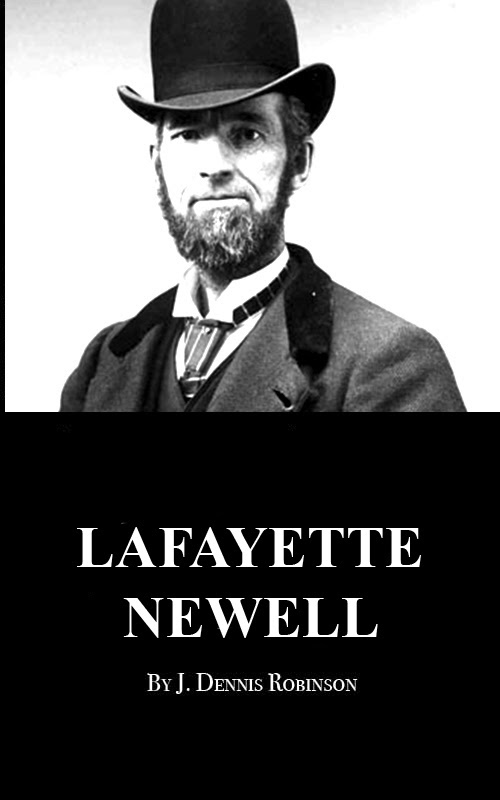
Hindle notes that the chemistry of Newell’s early “wet plate” process was especially delicate too. Negatives were large, 7 by 9 inches, designed to be printed on heavy paper “carte de visites” (CDV) and sold in quantity. The back of one of Newell’s Portsmouth cards specifically notes that he preserved his negatives for reprinting. Other Civil War photographers used an earlier method of printing one-shot ambrotypes on paper or tintypes and ferrotypes on metal, methods that did not allow duplication.
By the Civil War, photography was truly evolving into a high-tech business, and a lucrative one for Newell, it appears. Unlike famous battlefield photographer Matthew Brady, Newell worked at a safe distance from the war. He was invited to set up shop thanks to his twin brother Albert, a member of the 12th New Hampshire Volunteers, one of three regiments assigned prison duty at Point Lookout.
Lafayette Newell, a farm boy who had trained as a photographer in Concord, NH in the mid-1850s, brought his equipment and supplies, and enough lumber to construct a studio. Just seven days after his arrival, Newell completed a 25 by 12 foot shop and had a “captive” audience to photograph for the next three years.
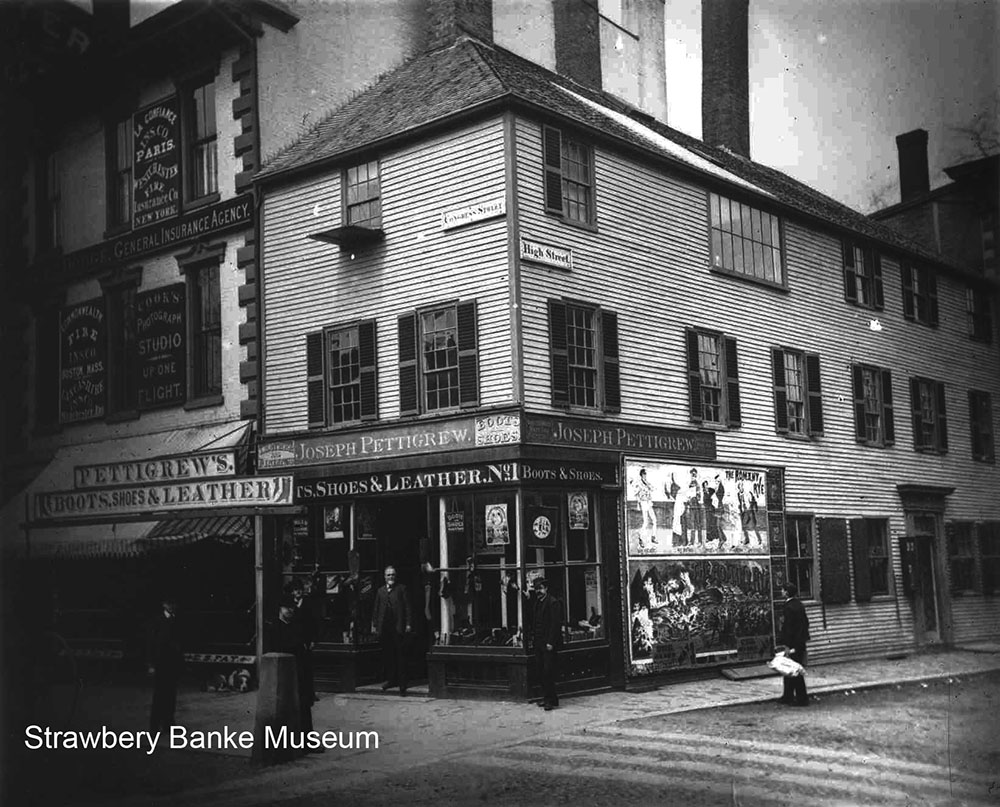
(Strawbery Banke Museum Collection)
But all that work was destroyed. Newell’s family suspected it was the work of local boys who found their way into the top floor of the family grocery store. Born in Barnstead , NH, one of 13 children, LV Newell married Annie Rider in 1857. Her father owned the grocery store downstairs on Bow Street where Newell often worked. The couple apparently met in 1857 when Newell came to Portsmouth from Concord, where he had trained in the photographic arts and kept a shop for a few months before moving to the Seacoast. Mostly, at this time, he made his living as a handwriting teacher. His script was so finely detailed, according to one report, that it looked like a copper engraving.
At age 35, despite the loss of his historic collection — or maybe because of the tragedy – Newell started over. For the next three decades, with a distinctively artistic eye for lighting and design, he captured scenes of Portsmouth and the surrounding area. His son John Newell inherited that collection. It passed to Portsmouth bordello keeper and antiques collector “Cappy” Stewart. Garland Patch, a welder at the Portsmouth Naval Shipyard, added Newell’s Portsmouth negatives to his collection and eventually sold them to Strawbery Banke Museum, where they are preserved today. Some of the most provocative views of the city in its Victorian era come from Newell’s later work.
Although Newell’s Civil War negatives are gone, some of that work survives, scattered through attics, in family scrapbooks, at flea markets, in museums and private collections. A recent image, sent to this newspaper by Civil War collector Nancy Pelletier of Maine offers a rare glimpse of the artist’s early work. The printed CDV shows a Union soldier in military dress with a dark saddled horse, especially unique because the horse is not blurred by movement. The back of the card identifies the photographer as LV Newell.
The identity of the soldier and the location of the buildings in the background is unknown. Could they be Point Lookout, or was this image posed after the war, perhaps in New Hampshire? Newell’s negatives, had they survived, may have solved the mystery. Instead, the picture of the unknown soldier and his horse is a haunting reminder of how much we might have known if not for the shattering mischief of boys.
SOURCES: “Historic Portsmouth” by James Garvin and Susan Grigg (1995) and the obituary of Lafayette V. Newell, Portsmouth Herald, April 8, 1914..
ABOUT THE PHOTO: The photo of the man with the horse is by LV Newell. It was likely not from the Confederate POW Camp, but similar. Nancy Pelletier allowed me to use the image in 2004 with the article. In 2025, working with ChatGPT, the robot and I placed the image in an artificial frame. I asked AI to make it look like the picture had ben hit with a hammer and place it on a wooden floor with the hammer and scattered glass negative –all created by the computer.
Copyright 2004 by J. Dennis Robinson, updated 2025, all rights reserved.
 The Miracle of Three Christmas Fires