


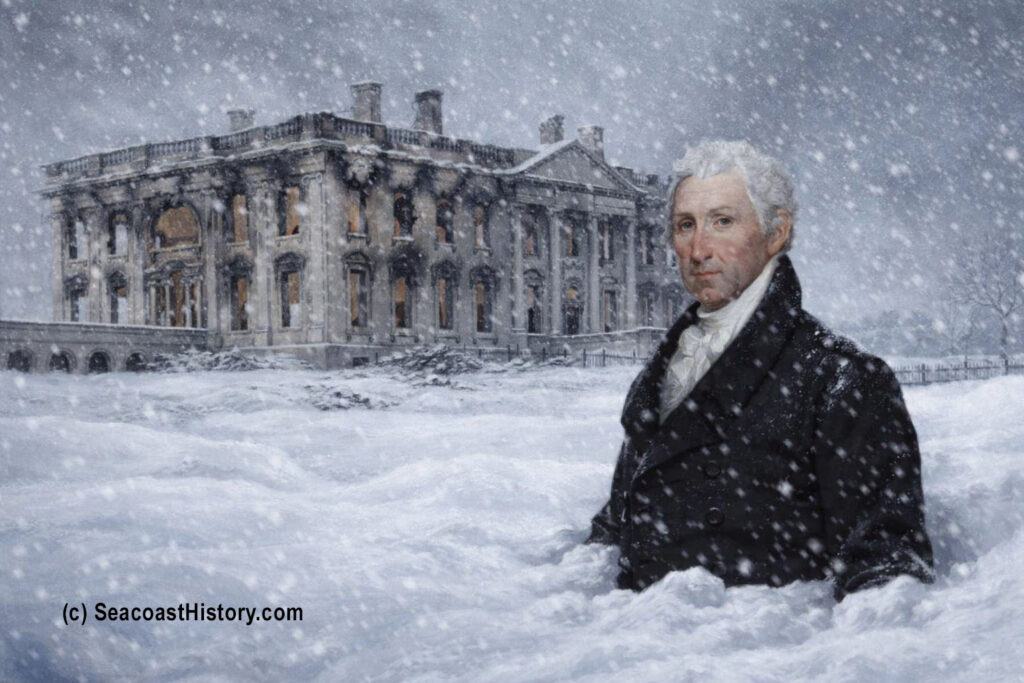
It was an election year. The lengthy War of 1812 with England was finally over. Historians call it “the war nobody won.” Yet, Americans were upbeat in 1816. President James Madison was on his way out after two terms, and the “Era of Good Feelings” had begun. Turbulent political parties were beginning to find common ground and make friends.
“Nothing like I ever saw.”
January and February gave no hint of what was to come. Winter temperatures hovered close to normal, although the air was noticeably dry. Adino Brackett of Lancaster, NH, noted in his journal that the weather was especially mild with little precipitation.
Early spring remained unseasonably dry and “backward,” as the earth refused to warm. Mud froze in the streets of Buffalo, NY, in the first days of May 1816. Late frosts, not uncommon here in New England, continued through the middle of the month and spread as far as Virginia and Pennsylvania. Even Thomas Jefferson noted the cold weather in his diary. Spring crops failed and had to be replanted.
By early June, temperatures were moving toward normal, but planting seasons had already been delayed. Snow fell in Quebec on June 5, but in New England, thermometers hovered into the 70s. Chester, NH, registered a high of 88 degrees that day.
While June 5 had been “warm and sultry,” according to a Vermont newspaper, the following day felt like November. By 10 am, snow and hail were falling. It continued until that evening, accompanied by a biting wind. “Probably no one living in the country ever witnessed such weather, especially of so long continuance,” the local newspaper noted.
Over the next few days, temperatures hovered at the freezing level, as small bodies of water iced over. Trees blackened. From six inches to a foot of snow was reported across New England. Sheets froze on the clothesline. Fruit trees and gardens suffered. Newborn sheep died in the cold as birds fell from the sky.
Within a week, however, temperatures had rocketed into the 90s. Crops were again re-planted and the crisis appeared at an end.
“The Poverty Year”
Caleb Emery of Lyman, NH, recalled investigating a neighbor’s well on the Fourth of July. “We found it completely frozen over,” he wrote, “and no appearance of water, except perhaps a quart in a small hole, which had been cut in the ice.” He also recalled that a farmer, who had been cutting logs, found them frozen into the ground.
By mid-July, temperatures regularly dipped into the 40s, with frost reported in Franconia, NH and northern Maine and elsewhere. New Englanders in 1816 were deeply dependent on agricultural production, and fears of famine set in. A burst of warmth and rain offset those fears — but only temporarily.
In mid-August, frost struck again. Severe thunderstorms and a 30-degree drop in temperature followed in New Hampshire. Corn, potato, and bean crops failed. A second cold wave at the final days of August forced farmers to cut down valuable corn crops for fodder. There was not a single cheery day in all of August, one diarist complained. All was gloom.
September and the coming fall were shockingly normal. The “Summer that Never Came” was over, but its impact had just begun. The New Hampshire Patriot, for example, noted: “Indian corn on which a large proportion of the poor depend is cut off. It is believed that through New England scarcely a tenth part of the usual crop of sound corn will be gathered.”
The poor suffered the greatest effects. Moldy grains did not fatten livestock or produce bread. Rev. William Fogg of Kittery opined, “No prospect of crops. Crops cut short and a heavy load of taxes.” The impact of devastated farms carried its economic impact well into 1817, which was also a cold, but less dramatic year.
It’s a small world after all
Cold weather and drought were a worldwide phenomenon, especially in England and Western Europe. in 1816. New England scientists blamed sunspots, and just about everything else, for the killing frost, snow, and ice. Some wondered what they had done to displease God, if Judgment Day was at hand, or whether the Almighty was there at all. Today, many scientists blame volcanoes.
The eruption of Mount Tambora on April 15, 1815, was the largest volcanic eruption of the 19th century. The disaster reportedly killed 10,000 citizens on an island in Indonesia. The explosion could be heard 1,800 miles away and was followed by two days of total darkness. It caused tsunamis and blew an estimated 180 cubic kilometers of rock, gas, and dust 25 miles into the sky. Dust trapped in the atmosphere from Tambora, many experts believe, combined with particles from eruptions elsewhere in 1812 and 1814, had a worldwide impact on climate.
Modern historians suggest that the “Year With No Summer” had a powerful impact on a new nation barely 40 years old. New England’s risky dependence on agriculture may have fostered a move toward manufacturing. Curiosity over the cause of the disaster opened the door for interest in the sciences. Thousands of families gave up on the changeable New England climate and began a westward migration.
Rice crops and water buffalo died in China. Rivers overflowed in Germany. Grain prices soared on the European market. In England, the frigid weather is said to have inspired Mary Shelley to write her novel Frankenstein, in which the monster is eventually driven to live in the Arctic.
Recent history books offer a detailed analysis of the devastating weather two centuries ago. Scientists interested in “greenhouse-gas-induced climatic change” continue to study the events of 1816.
New England’s strangest summer also lives on in pop music. For an eerie, discordant version, Google the innovative cello rock group Rasputina and listen to their song “1816, The Year Without a Summer.” Vermont folk singer Pete Sutherland’s ballad also tells the story of rising grain prices and famine in 1816. The chorus goes like this:
“When the summer winds blew
with an icy breath
in 1800-and-froze-to-death.”
SEE THESE BOOKS FOR MORE: The Year Without Summer: 1816 and the Volcano That Darkened the World and Changed History. by William K and Nicholas P. Klingaman (2013); and Eighteen Hundred and Froze to Death: The Impact of America’s First Climate Crisis by John V H Dippel (2015).
© Copyright 2016 by J. Dennis Robinson. All rights reserved.
 Lounging at the Farragut Hotel
Leave a Reply