


We only know the city we see. And no one living remembers seeing Jefferson Hall, or Old Franklin Hall, Queen’s Chapel, the Temple, the Cameneum or hundreds of other downtown Portsmouth buildings that disappeared before our time.
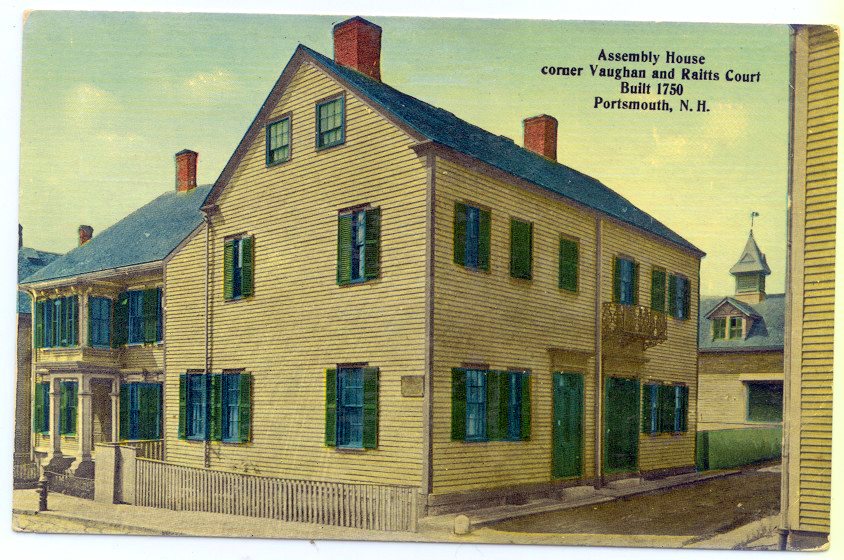
Other important city structures, like the Assembly House, lingered far enough into the 20th century to be glimpsed by a few among us before they met the wrecking ball. Opened in 1771 the stately white building had three great parlors, and a kitchen on the first floor. An immense stairway opened onto a huge second floor hall measuring 30 by 60 feet with tall windows and three chandeliers lit with wax candles. All but forgotten today, the Assembly House with its gilded wood carvings, became the entertainment center for the city’s upper crust, and eventually the next best thing to a public playhouse.
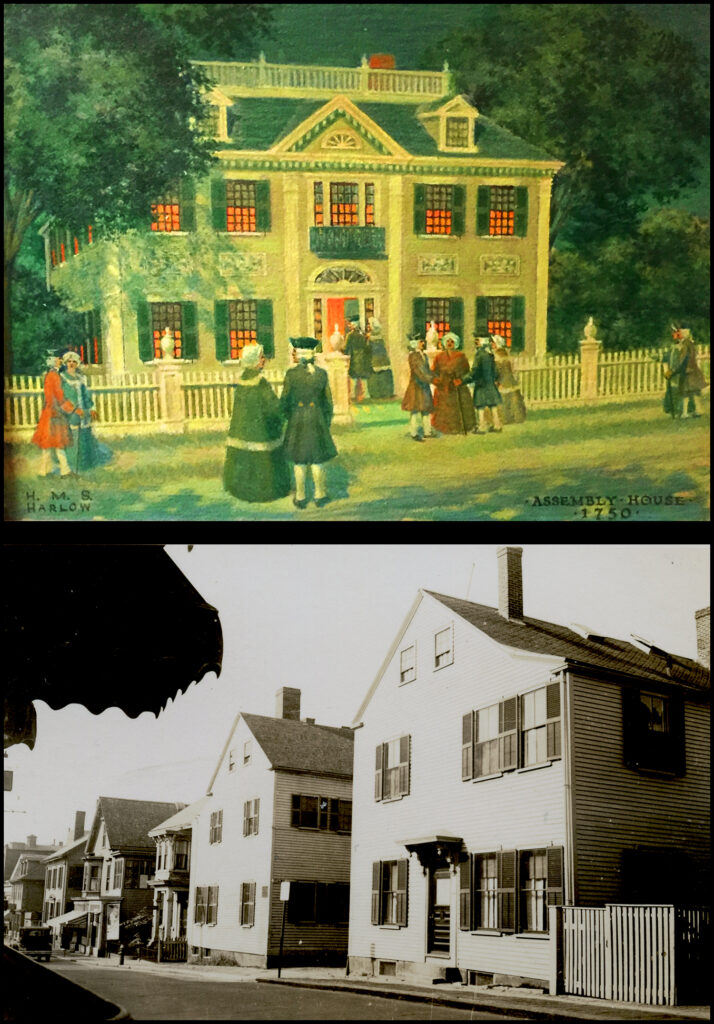
Built by Michael Whidden III the Assembly House was rented for dances, concerts, exhibits, lectures and religious services. After attending a fancy ball here in 1789 President George Washington described it as “one of the best I have seen anywhere in the United States.” The painting by Harry Harlow (above) is only one man’s guess at what the place looked like.
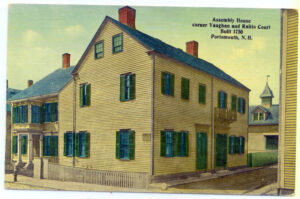
I still can’t get my head around the idea that in the early 1800s, the center of the Assembly House was cut away, creating two tenement buildings. The narrow alley up the middle was called Raitts Court. Those buildings were razed in the early 1970s. Many readers of this column may have walked between the two halves of the hall where the city’s wealthy aristocrats once danced.
We also lost Vaughan Street, reportedly one of the most important and attractive streets in town. It was, over the centuries, a hub of entertainment. Besides the Assembly Hall, the forgotten theater known as the Cameneum once stood at the site of today’s Worth parking Lot. Old Franklin Hall, another historic gathering place, stood where the Franklin Block is today. The Arcadia Theater, now gone, was part of that complex. And the Olympia Theater, the city’s first purpose-built cinema and now converted to office space was across Vaughan Street.
Today the city is rapidly filling in the empty spaces it created during the urban renewal destruction of the mid-20th century. But the good news is, we are restoring and preserving more of the city’s old buildings than ever before. The days of razing hundreds of “outmoded” or “blighted” structures in the name of progress are long over.
Copyright J. Dennis Robinson
 Creek Farm Faces Wrecking Ball in 2019
Leave a Reply