


SEACOAST POETRY (Scroll down to see manuscript and lyrics)
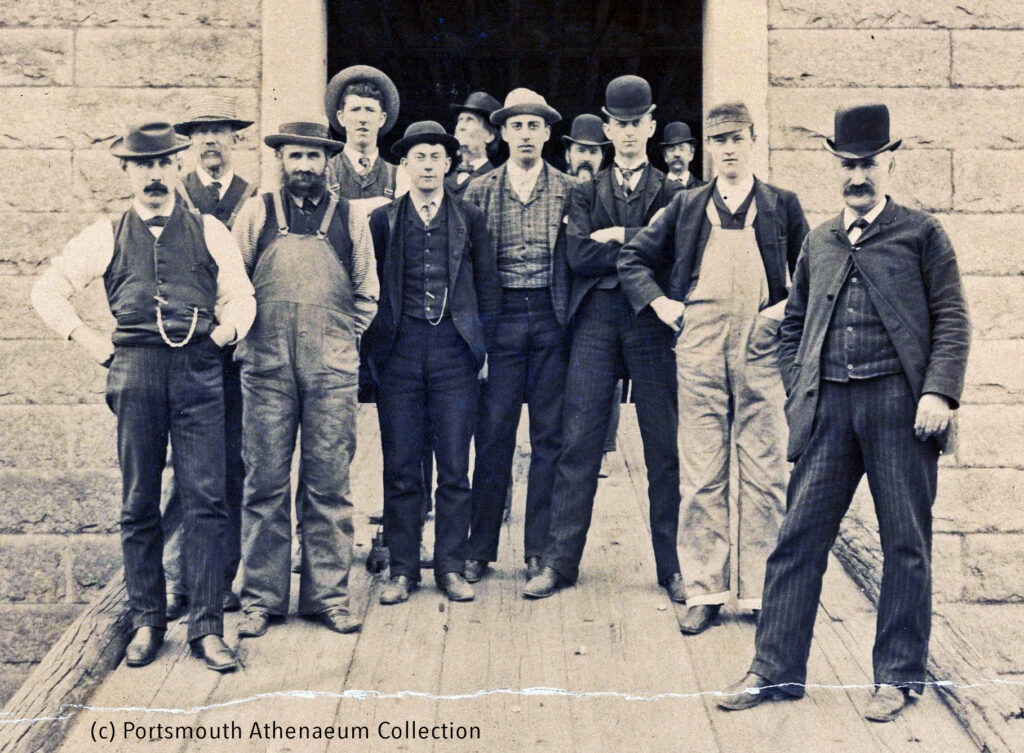
We know a lot about Portsmouth tycoon Frank Jones, but little about the men who worked for him. This rare manuscript takes us into the West End brewery to meet men like Yankee Denny “with his beautiful big nose” and Paddy Haloran.
The song also references Frank Jones’ campaign for governor of New Hampshire. Jones had served as Portsmouth mayor and a New Hampshire congressman, but was unsuccessful in his bid for the governor’s mansion. This song seems designed to stir up workers at the brewery to support their boss at the polls during his 1880 campaign.
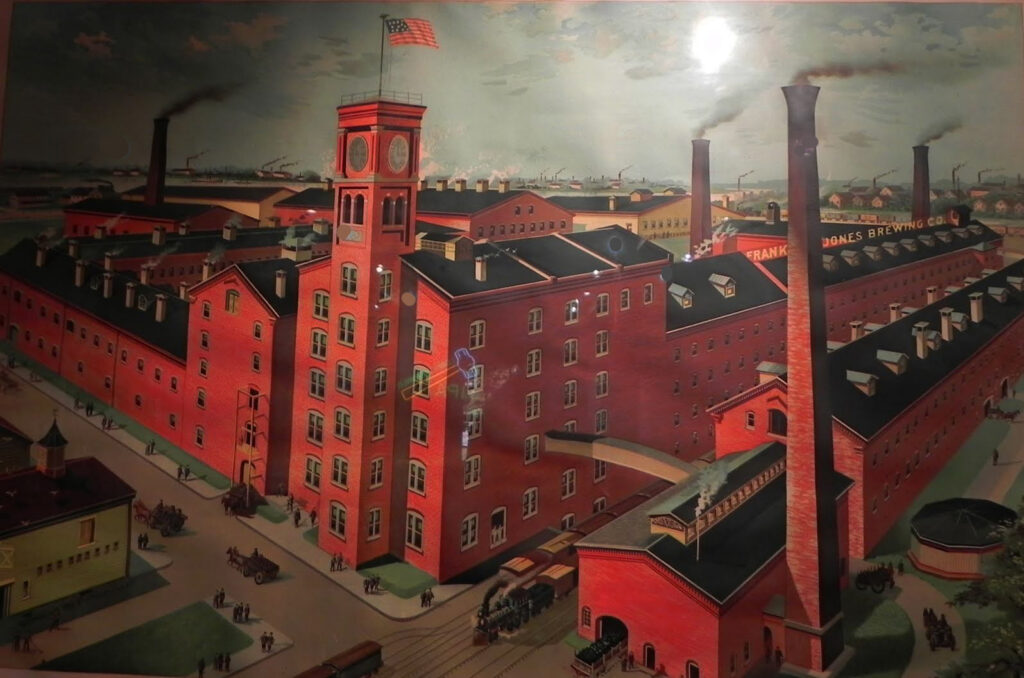
Born on a nearby Barrington farm in 1832, Frank Jones’ rags-to-riches story is still popular local history. Fueled by cheap immigrant labor, Jones grew his local brewery into a large brick complex, some of which survives today. At its peak, his brewery employed 500 workers and produced 250,000 barrels of ale per year.
Despite his wealth and power, Jones was often depicted as a champion of the working man, as this political ballad suggests. By 1880, he was an extraordinarily wealthy man, a billionaire by modern standards. Jones was, according to one historian, “the titular head of the Democratic Party in New Hampshire.” He and other local politicians briefly shifted the political control of the state from its capital at Concord back to the Seacoast.
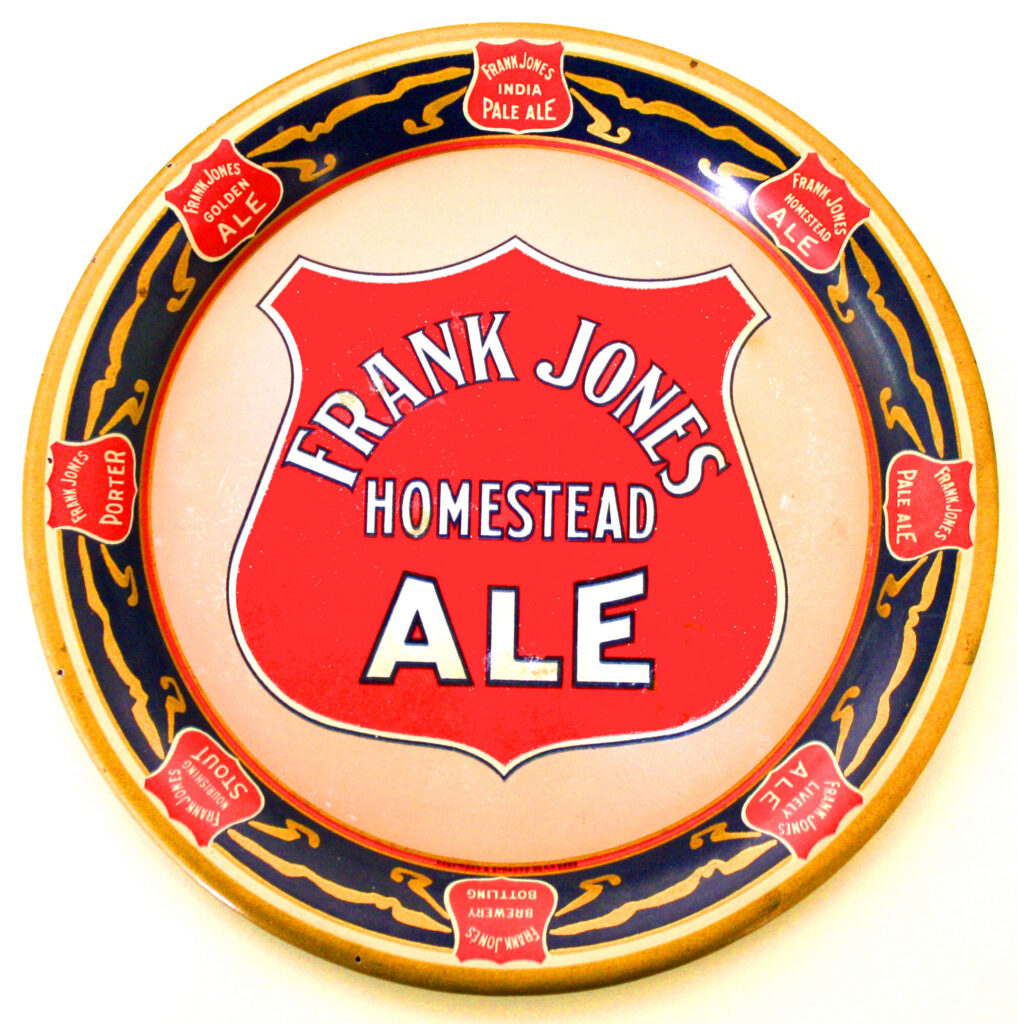
Nominated to run for governor in 1880, Jones was introduced as “a household word in New Hampshire.” His name was printed on the label of countless bottles of Frank Jones Ale. Although he was the owner of a mansion and massive estate in Portsmouth, which included horse racing stables, Jones ran for governor as a friend to the common working man.
Jones, who would later swap political parties, was strongly opposed by Concord Republican William Eaton Chandler, who owned the Concord newspaper. (Chandler was married to Lucy Hale of Dover, best known for her brief engagement to assassin John Wilkes Booth.) Chandler and the wealthy Republican party attacked alemaker Jones as the source of rampant drunkenness during the rise of the temperance movement. Both sides were known to purchase votes, and there were no moral giants amid the muckraking campaign. In the end, with the powerful influence of Chandler, Jones lost to Republican Charles Bell. The vote tally was 44,432 to 40,813.
In his biography of Frank Jones, Ray Brighton mentioned a pro-Jones political group called the “Jones Cadets of Christian Shore.” This was the nickname for the old Protestant neighborhood to the north of the city. Locals say that a number of Irish families moved “up the Crick” to Christian Shore when Italian immigrants began arriving in Portsmouth’s North End, dubbed “Little Italy.” The local newspaper, according to Brighton, noticed that Irish Catholic supporters of Jones had joined this Christian Shore group, which had previously been exclusively Protestant. The following brewery song, signed by “P. Ryan,” may have been the anthem of this political group.
How the Song Was Discovered
The editor received this rare original piece of ephemera from reader Mike O’Keefe (1947-2017) of Washington, DC. Born in Portsmouth, NH, Mike graduated from the local high school in 1965 and taught history at nearby York High in Maine. At the time of the discovery, he worked at the refugee bureau of the Department of State in Washington, DC, where he lived with his wife Ann. His job took him to Botswana, Costa Rica, and other locations where Mike was responsible for programs impacting two million refugees in the Sudan.
Mike’s mother, Mary of Portsmouth, discovered the fragile manuscript in 1999 among the family papers. His grandfather worked at the Frank Jones Brewery toward the end of the 19th century, as did many Irish immigrants. The O’Keefe family arrived in the Seacoast in the 1850s.
His great-granduncle, Cornelius O’Keefe, owned a saloon on Market Square and represented a Portsmouth ward in the New Hampshire General Court during the 1890s. In a twist of fate, Mike, too, represented Portsmouth Ward 4 in the General Court from 1972-80. Cornelius followed the typical Irish job immigrant progression, Mike says. First, he was a “sole sorter” at Gale Shoe Factory, then a barrel maker at the Jones Brewery, and finally worked at the Portsmouth Navy Yard. He was the only survivor of an accident at the Yard in the 1920s when a construction building he and several other men were on fell into a dry dock.
. “I was so delighted to find your website,” Mike wrote. “I have never seen a web site like it. You have done a great job. Whenever I feel homesick, I turn to your site and remember Portsmouth.
Sources: (1) Richard Winslow, “Frank Jones of NH: A Capitalist and Politician during the Gilded Age,” UNH History Dept Master’s Thesis, 1965; (2) Ray Brighton, Frank Jones: King of the Alemakers, Peter E. Randall Publisher, 1976.
© 1999 by J. Dennis Robinson. All rights reserved. Reprinted in 2008, revised 2026.
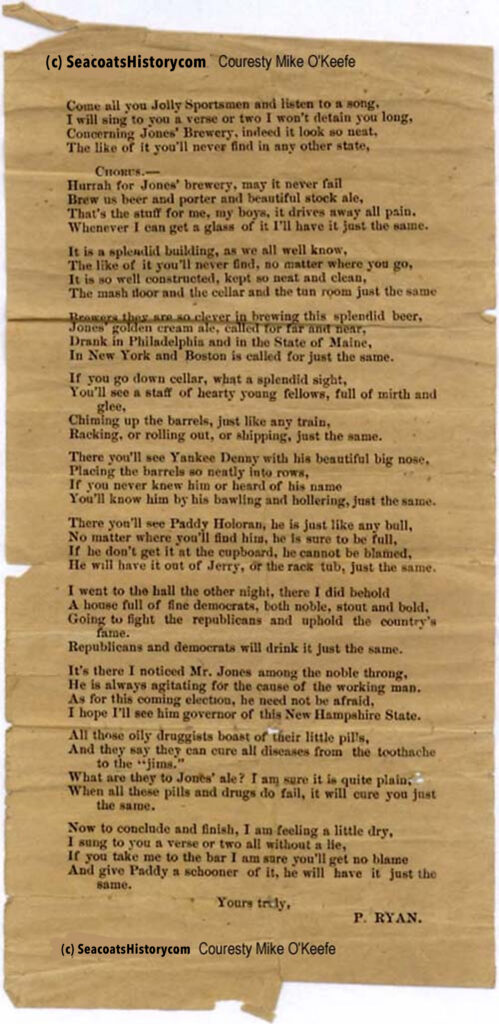
Frank Jones Brewery Song
Circa 1880
Editor’s Note: Discovered in 1999, this delicate one-page manuscript was transcribed by Mike O’Keefe exclusively for my website. We’ve never seen a similar one. The tune is unknown, but sing it to the melody of the popular “MacNamara’s Band,” and you will capture the feeling. Copyright Mike O’Keefe Family. –JDR
Come all you Jolly Sportsmen and listen to a song,
I will sing to you a verse or two; I won’t detain you long,
Concerning Jones’ Brewery, indeed it looks so neat,
The like of it you’ll never find in any other state,
‘Chorus’
Hurrah for Jones’ brewery, may it never fail.
Brew us beer and porter and beautiful stock ale,
That’s the stuff for me, my boys, it drives away all pain,
Whenever I can get a glass of it, I’ll have it just the same.
It is a splendid building, as we all well know,
The like of it you’ll never find, no matter where you go,
It is so well constructed, kept so neat and clean,
The mash floor and the cellar and the tun room just the same.
Brewers they are so clever in brewing this splendid beer,
Jones golden cream ale is called for far and near;
Drank in Philadelphia and in the State of Maine,
In New York and Boston is called for just the same.
If you go [to the] cellar, what a splendid sight,
You’ll see a staff of hearty young fellows, full of mirth and glee,
Chiming up the barrels, just like any train,
Racking, or rolling out, or shipping, just the same.
There you’ll see Yankee Denny with his beautiful big nose,
Placing the barrels so neatly into rows,
If you never knew him or heard of his name,
You’ll know him by his bawling and hollering, just the same.
There you’ll see Paddy Holoran, he is just like any bull,
No matter where you’ll find him, he is sure to be full;
If he don’t get it at the cupboard, he cannot be blamed,
He will have it out of Jerry, or the rack tub, just the same.
I went to the hall the other night, there I did behold,
A house full of fine democrats, both noble, stout and bold,
Going to fight the republicans and uphold the country’s fame.
Republicans and democrats will drink it just the same.
It’s there I noticed Mr. Jones among the noble throng,
He is always agitating for the cause of the working man.
As for this coming election, he need not be afraid,
I hope I’ll see him governor of this New Hampshire State.
All these oily druggists boast of their little pills,
And they say they can cure all diseases from the toothache to the “jims.”
What are they to Jones’ ale? I am sure it is quite plain,
When all these pills and drugs do fail, it will cure you just the same.
Now to conclude and finish, I am feeling a little dry,
I sung to you a verse or two all without a lie,
If you take me to the bar I am sure you’ll get no blame,
And give Paddy a schooner of it, he will have it just the same.
Yours truly,
P. RYAN
 Frank Jones is Dying, But Slowly