



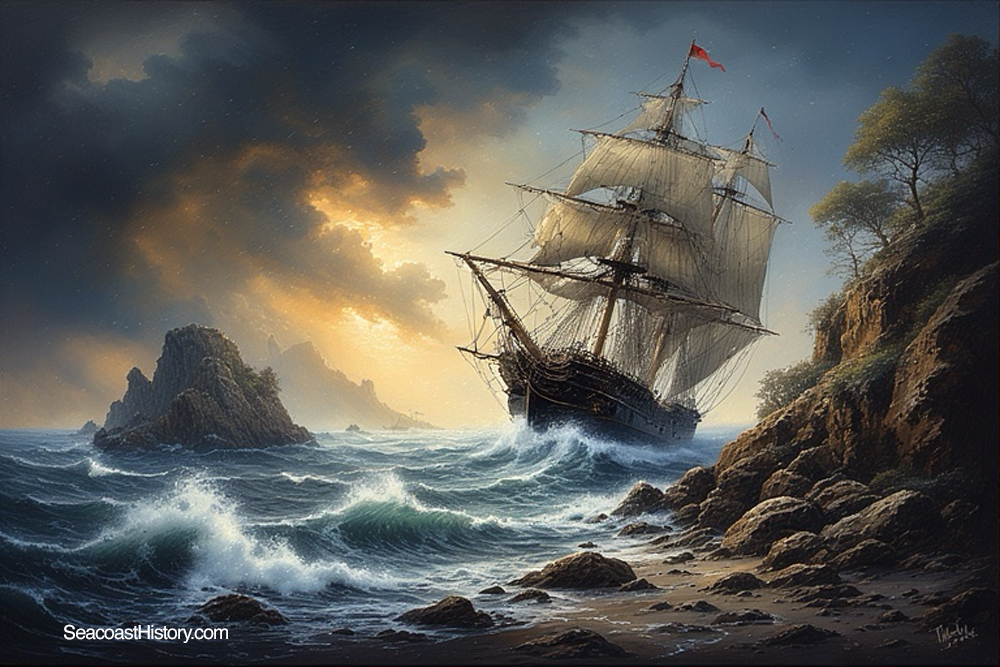
Is anyone buried in the thin Smuttynose soil, or is it just a tale told by poets? According to the late Shoals’ historian , Bob Tuttle, the Gosport Town Records note a ship was wrecked on the night of January 14, 1813, during a snowstorm. The body of one sailor was found the next morning, six more bodies on January 17, and five more on October 21. Six days later, a body was grappled up from the Hog Island (Appledore Island) passage, and another in the Malaga Gut on August 8, a total of 14. They were reported to be buried on Smuttynose. But where are they?
It’s time to peel the onion on the legend of the shipwrecked Spanish sailors at the Isles of Shoals. Two 19th-century poems tell the story. But what about the facts? Were 14 corpses buried on Smuttynose Island in 1813? Here are the few pieces of the puzzle we have.
Poet Celia Laighton Thaxter lived briefly on Smuttynose as a child. Her father Thomas Laighton bought the little rocky island from Captain Sam Haley who likely passed on the story of the Spanish shipwreck. The Laightons sunnmered briefly, probably in the Haley House, known as the Mid-Ocean House of Entertainment, now gone. The bearly Haley Cottage and a mid-20th-century one-room cabin are the only surviving buildings on the island today.
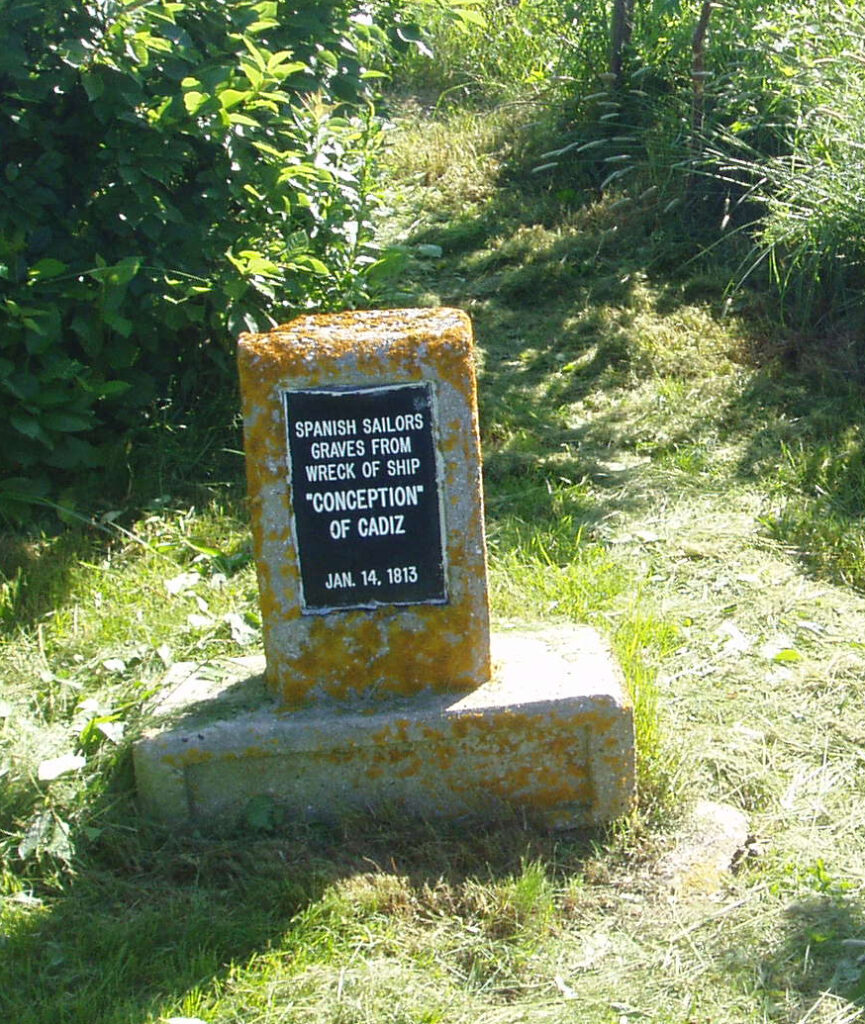
Most people confuse the Haley Cottage with the Hontvet House, the site of the grisly March 1873 ax murderer. But that house burned over a century ago. This is the story of the “other” great island mystery. Just behind the Haley House and up a small grassy rise is the Haley family cemetery. A few dozen yards further down the path is a sign marking the burial of the shipwrecked Spanish sailors.
At least that’s what Celia tells us in her poem “The Spaniard’s Graves” (1865). Celia addicts know this one by heart. In it, the poet stands weeping at the abandoned mass grave and whispers comfort to the dead sailors. Focusing the accumulated sadness into herself, the poet broadcasts the location of the dead sailors through space and time like a geo-positioning satellite. Celia channels the emotions of all the distant widows, mothers and sisters who never saw their loved ones again and never learned their fate. Here they are, the poet cries into the wind. She writes:
Spanish women, over the far seas,
Could I but show you where your dead repose!
Could I send tidings on this northern breeze
That strong and steady blows!
It’s a good poem, very good. Celia once told a friend in a letter that she thought of the poem “among the pots and kettles” while doing housework. Maybe, maybe not. Perhaps she also read a recently rediscovered work about the Spanish sailors by Portsmouth poet James Kennard Jr.. His “Wreck of the Seguntum” first appeared in 1847. Poet Kennard gives a stirring eye-witness-style account of the sudden winter snowstorm, the cleaving green sea and the tragic wreck. The captain cries, the ship tacks, the foaming breakers roar.
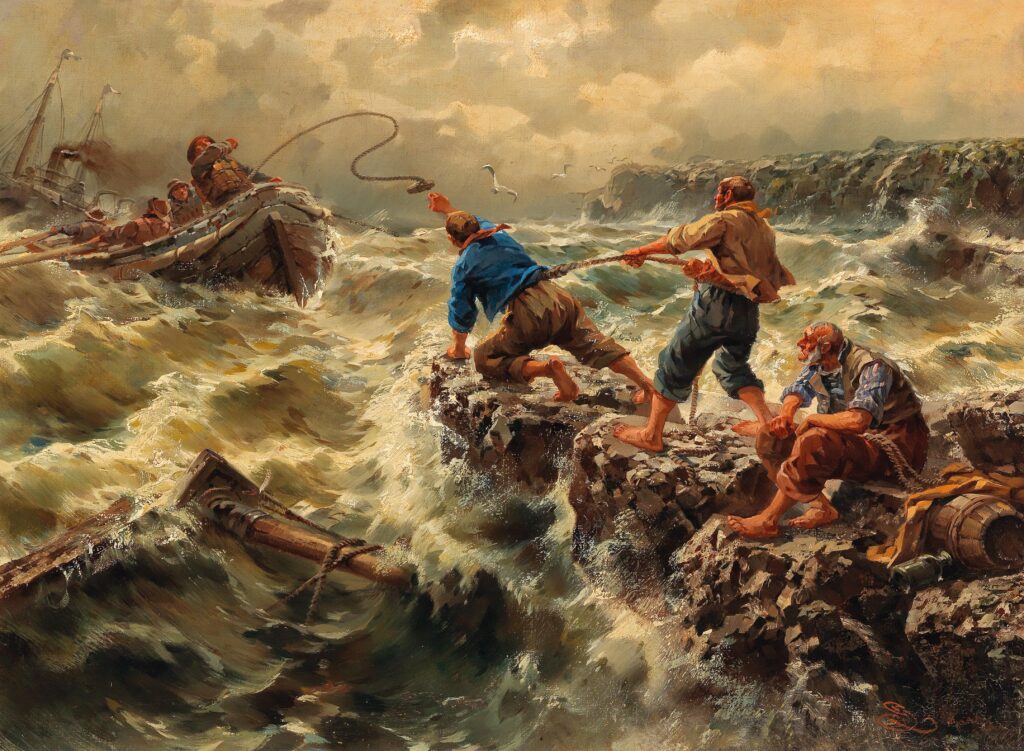
It seems more than coincidental that the final stanza of Kennard’s action-packed tragedy dovetails neatly with the opening lines of Celia’s emotional response. Kennard ends his dramatic shipwreck poem noting that the Spanish sailors remain lost in a foreign land with no one to mourn them. It’s the kind of connection PhD candidates in English Literature thrive on. Two decades before Celia’s work, Kennard wrote:
No mourners stood around their graves,
No friends above them wept ;
A hasty prayer was uttered there, —
Unknown, unknelled, they slept.
It was important to Celia that her readers know the facts of the wreck. She devotes six pages to the background story in “Among the Isles of Shoals,” the little history book that she reluctantly wrote for all the demanding 19th-century tourists. It was a runaway bestseller, drawing visitors to her family’s grand hotel on the Shoals by the ferry-full. It’s still in print today and the tourists are still coming.
The Spanish ship Sagunto, she explains, crashed at Smuttynose in a storm on January 14, 1813. All hands on board died. Fourteen were found over the next few days, some having crawled toward the candlelight in the window of Sam Haley’s cottage. Haley kept a candle burning for 50 years before White Island lighthouse was built nearby.
It’s a powerfully gruesome image, a band of hoary figures like HMS Titanic victims, frozen solid, one just inches from the Haley home, his arm raised stiffly toward the cottage door.
Okay, that’s probably not how it happened, if it happened at all, but poets take license with facts to hold their reader’s attention. Celia recounts the official Gosport town records of the “ship Sagunto Stranded on Smotinose Isle,” but disputes the dates and body count. Sam Haley, she insists, buried the bodies, but his tombstone nearby in the Haley Cemetery proves he died two years earlier in 1811 at age 80. The record accounts for 12 Spanish bodies. Celia says 14. Old records can be as faulty as ‘ye olde” spelling.
So we’re forced to consult the usual cluster of Isles experts for clues. In his 1873 island history, John Scribner Jenness (1875) appears mute on the Spaniards’ graves. Celia’s granddaughter, Rosamond Thaxter says there were 15 sailors and simply reprints the poem in her Celia biography, “Sandpiper” (1962). Celia’s brother Oscar Laighton also reprints the poem in his biography “Ninety Years on the Isles of Shoals” (1929). He sticks to his sister’s version, but counts 16 Spaniards, three of whom survived a short while in the night, he says.
(Author photo)
But beloved historian Lyman Ruttledge waxes eloquent in “The Isles of Shoals in Legend and Lore” (1965). Celia is confused, he writes, because there were two Sam Haleys. It was the son, Captain Haley, who discovered the bodies.
Then Ruttledge lobs a curveball. Cap’t Haley, he says, told a Massachusetts court that the ship was not the Sagunto, but the “Concepcion from Cadiz”. A Spanish ship named Sagunto did arrive safely in Newport from Cadiz two days earlier, Ruttledge argues. Haley recounted finding bodies strewn around the island and in the water, 14 in all.
In his “Visual History” (1989) of the Shoals, the late John Bardwell reverted to the Sagunto story. Two men struggled toward the cottage and got as close as the stone wall, he says. They were found like a dozen others, coated in fresh snow. Another was found in the bushes six months later. Ferryboat Captain Robert Whittaker told the story hundreds, maybe thousands of times to passengers on the ship Thomas Laighton. Like lost poet James Kennard, Whittaker’s version in “Land of Lost Content” (1994) reads like a Howard Cosell blow-by-blow account. The snow dances, the surf roars, the mast cracks as each man embraces his Mistress Death. But this is again drama, not fact.
There’s more. Kicking around in the archives on Star Island, the late Shoals’ historian Bob Tuttle found an annotated copy of the Jenness history. Now this gets complicated, so hold tight. The book was annotated by a doctor named Joseph Warren. Warren had copied a paper written by a Shoaler named E.L. Ham. Ham had been given the copy by Celia’s brother Oscar, who said it came from the Haley family bible. Still with us?
Assuming it is authentic, the paper tells of various shipwrecks on the Shoals. On the list we find — “the Spanish ship from Cades (Cadiz) Bound to New York was Castaway on this island of Smuttinose.” The dates match the Sagunto report, and the Haley report goes on to say that no one survived and there was not much worth salvaging. The next passage reads:
“my sons & what other men I Hired picked up 14 of the Dead men & buried them in my Buring [sic] field; but I Did not get my pay from any man.”
So maybe, Tuttle concludes, the shipwreck really happened. But think about it. The topsoil on rocky Smuttynose is about a foot deep. It was January. The graves were marked by a line of rocks, we’re told.
Enter Henry Ingersoll Bowditch, another doctor who spent 10 days on the Shoals in 1858 and later purchased a cottage. Not far from the Haley family cemetery at Smuttynose, he saw what could have been the identifying stones. Bowditch was speculating when he noted in his journal that “they were buried close together, evidently in one trench, with their feet to the East & their heads to the Setting Sun.”
Bowditch saw 28 stones lined up, stones he identified as the 14 headstones and 14 footstones. Twelve, he wrote, were clustered practically on top of each other, while two sets are paired a couple of feet away. Were these the officers of the ship, he wonders, segregated in death as in life from the “rude seaman”?
Bowditch guessed. Archeologist Faith Harrington tested. In 1991, while an assistant professor at a Maine University, her crew dug discreet, systematic test pits across the burial area where the soil is about a foot deep. They found no graves, no evidence of any human remains, no trenches, just rocks and more rocks. There was no proof that the ground at the appointed spot had ever been disrupted.
“All the archeology is inconclusive,” Harrington says today. Although historian Ruttledge suggested it would be sacrilegious to excavate the remains, he had not imagined ground-penetrating radar. The scientific search found no proof of the burials. Harrington chooses her words respectfully.
“We did not find evidence for the graves in the research that we did,” she says. Pushed, the existence of 14 Spanish sailors buried in a foot of soil on Smuttynose Island “seems unlikely,” Harrington admits. But there may be more clues in a study of maritime history; an equally scientific survey of ships from that era may turn up something.
Maybe, maybe not. In the early 21st century, Nate Hamilton and his archaeology team repeated the radar tests and came to the smae conclusion. So for now we’re left with a sinking ship of facts, a conflicting sea of words, some piles of rocks, and a storm of misplaced emotions. Although the written record suggests that Captain Haley found nothing valuable to salvage, just seven years later, in 1820, Haley built a costly stone breakwater connecting Smuttynose with nearby Malaga Island. Legend says he paid for the work with bars of silver. Silver bars salvaged from a shipwreck. But there is no proof there were any silve bars at all. Haley died in 1839 at age 76 when Celia was just five years old.
The mystery remains. Spanish sailors struggling to reach the light in a distant window? Silver bars? Buried bodies? All we have, so far, is an entry in a log, a missing ship, two heartfelt poems, and a rich cache of speculation.
Copyright © 2006 by J. Dennis Robinson. All rights reserved.
 Harriet Ryan Albee Dedicated Her Life to Terminally Ill Women