


It’s been a depressing week and I’m not talking about the weather or politics. It’s my job. I’m pleased to join the panel for this Sunday’s New Hampshire Black Heritage Trail “tea talk” at the Portsmouth Public Library. These are amazing and refreshing gatherings of kind and curious people. But my topic is the popularity of blackface minstrels who performed for decades on the Portsmouth stage. Hard to believe, but sadly true.
Meanwhile, I’ve been living deep in the 17th century again. I love how little we know about the people who populated this region only a few centuries ago. My research meant rereading professor Emerson “Tad” Baker’s book, “The Devil of Great Island,” about the alleged “stone-throwing devil” who pelted George Walton’s tavern on Great Island (New Castle) with rocks during the summer of 1682. It wasn’t Satan, of course, but Walton’s neighbors and probably his own grandchildren who staged the attack.
George Walton, you see, was elderly, wealthy, and influential, at least by 17th century standards. But worse, Walton was a Quaker in an age when the Puritans of Massachusetts largely governed New Hampshire. Puritans hated Quakers. We need to remember that while tens of thousands of Puritans had migrated to America for religious freedom, they were not interested in religious freedom for anyone but themselves.
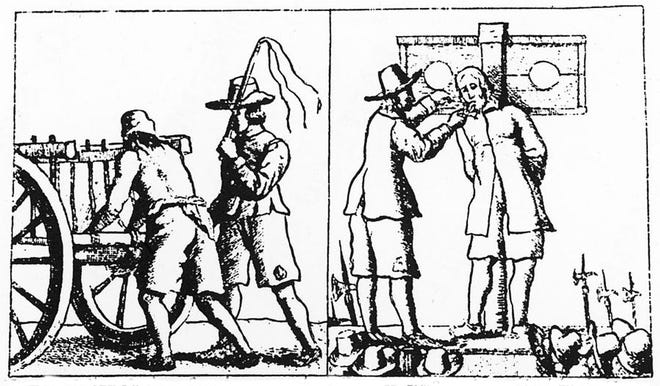
Quakers arriving in “The Lord’s Kingdom” (New England) in the mid-1600s could have an ear cut off just for showing up. A second ear would be cut off if they returned. A third offense meant having a hole drilled through the tongue with a hot iron. In Massachusetts, Quakers were persecuted, fined, tortured, driven out and even hanged.
Puritans saw themselves as the definers and protectors of “God’s law.” Quakers believed each individual had the right and ability to access the spirit of God. Following one’s “inner light” was, therefore, more important than a strict teaching of biblical scripture. Quakers had no need for ordained clergy of any kind in order to “talk to Jesus” directly. In the Society of Friends, everyone, including women, were equivalent to any minister or preacher. For Puritans in New England, this was not only blasphemous but a threat to their highly structured way of life.
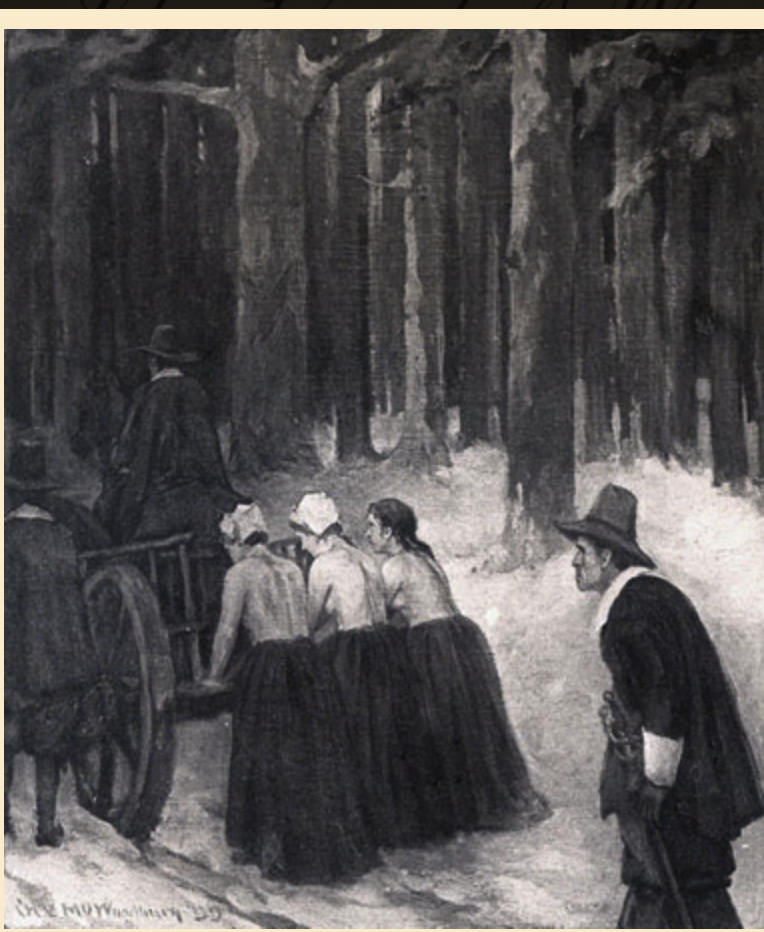
Beyond the “supernatural” stoning of George Walton, the most famous local example of Quaker persecution comes from Dover. In 1662, three Quaker women from England preached briefly before they were arrested. Ann Coleman, Mary Tompkins and Alice Ambrose were stripped to the waist and tied to the back of a cart. They were sentenced to walk 80 miles in harsh winter weather and be whipped publicly in every town they passed until they were driven out of the region.
Whipped severely in Dover, Hampton, and Salisbury, Massachusetts, the three women were then rescued and taken to the home of a Quaker family in Kittery, Maine. They eventually returned to Dover where they established a Quaker worship that survives to this day. Their story is best remembered in John Greenleaf Whittier’s poem, “How the Women Went from Dover.” Curiously, it was Walter Barefoot (his real name) of New Castle–and briefly governor of New Hampshire – who opposed the persecution of Quakers and put a stop to the torture of the three women.
Copyright by J. Dennis Robinson, all rights resered.
 Rye’s Underwater Petrified Forest