


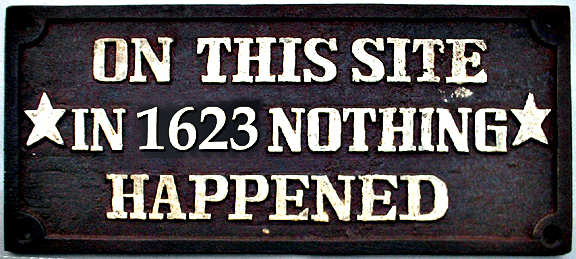
The past is never over for the harried historian. Important dates replay for us like poor Bill Murray in the movie “Groundhog Day.” For me, as I struggle to reconstruct the founding of New Hampshire, every year is 1623.
I first wrote about the David Thompson (aka Thomson) for NH Profiles in the mid-1970s when I stumbled across his name in the journals of the Mayflower “founders.” Some 45 years later, the details of New Hampshire’s first “settlement” are still just out of reach. We’re pretty sure Thompson, his wife Amais, his son John and a tiny group of fishermen and servants set up housekeeping at what is now Odiorne State Park in Rye. And we’re pretty sure they were gone a few years later.
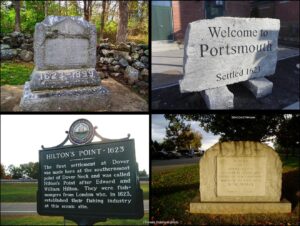
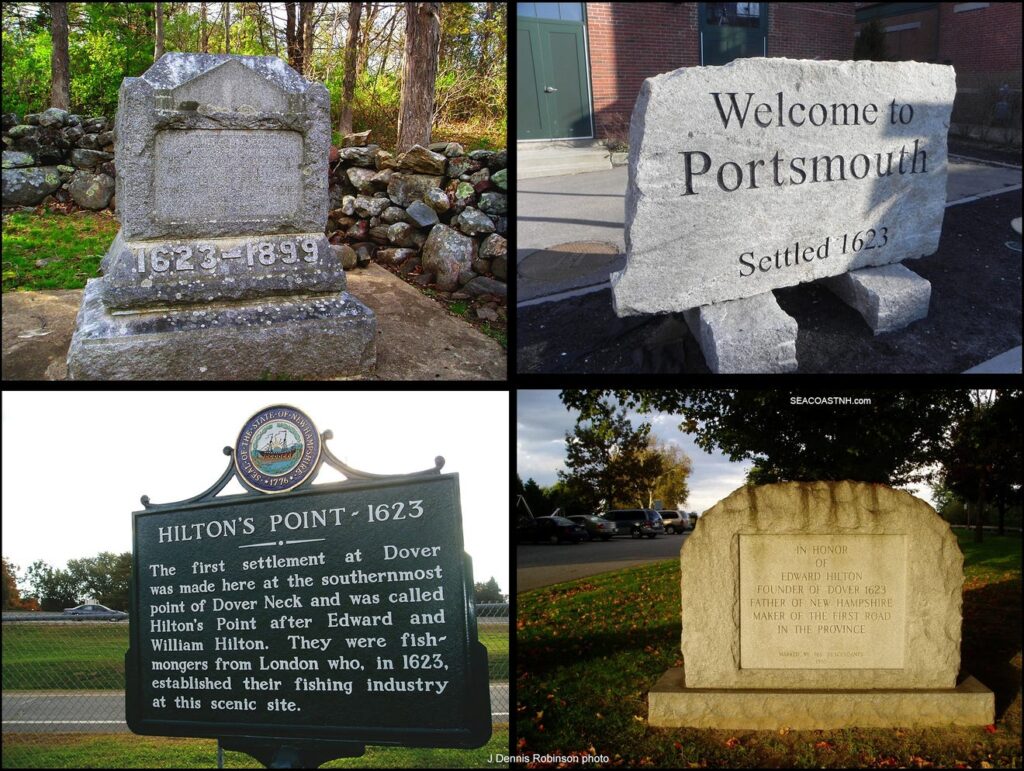
So was Portsmouth “settled” in 1623 if everyone moved away? That’s what it says on a big rock at the bottom of Market Street in Portsmouth. But there was no Portsmouth until the 1659s, and down is 10 miles away from the Thompson site that was abandoned around 1627.
And that’s what it says on a tombstone-shaped monument on the Rye coast that was dedicated there at Little Harbor in 1899. That one looks like a tombstone and has been moved from the water’s edge to the Odiorne Cemetery (as seen here) and then back.
The next wave of English colonists arrived at what is now Prescott Park seven years later to find the Rye site abandoned. Then that 1630 Strawberry Bank group went off to search for gold and trade with Native Americans – with little success. So where’s that monument?
And what are we to make of the official state historic marker and the hulking monument at Hilton Point in Dover? They claim, I believe incorrectly, to be the 1623 landing site of Edward and William Hilton. Most historians agree that it is the right spot, but the wrong date. William Hilton was already living among the Separatists at Plymouth Colony in 1623. Edward Hilton may have been among the early Thompson fishermen at Little Harbor. But he does not appear to be in the Dover area until 1628. Of the half dozen Englishmen who documented their visit to LIttle Harbor with Thompson (including Miles Standish and the two key Pilgrim fathers Bradford and Wilson) not one of them mentioned Edward Hilton or visited his mythical settlement in 1623.
Dover can claim to be the site of New Hampshire’s “first permanent settlement: in 1628. They just have to chisel and repaint that “3” into an “8” on the markers at Hilton’s Point. And Portsmouth should add “sort of settled” in 1623 to our monument. Confusing to visitors and locals alike.
Copyright J. Dennis Robinson, all rights reserved.
 Three Women Hanged in Portsmouth