


The pandemic was a tough year for students and teachers alike. Tough times in school has long been a theme for Portsmouth area writers. High on the list, of course, is “bad boy” Tom Bailey, the fictional alter ego of Thomas Bailey Aldrich (1836-1907). Tom’s antics and schoolboy pranks, including nearly blowing himself up with gunpowder, were so popular that his house was turned into a literary shrine in 1908. You can still visit it today as part of Strawbery Banke Museum.
Exeter had Plupy Shute, based on the rambunctious childhood of Judge Henry Shute (1856-1943). The judge was 40 years old before he began submitting his boyhood tales to the Exeter Newsletter. The misadventures of Plupy and his friends Newt, Beany, Pewt, Nibby, Bug, Fuzzy, Skinny, Whack and Boog, appeared in no less than 20 books and in magazines like the Saturday Evening Post.
Kittery’s copycat character, the “Kittery Kid” was the brainstorm of author Fred N. Pray (1885-1973). Much of the opening action in Pray’s book took place at the old Austin School. In one episode, young Fred cut most of the way through the rope that hung from the schoolbell in the belfry. When the janitor yanked the rope the next morning, it snapped, and the kids got a delayed opening. In another scene, the Kittery boys shimmied along a perilously high rooftop in order to block the school chimney with boards and bricks. The smoke-filled classroom was closed for days. They routinely smuggled bees, frogs, beetles, turtles, and other creatures into class to set the girls screaming. And yes, these were all boy stories.
It began with Benjamin Penhallow Shillaber (1814-1890) whose protagonist, Ike Partington, was the troublesome nephew of his ditzy Aunt Ruth Partington, who lived in the North End of Rivertown. Born in Portsmouth, Shillaber became one of the best-known American humorists of the 19th century. In 1848, two decades before Aldrich published “A Story of a Bad Boy,” Shillaber introduced Ike to the reading public.
Real boys, the author argued, naturally do bad things. They should be allowed to experiment and work out their mischievous nature. There should be no attempt by parents and teachers to mold them into polite and well-mannered miniature adults. Shillaber’s theory of the Human Boy states: “The boy has but little plan, purpose, or intention in what he does, beyond having a good time.”
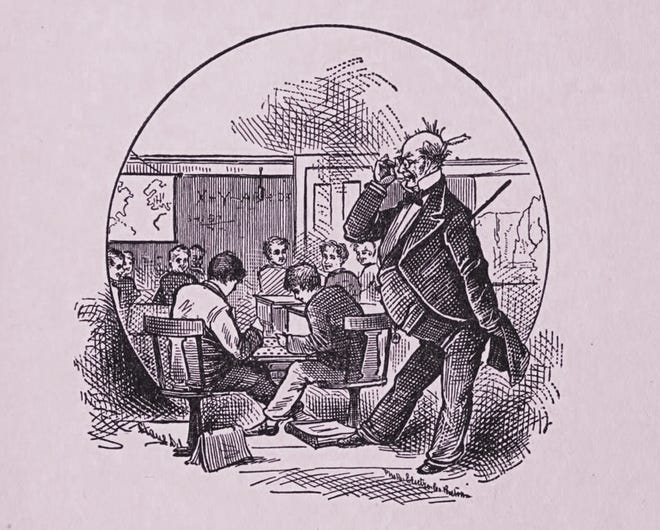
Today’s illustration comes from one of Shillaber’s later works simply titled “Ike Partington,” first published in 1878. In the scene depicted, Ike and his classmates are breaking in a new teacher. Their classroom may have been on the top floor of the Portsmouth Academy on Middle Street, now the Portsmouth Historical Society.
Ike is described as “an active, bright-eyed, curly-headed, roguish little fellow” with a bad reputation. His liveliness, Shillaber explains, should not be mistaken for wickedness. In his first week at school, Ike manages to cut a hole in his wooden desk, spill his ink, and distinguish himself as the worst scholar of the bunch.
The teacher, a severe man, tries whipping Ike into shape, literally. When the teacher falls asleep, Ike ties the school bell to the teacher’s chair. When the schoolmaster discovers the boys secretly playing checkers instead of studying, he sneaks up behind them. The boys are so frightened that the teacher all but bursts with laughter. Ike is forced to admit that the teacher is a pretty good man after all.
Copyright J. Dennis Robinson, all rights reserved.
 Readers React to Rickover Report