




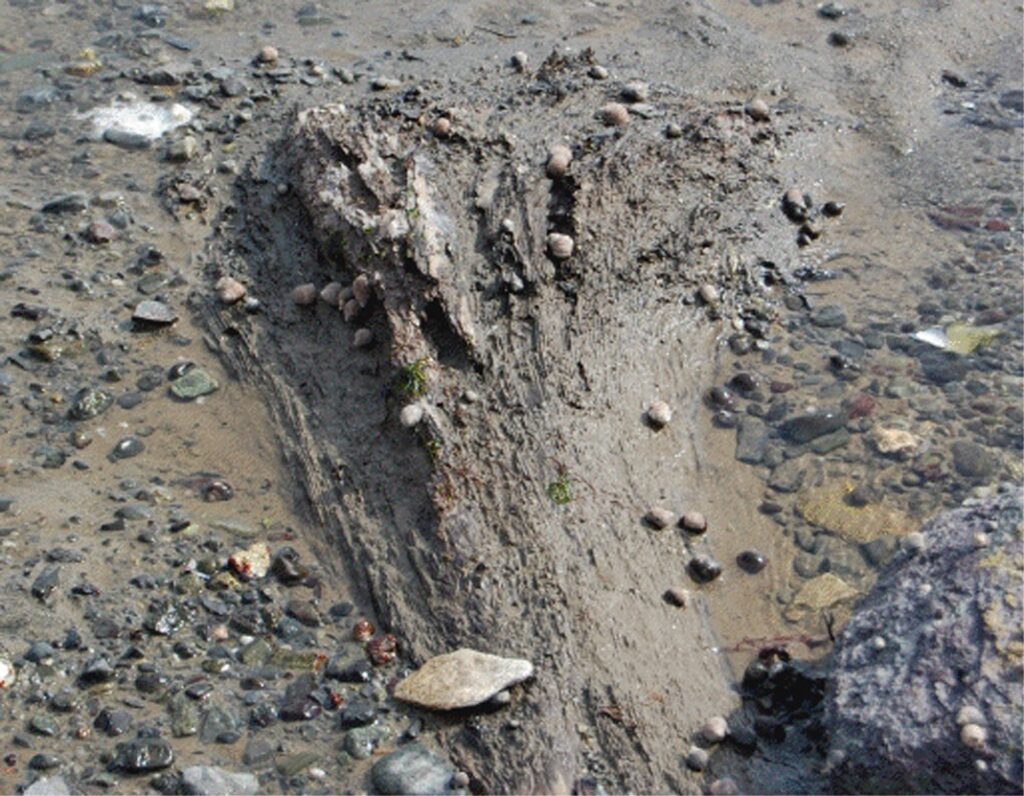
Like sands through the hourglass, so are the days of our lives. And if you don’t believe our passage here in the Seacoast is brief, think about the Drowned Forest in Rye, NH. The petrified stumps, logs and tree limbs make an appearance every few years, when tides, storms, and wind are perfectly aligned.
The drowned or “Sunken Forest” appears and disappears in two spots on the Rye coast. It may be glimpsed, at times, among the rocks and seaweed, along the southern edge of Odiorne State Park. Rarer still are sightings at the northeastern point of Jenness Beach.
Carbon dating indicates that an extensive forest of white pine and hemlock thrived here some 3,400 years ago. In scientific terms, the forest sunk below sea level following the Wisconsin Glacial Episode that covered Canada and New England, extending as far as the Upper Midwest to Washington state for more than 70,000 years. It receded some 11,000 to 12,000 years ago, around the time archaeologists have found local evidence of Native American occupation.
Wendy Lull, president of the Seacoast Science Center, offers a long view of the Odiorne site in her book “Footprints in Time.” Her story begins with the drifting apart of the continents some 200 million years ago. Just 20,000 years ago, at the height of the last ice age, Odiorne State Park lay beneath a mile of ice. The weight of the ice pushed the land down an estimated 1,300 feet. As the glacier began to recede, the New Hampshire shoreline was located 20 miles inland, near what is now the Lee traffic circle.
As the land rebounded and the ice withdrew, a forest sprang up extending out toward the modern Isles of Shoals. Melting glaciers brought the sea level to near its present level, and the forest disappeared. It returns every now and then to remind us that we live in a dynamic, ever-changing ecosystem.
 Portsmouth Adores Pageants and Parades