




Legend says that Richard Potter (1783-1835), America’s first native-born stage magician, could climb into one end of a solid log and exit from the other end. He once made a rooster pull a heavy load of hay up a steep hill. According to a man from Andover, New Hampshire, where Potter once owned a farm, dozens of witnesses standing in an open field saw Potter toss a ball of yarn into the air, then he and his wife, Sally, climbed up the dangling string into the sky and disappeared.
Those miraculous events never happened. They were promoted by the man from Andover, in an effort to impress the escape artist Harry Houdini, who was searching for stories about the evolution of popular magic in America. Potter was also not the illegitimate son of Benjamin Franklin and his African servant. Such are the myths that, until now, have been swirling around the hazy history of Mr. Potter, whose sleight of hand and ventriloquism skills wowed audiences in Portsmouth and across the globe in the early 1800s.
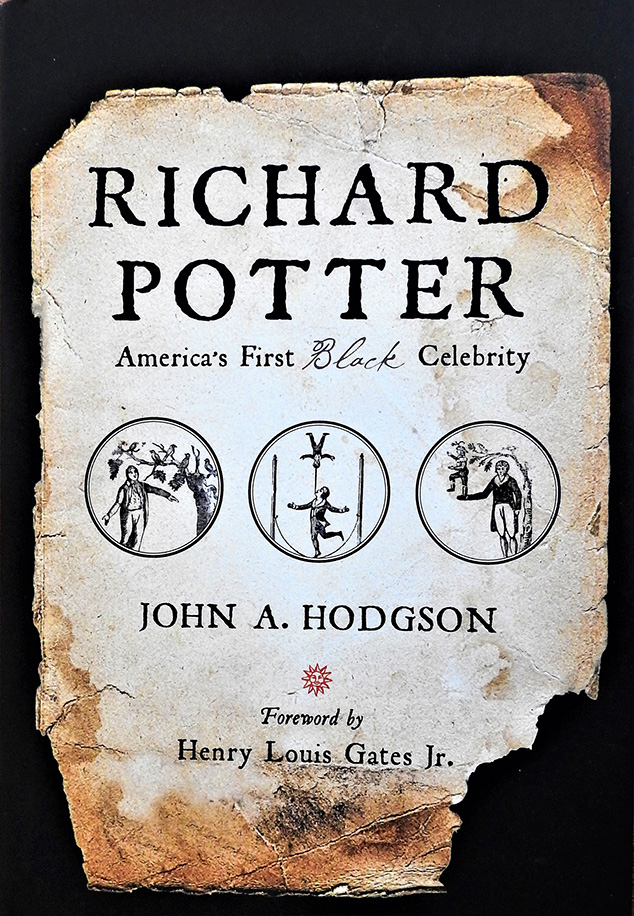
The facts are contained in an exhaustively researched book by John A. Hodgson entitled Richard Potter: America’s First Black Celebrity (2018), University of Virginia Press. Potter was born in Hopkinton, Massachusetts, to an enslaved woman from Guinea who had been sold at auction on a Boston pier. But his mother, known as “Black Dinah,” had served in the household of Sir Charles Henry Frankland (not Franklin). His father was a white man, repeatedly in trouble, who was banned from his church for “making attempts on the chastity” of at least six women.
The Portsmouth broadside
Richard Potter was not kidnapped by a sea captain at age 10 and abandoned in London, as many brief biographies contend. He did, Hodgson tells us, travel to Europe as a teenager and there apparently apprenticed as an acrobat and tightrope artist or “wire dancer.” Precisely where and when Potter connected with the famed Italian tightrope walker Signor Manfredi is unclear. Hodgson theorizes that Potter was likely assisting Manfredi in Paris in 1802, and they then returned to the United States together. After a wildly successful run of shows in New York in 1803, Manfredi toured several smaller venues, including appearances at the Assembly Room in Portsmouth, NH.
We know from local historian Charles Brewster that a young Richard Potter once worked here in town. In his Rambles About Portsmouth, Brewster noted that Potter had been a “polite waiter” at the Portsmouth Hotel on Water (now Marcy) Street, in a building that burned down a decade later. This jives with other reports of Potter as “a modest man, with gentlemanly deportment.” The theory that Manfredi reconnected with his young assistant at Portsmouth in September of 1803 is strongly suggested by a rare advertising broadside.
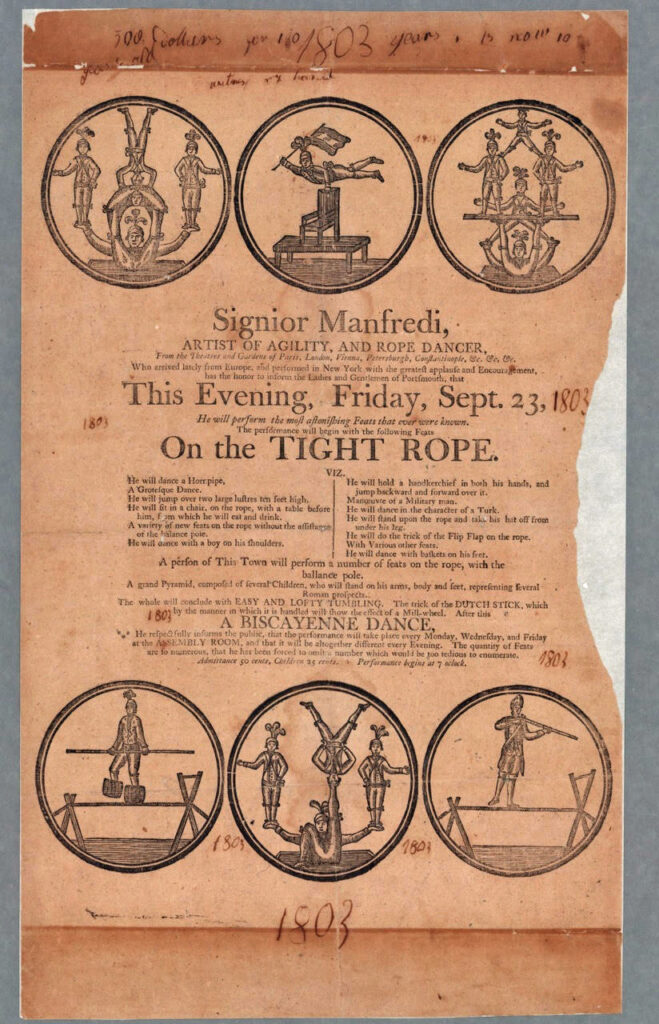
“It is one of the most remarkable documents of its type in early American publishing,” John Hodgson writes.
The Portsmouth broadside, as pictured in the new biography, not only describes Signior Manfredi’s evening performance in rich detail, but it also includes six rare woodcuts illustrating the upcoming acrobatic feats, such as walking the tightrope with baskets on his feet. The broadside also announces that: “A person of this town will perform some feats on the rope, with the balance pole.” The likelihood that anyone in Portsmouth in 1803, besides young Richard Potter, was a trained and skillful tightrope walker is hard to imagine. Hodgson’s scholarship neatly connects the dots.
After polishing their act in the rural New Hampshire seaport, Manfredi and Potter moved on to an engagement in Boston. Potter then made a dramatic career change. While developing his own act, he apprenticed to James and John Rannie, The Rannie brothers, then touring the United States were a well-known ventriloquist and magician duo from Scotland. Potter disappeared briefly from the historic record, popping up at Boston in 1807. In 1808, he married Sally Harris, a petite young singer who, despite most reports, was not a full-blooded Penobscot Indian. When Potter began promoting his own act the following year, his wife frequently took the stage with him.
Mr. Potter’s act
We can hardly imagine the hard life of an itinerant African American performer in an age before trains and electricity, before emancipation, and largely without formal theaters. Yet after James Rannie hung up his magician’s cloak in 1810, and after the War of 1812 ran its course, Potter’s celebrity exploded. A master of misdirection, Potter’s singular goal was to distract audiences from their toilsome lives. His advertising handbills offered “to give an evening’s brush to sweep away care.”
American audiences, then as now, were intrigued by visual illusions and the possibility of supernatural forces. Their hunger for “new deceptions” rivaled our desire for the next binge-worthy mystery show on Netflix. Besides the acrobatics he had mastered as a teenager in Europe and while assisting Signior Manfredi, Potter had a catalog of tricks inherited from the Rannie brothers. He could make a playing card vanish and reappear across the room, catch a bullet on the point of a sword, or break and recreate a gold ring. His balancing skills, Hodgson writes, involved long-stemmed clay pipes, plates, swords, glasses, keys, tables, and chairs, plus a variety of silverware.
The Potter act, when Sally was not busy with their three children, might include interludes of song, comic skits, or a lecture on noses. Miles of colored ribbon gushed from the magician’s mouth. Eggs dropped in his hat came out as pancakes. In a popular act called “Man Salamander,” the magician appeared to handle a red-hot iron and thrust his feet into molten lead. Witnesses claimed he could step into a blazing oven with a joint of raw meat and emerge with it fully cooked.
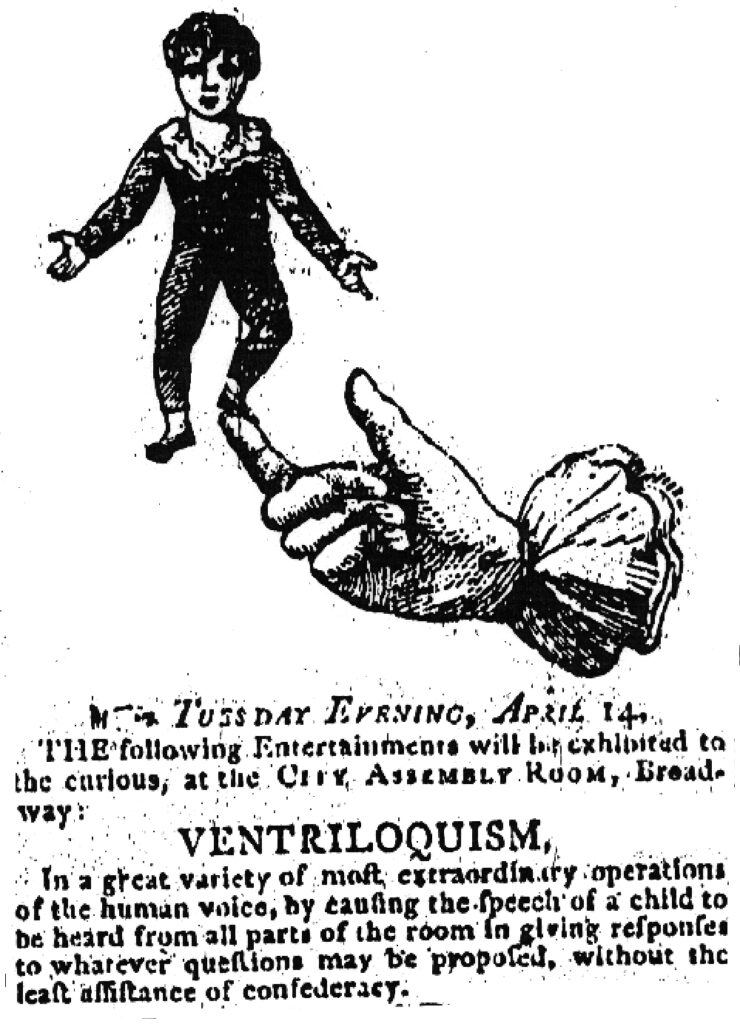
But it was Potter’s ability to throw his voice that drew the greatest praise. Instead of the wisecracking laptop dummy so familiar to modern audiences, Potter’s ventriloquism filled the hall with invisible birds, animals, and crying babies. He could make the plaintive voice of a small child speak from a man’s pocket or a woman’s hand warmer. Another child, its tiny voice muffled, might sound from behind a door, begging to be let in from the cold.
Why Potter matters
“I found my way to Richard Potter by chance,” author John Hodgson told a diverse audience at a black history symposium in Portsmouth. He stumbled onto Potter’s story and gravesite through friends in Andover, NH. Hogdson grew intrigued, eventually obsessed, by what he describes as a transformative cultural character. “He was a slave’s son who became the most famous and beloved entertainer in all of America,” Hodgson said.

Unlike one more book on the Kennedy assassination or the life of George Washington, Hodgson’s deep study of the formerly famous Richard Potter gifts the reader with a unique character who thrived, against the odds, in a little-known era of American history. We get a rare peek backstage at the dawning of the entertainment industry and the rise of American celebrity. Potter, “the Emperor of all Conjurors,” an independent black businessman, was able to earn enough to purchase and maintain a substantial New Hampshire farm.
But to do so, Potter was required to downplay his race. Among friends in Boston, he was a “colored gentleman,” and a proud black member of the African Lodge, a group with Masonic affiliations. Elsewhere he was a man of indiscriminate origins who often passed as West Indian or Creole. He was described as “halfway between fair and black” or “a light mulatto.” But for the most part, wrapped in dark robes and sometimes wearing a turban, Potter was–as his audience demanded–a man of mystery and miracles.
It was only later, as race tensions increased in the expanding nation, that Potter became a litmus test for prejudice and bigotry among whites. He was, for most, the consummate stage performer with a bottomless bag of amazing tricks. At the same time, he was becoming that “little black fellow” who was in league with the devil to trick people out of their hard-earned money. These newspaper attacks, sadly, came from Potter’s New Hampshire neighbors. In his final years, Potter toured less and turned his attentions to the family farm. But his life turned tragic as he was forced to deal with the death of his young daughter, an illegitimate grandson, legal troubles, a rebellious son, and an alcoholic wife.
Hodgson introduces us, once again, to the act America knew so well two centuries ago, replacing comfortable myths with fascinating facts. We learn that Potter was most probably not a conductor on the underground railroad, as some have claimed, because he was dead by 1835. And despite rumors, he was not buried standing up, we know, because the bodies of Richard and Sally Potter were later exhumed and moved to make way for a railroad line. Their home at “Potter’s Place” in Andover is gone, but their graves and a roadside plaque remain.
It was this small local memorial and the swirling rumors of a black magician that launched Potter’s latest biographer into years of research. “I aim to make Richard Potter reappear,” Hodgson writes in his introduction. “I want to give him, at last, a voice.”
Copyright © 2017 by J. Dennis Robinson, all rights reserved.

 Sarah Purcell’s Mourning Ring