


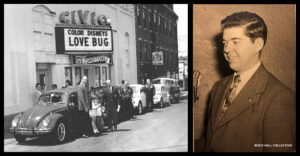

A few months ago, I put out a call for pictures of Walter Brooks who managed the Civic (now The Music Hall) for almost 40 years. The article bounced around on the Internet for a few hours before the daughters and grandchildren of Walter Brooks began responding. Crowdsourcing really works. Among the pictures they found was a shot of a handsome young Walter Brooks talking on the radio. There was also this classic picture of the “Love Bug” movie premiere at the Civic in 1968. If you’re my age, you can’t forget Herbie the Volkswagen Beetle with a mind of his own.
The downside of creating a book with over 200 illustrations is that you have to write over 200 captions. That’s after you spend two years writing the text. Then it’s time to gather the images, credit the pictures accurately, figure out where they go, size them correctly, and place them into an attractive page design. That pretty much sums up my summer.
I think of the “coffee table” books I do in layers – like a time-release cold capsule. There is the cover, of course, that has to grab your attention, followed by the back of the dust jacket and the introductory blurb inside. Most readers will flip through an illustrated history book and scan the pictures. Then they peruse the captions. Someone told me the other day that he had one of my books on his coffee table for 10 years before he actually got around to reading it. That’s okay. I can wait. The trick is to write books that are still worth reading in 10, 20, or even 100 years.
Writing good captions is harder than it sounds. While some captions fall trippingly off the tongue, others can take hours to craft. And I’m a stickler for details, “stickler” being the nice word for it. Most captions describe illustrations that are directly related to the text. If you’re reading about Stoodley’s Tavern, for example, you want to see a picture of Stoodley’s Tavern. A great caption tells you a little more about the picture than you could learn from reading the book.
As often as possible I like to include a picture that seems to have nothing to do with the story itself. These bonus or “sidebar” pictures make no sense unless you read the caption that ties the picture to the story. In the second chapter of The Music Hall book, for example, we have a picture of the goddess Athena and the philosopher Aristotle. The images help explain how the Portsmouth Athenaeum and the Portsmouth Lyceum got their names.
At this writing, I have over 100 captions locked in with more than 100 to go. It is a process not unlike being eaten by blackflies. But every picture tells a story. And when they all come together, hopefully in time for Christmas, your coffee table will never be the same.
Copyright 2019 by J. Dennis Robinson.
 Coloring Frank Jones’ Massive Estate