


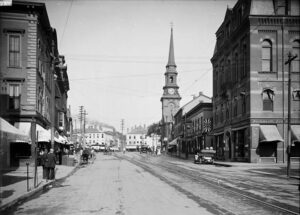
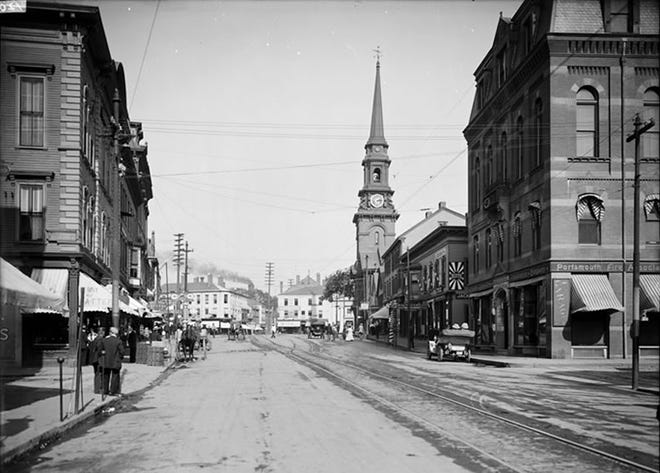
It is March 1873. The Portsmouth railroad depot, future site of the city’s next parking garage, is thick with people. Thousands of vengeful citizens are waiting for the train from Boston and the passenger onboard. They grip bricks, sticks, rocks and jagged chunks of ice. One man cradles a revolver. The mob is fired with righteous anger as they shout, “String him up! Kill him!”
That’s pretty much how I began my talk to the Portsmouth Rotary at its luncheon meeting last week. It was my sixth, maybe seventh, appearance before this irrepressibly upbeat audience. My message, this time, was about our checkered past.
The Victorian mob of at least 5,000 locals did not lynch Louis Wagner in 1873. There was bloodshed, but the police effectively held the crowd at bay with guns and bayonets, and got their prisoner safely to jail. Wagner was found guilty and hanged two years later for the infamous ax murders at the Isles of Shoals.
But public outrage is not uncommon here. Eight years earlier, at the close of the Civil War in April 1865, a horde of celebrating citizens trashed the Daniel Street office of the States and Union, a pro-slavery newspaper. Unable to find editor Joseph Foster, they reportedly dumped his printing press into the Piscataqua River.
Thomas Bailey Aldrich wrote about a bloody snowball fight that took place in the 1840s between the North End boys and the South End boys. No one knew, he admitted, what had caused the annual battle, but it was rumored to have begun in Colonial days. Its origins might have been the “great schism” and rivalry between members of the South Church and the North Church that can be traced to 1713.
In 1765, Portsmouth residents warned George Meserve not to attempt to collect the tax imposed by the hated Stamp Act. Locals hanged Meserve in effigy in Haymarket Square (across from the John Paul Jones House) and set his image ablaze. They later delivered the Stamp Act document back to a British ship on the tip of a sword at what is now the Liberty Pole in Prescott Park. “Send this back to the king,” the mob cried.
And of course we know that the city, roused by Paul Revere, stole 100 kegs of gunpowder from the king’s fort at New Castle in 1774. A few months later we drove our favorite native-born governor, John Wentworth, and his family from their home on Pleasant Street with a stern warning never to return here under penalty of death.
My point to the kindly Rotarians was this: When people in Portsmouth get greedy or ticked off – watch out!
This is, after all, a city where the wealthiest merchants and ministers often enslaved and sold Africans. Black residents were segregated after death to a distant cemetery that was later paved over with roads and carved up by housing lots.
This is the city that hanged Ruth Blay at South Cemetery in 1768 for the crime of concealing the death of her stillborn child. This is the city where, after a series of South End murders in 1912, the police commissioner refused to close a dozen bordellos there because they were good for business.
Our colorful millionaire mayor, ale king Frank Jones, sold a lot of beer with his name on the bottles. The “Donald Trump of Portsmouth,” Jones built a lot of buildings, but he was also a rascal playboy who kept his financial records well hidden, and scarcely gave a nickel to charity.
This is the city that tore down its own historic North End neighborhood in the name of economic progress and then largely let the land go fallow for decades. When new hotels appeared, we protested again.
We have been reckless and rowdy and argumentative for centuries. We have been our own worst enemy, at times, and we have a lot to atone for.
Protesting, I argued during my Rotary talk, is in our DNA. We can see it played out daily on the front pages of this very newspaper. I’m speaking, of course, of the ongoing Battle of Prescott Park, and the sharp reaction by many downtown residents, to the Attack of the Giant Buildings. We recently survived the Scandal of the Skating Rink and the Revolt of the Uber Cars, not to mention the Standoff at the Sewer Plant, and the Mutiny of the Non-Meetings of the inner City Council. Our riotous ancestors would be proud.
Curiously, it has often been the “outsiders,” I reminded my audience, who preserved much of the city’s historic character. While locals were busy creating parking lots, it was money from other cities and towns that saved the houses of Warner, Langdon, Jackson, Lear, John Paul Jones, and other heritage sites from destruction. Hats off, I say, to the visitors, the come-from-aways, the aliens, the foreigners, the snowbirds and the carpetbaggers, who made this city what it is today.
So why is Portsmouth so great? Why is downtown awash with tourists, while the blogosphere claims Portsmouth may just be the best small city in America? I’ll tell you why.
It all started with the river, the fast-flowing Piscataqua that cuts inland from the Gulf of Maine to a rich salt water estuary. The original settlers saw, not a religious hideaway, but a fertile cache of fish, fur and forests they could sell. We were a tiny, but a mighty and independent seaport, a rowdy Royalist trade center wedged between Puritan Massachusetts and Puritan Maine.
But by the early 1800s, Portsmouth’s Golden Age was over. The wealthy families died out or moved away, leaving their grand dilapidated mansions behind. The economy stagnated. The city did not grow like its sister ports. Many historic structures were lost, but a few were saved.
Tourists took interest in Portsmouth after the Civil War. The “Old Town by the Sea” was then a faded reminder (unless you were enslaved or poor or indentured) of grander days. Seaside hotels sprang up to house the summer visitors.
By the time my generation of carpetbaggers arrived in the 1960s and ’70s – the gritty old city was ready for a renaissance. But change did not come easily. Many locals resented the gentrified newcomers and the influx of tourists, despite the accompanying influx of cash they brought. There were no bloody riots, but there were skirmishes, debates, protests, and plenty of name-calling. There was also compromise and growth and more historic preservation. Strawbery Banke Museum came of age. Market Square and the waterfront got a makeover. The festivals began.
The lively history of the city, therefore, sprouted and flourished within the fertile Seacoast ecosystem. The cultural renaissance – music, literature, theater and the visual arts – blossomed within the nutrient-rich narratives and the preserved architecture of the city’s heritage. It remains a delicate balance.
We sometimes forget that librarian Dorothy Vaughan, the first president of Strawbery Banke Museum, was not born here. Other influential “tourists” of the era included developer and philanthropist Joe Sawtelle, restaurateur Jim Haller, Theatre-by-the-Sea director Jon Kimball, newspaper editor and historian Ray Brighton, Press Room owner and philanthropist Jay Smith, historian Richard Candee, and later The Music Hall director Patricia Lynch – plus so many more. I’m not from here, myself. Are you?
Since then, a generation or two of alien tourists have landed here. They fell in love with an even more beautified, preserved, gentrified and sometimes over-developed city. They have joined the fractious family of Port City protesters. Change doesn’t come easy here – nor should it.
But what a gift our founders left us. Look what our battles have gained in recent years. We hauled the USS Albacore onto dry land. Our restored Music Hall has become a Mecca for the greatest living authors. Who could have predicted the 3S Artspace, or the arrival of galleries, concert venues and festivals? We saved the leaning North Church steeple. We built, after a 30-year struggle, the thriving new library, and turned the old library building into the cultural hub called Discover Portsmouth. A multi-million dollar Memorial Bridge is complete and another dramatic bridge is underway. The “lost” African American Burying ground is now a sacred space.
No wonder everybody wants to live here. Portsmouth is “back.” But beware, we could lose it all again. Here’s what we cannot afford to do.
1. Don’t ruin the river. The natural environment that drew the first Portsmouth settlers still nourishes us. Without it, we’re lost.
2. Don’t forget our shared history. Without our checkered past, we’re toast. This is a great city for beer and coffee and restaurants. But let’s be real. That describes a lot of cities, while there is no other place like Portsmouth. Hospitality and service industry businesses, real estate agents and retailers, who thrive off the rising tourist industry must, in return, support our heritage and cultural organizations. Everyone should study Portsmouth stories, and not just silly tales of ghosts, and pirates and witches. Dig into the true tales, good and bad. So far, we have done a fine job of preserving the past – but there is a tipping point we dare not challenge. We cannot lose the ancient structures and winding streets we have left, or forget who we once were. Without our shared history, as Dorothy Vaughan warned, Portsmouth is doomed to become Anywhere, USA, and our visitors will quickly go elsewhere.
3. Don’t stop fighting. Our tumultuous way of solving community problems works. Sure, the chronic protesters can be peevish and exhausting. But they are also paying close attention, and they care. The better things get, the more we need their alternate perspective as we stumble, compromise and evolve. Portsmouth will never agree. Just as the Sons of Liberty tackled the Tories, and the Townies took on the Hippies, chaos will reign. The Newcomers of today will challenge the new Newcomers of tomorrow, and together they will wrestle the city forward.
Thank you for listening.
Copyright 2016 by J. Dennis Robinson, all rights reserved.
 USS Albacore Journal: May 15, 1985