


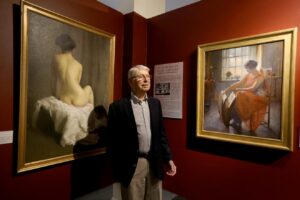
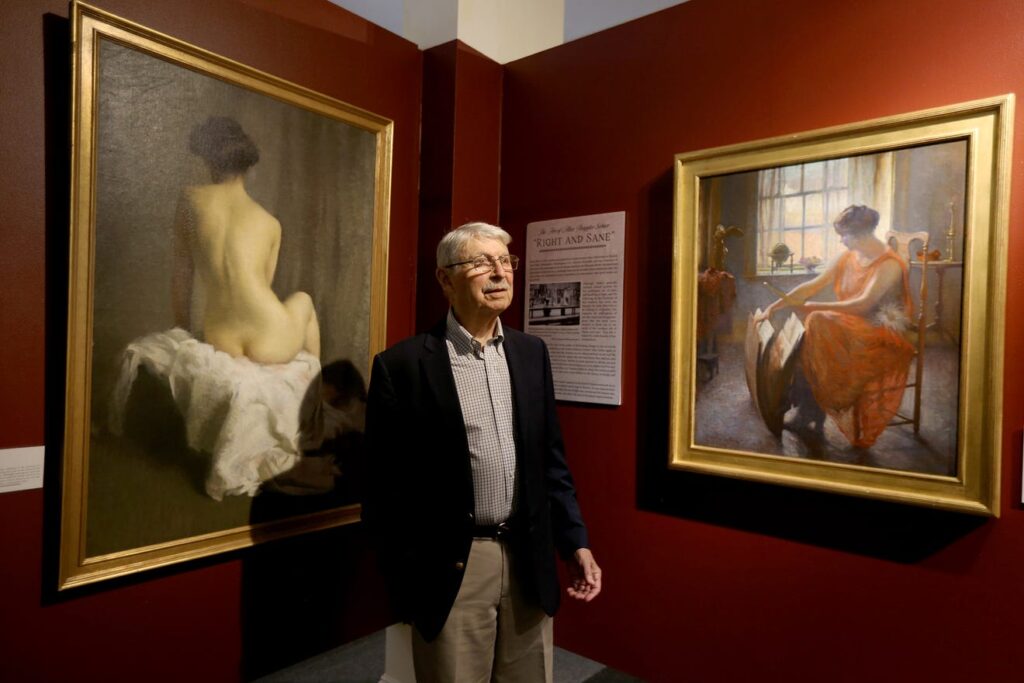
William Brewster Jr. is surrounded by ghosts. All 50 of the paintings around him at the Portsmouth Historical exhibition were created by his ancestors.
Twenty-five are the work of his grandfather, Frederick Andrew Bosley (1881–1942). The other half, including stunning portraits of women, were painted by Alice Ruggles Sohier (1880-1969). Sohier married Brewster’s great-uncle and the entire collection, rarely seen, is on loan this year from Brewster and his family. Will Brewster, now in his 80s, curated the exhibition.
Both Sohier and Bosley were students of Edmund C. Tarbell (1862-1938) of New Castle, certainly the most famous and most influential painter of the Seacoast region. As a member of the Boston School at the Museum of Fine Arts in Boston, Tarbell promoted a regional style now known as American Impressionism.
A century ago, the Tarbell style, borrowing from classical painting, was under siege. “Modernists” were rejecting the traditional Victorian look in favor of bright colors, experimentation, politics, and abstraction. Sohier and Bosley, as the exhibition title explains, represent the “Twilight of American Impressionism.”
Alice Sohier, whose work had been praised by critics and widely exhibited, slipped from public view. Married to a wealthy man, Sohier “was not particularly encouraged to continue her artistic career,” Will Brewster writes delicately in the catalog that accompanies his new exhibition. She took on a more “acceptable role for upper-class women of the day” and became a housewife, painting only as a hobby.
Fred Bosley, who had been an acclaimed artist and a Boston School teacher, found himself pushed aside by the rise of Modernism. Bosley “went into a profound depression and was institutionalized,” Brewster writes in the “Twilight” catalog. Will Brewster remembers his grandfather only as a gaunt elderly man in a wheelchair the year before his death in 1942.
“He [Bosley] asked me to look out of the window and tell him what I saw,” Brewster recalls. “I told him I saw a tree. He asked me what color. I said ‘green.’ He told me to look again. I told him green, yellow, dark gray, and black. He smiled.” It was a lesson in “seeing” that the young man never forgot.
“It was my late mother’s wish,” Will Brewster says, “that somehow her father’s paintings would come to light again, because the 1930s kind of temporarily obliterated the whole Boston School.” Paintings for the “Twilight” exhibition were selected, restored and framed. But the show almost didn’t happen.
“We were all ready to launch and then the pandemic hit on the second week of March in 2020,” Brewster explains. A year passed. But the staff of the Portsmouth Historical Society would not relent. “Twilight,” after all, would never have happened without two earlier Boston School-style exhibitions that paved the way for the current show.
Illuminating Tarbell
The idea for an exhibition of works by Edmund C. Tarbell began to “percolate” around 2007, according to restoration artist Jeremy Fogg. A number of unstretched canvases owned by Tarbell’s great-grandson arrived at the studio of Anthony Moore Painting Conservation in York, Maine, where Fogg worked. Over the years, restoring more and more of Tarbell’s paintings, meeting members of the family, and studying the artist, Fogg was inspired to take on the role of curator for a major exhibition. Portsmouth Historical Society leader Richard Candee saw an opportunity.
“Illuminating Tarbell” opened on March 4, 2016, to rave reviews. Tragically, just weeks earlier, the Tarbell House in New Castle had burned. Firefighters from 15 towns could not save the historic two-story Greek Revival home where the painter and his family had lived for 30 years. All nine current residents of the house escaped without injury.
For many locals, the Tarbell fire and the Tarbell exhibition were a wake-up call. Even some art lovers familiar with American Impressionism and the Boston School were unaware that the famous Mr. Tarbell had lived on the New Hampshire Seacoast. Visitors rushed to the museum-quality exhibition to see what the buzz was all about. But how do you follow a hit show?
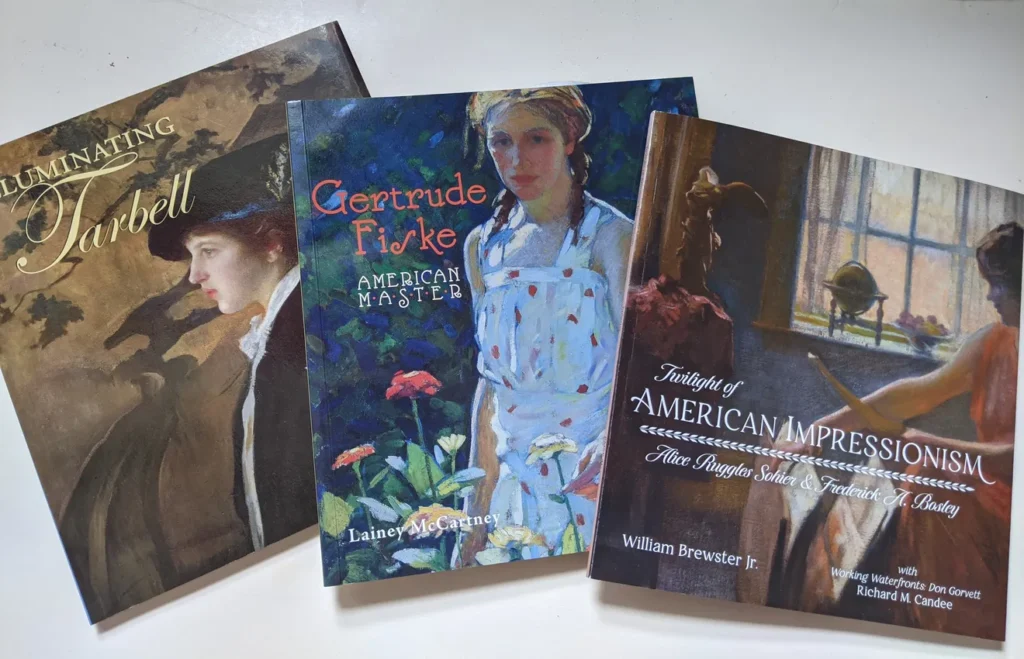
Gertrude Fiske, American Master
“I’ll tell you exactly what happened next,” says Lainey McCartney, who was then curatorial associate at Portsmouth Historical Society. “I was thrilled that we were doing Tarbell and became intimately familiar with his work.”
While visiting an art show at York Library in Maine, McCartney spotted a painting over the fireplace “that had to be a Tarbell,” or perhaps a work by acclaimed portraitist John Singer Sargent. The painting, however, was attributed to Gertrude Fiske.
“I cannot believe what I’m looking at,” McCartney says, recalling the moment of discovery. “Who is Gertrude Fiske? I’ve never heard her name, but I think her work is better than these two men who we all know. The color she used, the composition, everything about her work was much more daring and modern than Tarbell, but it was clear she had painted with him. I was in love.”
McCartney shared her discovery with Richard Candee, the founder of Discover Portsmouth and head of the Exhibition Committee. “You’re so passionate for this,” Candee said, “I think you need to curate this show.”
“I’m all in,” McCartney told Candee.“I’m dying to tell the story of how do we not know her name?”
“This was all very ad hoc,” Candee says today. “Tarbell was successful, so let’s try Fiske.”
There turned out to be a huge cache of unseen paintings by Gertrude Fiske (1879-1961) at the artist’s former studio in Massachusetts. Fiske had, indeed, completed seven years of study at the Boston School with Tarbell. She was also influenced by a creative group of Ogunquit artists including Charles Woodbury, and developed her own unique and daring style. But like her fellow American Impressionists, by her death in 1961, Fiske’s reputation had faded in the wake of the Modern Art movement.
McCartney’s 2018 exhibition featured 73 paintings and was an unqualified success. Lenders, sponsors, volunteers and historical society staff were determined to restore Fiske to her rightful status as a virtuoso. Conservator Jeremy Fogg, curator of the Tarbell show, was very active behind the scenes restoring Fiske’s work. No one knew it at the time, but there was one more Boston School exhibition on the horizon.
Into the twilight
Lainey McCartney was giving a tour of Fiske’s work at Discover Portsmouth one day when she was approached by a young woman. “You may be interested in looking at my family’s collection,” she told McCartney. The woman was Will Brewster’s niece. Her ancestors, both Alice Sohier and Fred Bosley, it turns out, had been students at the Boston School with Gertrude Fiske. “There’s so much work here on the Seacoast,” the woman said, “that you may want to do another show.”
“I have a soft spot for the Portsmouth Discover Center,” says conservator Jeremy Fogg who has worked on all three Tarbell-related exhibitions. He reminds us that the three-part revival of American Impressionism has happened, in part, because three families cared deeply about the legacy of the artists who came before them. The Tarbell, Fiske, and Brewster families preserved these great works. The Discover Center (now Portsmouth Historical) then created the opportunity for those largely forgotten works to be put on display, admired by the public, and preserved in the colorful catalogs that accompany the three exhibitions.
It’s the sequel to the story,” McCartney said of the “Twilight” exhibition. “We’re educating people to the history of the Boston School. While Fiske was bursting out of the Tarbell tradition and moving toward Modernism, Bosley wanted to retain the very genteel, very domestic Tarbell aesthetic. But forces were breaking down that social sensibility.”
Lainey McCartney and Jeremy Fogg joined Will Brewster in visiting the homes of his family in New Hampshire and Maine. They examined and photographed the Sohier and Bosley works and examined a treasure trove of family archives and scrapbooks. McCartney and Brewster identified paintings for a possible exhibition. Richard Candee asked Will if he would act as curator of “Twilight of American Impressionism.” After the show was delayed for a year due to the pandemic, Program Manager Meredith Affleck stepped in to help.
“What interests me are the conversations that happen,” Affleck said. “The Tarbell show started a conversation where Lainey discovered Gertrude Fiske. Once Fiske was on the wall, the conversation turned to people in the immediate vicinity with all these Bosley and Sohier paintings.”
“They were really hanging onto something that was on its way out the back door,” Affleck said of the two featured “Twilight” artists. “But the hundred years in between have allowed us this breathing space to say, gosh, they really had talent and deserve to be appreciated even if they’re not names that we know.”
“While the world was moving on to Modernism, trying to be edgy and different and abstract, they still wanted to paint things that were pleasing to the eye and give joy,“ she said of the featured Boston School artists. “I feel that makes them accessible to people who don’t know a lot about art history. It’s personal. You can make your own aesthetic.”
“I am certain,” Will Brewster says, “that this era of painting will come back again and be appreciated again.” Surrounded by the works of his talented ancestors, as visitors flow into the gallery, his prediction appears to be coming true already.
 Making the Music Hall History Video