


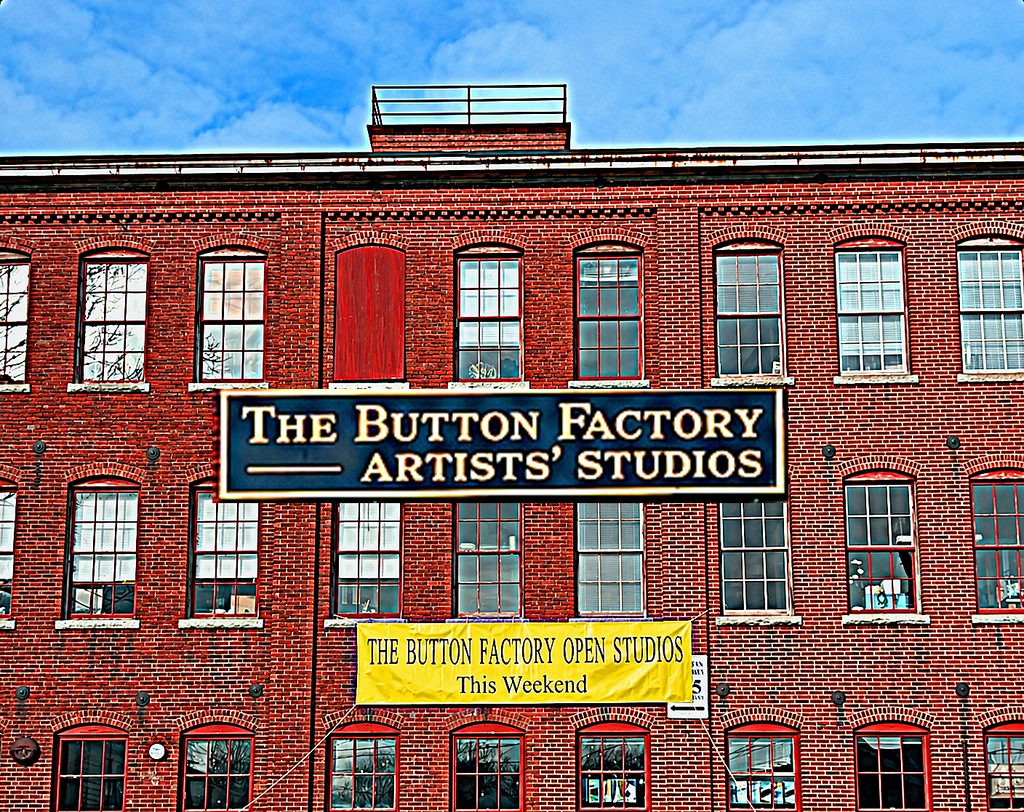
NOTE: This article appeared in the Spring 1987 issue of Seacoast Life magazine. Did the artists who saved the economy attract the wealthy people who forced our creative artisans out of town? One interviewee predicted it 40 years ago. Decades later, the beloved annual artists’ Open Studio event takes place in December. But in 1987, the fate of the Button Factory was on the line. — JDR
Blood dropped from the ceiling. “That was about 1975,” says Peter Moak, a cubist painter. The blood puddled on the floor of his rented studio in Portsmouth’s Button Factory in the city’s West End.
“There was a taxidermist upstairs,” Moak explains.
“Then there was a leather factory next door. That guy accidentally set fire to the building and all the sprinklers went off.”
SEE our Morely Buttons
The halls were winter cold, cluttered and dimly lit. Polyurethane flapped loudly in the window frames of the old brick factory at 855 Islington Street. But the price was right, and conditions never halted the steady parade of artists and craftspeople who marched in and out of the old brick Button Factory.
“George would even rent a space for $25 or $50 a month. It was always very cheap,” said Isabel Irwin, a retired Spanish language instructor. Back in the 1960s, she and her husband were up from Natick, Massachusetts, scouring the Seacoast for a place to locate George’s paper bag company. They discovered the abandoned Button Factory not far from the 19th-century Frank Jones Brewery.
“One day George was going along the railroad tracks in Portsmouth looking for a spur, an access, when he saw a fire engine in front of 855. The hallway was on fire.”
“When we walked in, there were no windows in the whole place and pigeons were roosting everywhere. The wiring was the kind with the porcelain fixtures. George had to go in with a Coleman lantern.”
The Irwins rented space until, in 1968, their landlord announced that they would have to buy the 50,000 square foot building or shove off.
“We were forced to buy [the building] for $40,000 and we almost cried,” Señorita Irwin recalled, then smiled. “Did you hear that we sold it for a million?”
Two new Massachusetts entrepreneurs closed the deal just as the 1986 tax year clamped shut. With the Portsmouth Music Hall bankrupt and Theatre-by-the-Sea in freefall, rumors of widespread condo-conversion shot through the Seacoast arts community. Custom furniture maker Bill Doub, a Button Factory veteran, was among a group that struggled to co-buy one of the area’s last creative outposts.
“We decided it was too big a nut to crack,” Doub says from Woodworks, a loosely knit co-op including cabinet maker William Clarke. Clarke and Steve McHenry, later a local architect, created the majority of carved wooden signs that marked the 1970s downtown cultural renaissance. Doub fears the continuing Renaissance could get out of hand.
“For years we tried to attract the well-heeled people from Boston. Now there’s enough. There has to be a balance, an ecology to this growth.”
Doub’s comments reflect the first wave of area artists who made a modest living from Seacoast arts and craftwork during the ’60s and ’70s. Attracted by Strawbery Banke Museum and TBS, these creative artisans found cheap space at the Button Factory under the Irwin’s 18-year reign.
The Button Factory alumni list reads like a Who’s Who of area talent: sculptor Christopher Gowell, designer Tom Hibschman, photographer Dean Rock, dancer Chase Robinson, painters Russ Aharonian and Jon Yagel. The list goes on and on.
“In the beginning, it was like working in a refrigerator,” Andy Chulyk notes. Drawn here from Haverhill, Chulyk was the original Button Factory artist. From 1971 to ’73, he lived illegally and worked at the site. No heat, no bathroom; he cooked on a kerosene stove. Chulyk created life-sized sculptures out of found objects that glowed eerily in the diffused light from streetlamps outside. A noisy family of raccoons inhabited the freight elevator. Snow drifted in the hall.
But the garret days were numbered. In the ’80s, the city reassessed the building from $59,000 to $400,000 and taxed accordingly. Meanwhile the B&M Railroad out the back door shut down. George Irwin’s paper bag business crumbled and he was trying to hang onto a Volkswagen repair business on the bottom floor. Maintenance and replacement costs swelled. Neighbors complained of live-in artists and dangerous conditions.
“Somebody reported us. The real estate agents hated us. The city attorney came down with reporters and photographers, and Oh my God what grief we got. But we stuck to it like bulldogs,” Isabel Irwin recalls.
“They [the artists] were like our children,” she says nostalgically, “only they didn’t know it.”
Exit Mom and Pop
But no longer. Exit Mom and Pop. Enter Yankee Realty, a Boston-based partnership with a small branch office in York, Maine. Despite local rumors, new owner Peter Barrow says [in 1987] he plans to keep the Button Factory as artsy as possible.
“We’re not in this to evict everybody or to profiteer,” says Barrow. “We bought this as a fun project. I hope to promote it as an artist community, but we also want to pay our bills and make a fair return.”
Barrow sees no reason why both goals are not attainable. “This is a very upscale area,” he says, “and upscale people support the arts. The arts can mellow the hard edge of growth in this area.”
Barrow defines his ideal tenants as working artists who want a “clean well-lighted space.” His immediate plans are to tar the parking lot and improve the entranceway, signage, hallways, and safety, and rent all unused space. Full occupancy is the key, he says.
“We’re not going to rent cheap space in a garret style,” Barrow says. He talks about local arts with excitement and understanding. He sees artists as business people selling a creative product.
“If there really is a new breed of artist with business acumen, then the Button Factory may remain at the center of the local arts community,” he says.

The new breed
Photographer Bill Truslow is sitting in the upper loft “hideaway” of his new Button Factory studio when the UPS delivery person arrives. Truslow cannot quite stand to his full lean six-foot-five inches in the glassed-in space that presents a panoramic view of the city’s old manufacturing area. Virginia-born, Truslow got a taste of New England when a Pittsburgh firm assigned the young architect as a building inspector for the Seabrook Nuclear Power Plant.
That was a decade ago. Truslow met his wife, Dana, a hydrogeologist, during an anti-nuke demonstration. Bill went back to school to study photography in California. Today, the couple is back in Portsmouth with their four-month-old daughter, Hannah. Truslow rediscovered the Button Factory just as the Irwins were departing. He does not fear a more businesslike landlord.
“There is a certain level of professionalism that goes with being a commercial artist,” says Truslow. His photo assignments routinely take him to New York, California, and beyond, “I’m betting on the improving business climate in New England and these clients need to have confidence in your operation. Having a nice studio space helps.”
The UPS package contains proofs of an advertisement Truslow recently shot for the Sunday Washington Post Magazine. The two-page color spread shows magnificent fountained condominiums on the Potomac River. The photographer holds the proofs to the window light for a microscopic analysis of his work.
“As I see it, the fine artist and the commercial artist are both solving a problem,” he says. “The fine artist is answering his or her own questions, while I’m solving a problem for a client.”
In the main studio, Truslow’s decor is corporate-funk. Handmade furnishings sit beside sophisticated modern camera equipment. Although an independent businessperson, he draws energy from the creative people in the building—from other photographers, craftspeople, architects, and painters.
“I don’t really see myself as a Portsmouth photographer. I’m a photographer who lives in Portsmouth. I like it here,” says Truslow.
The old Button Factory days are over, says owner Barrow. Only the stories remain. He has cautious dreams about the future, thoughts of a resident gallery perhaps, but for now his eyes are on the slow upgrading process.
“We are willing to let the building evolve,” he says. “If someone offered us 10 million…we’d think about it, but we have yet to sell a building we own. It’s a question of working together.”
“It really comes down to a matter of zoning,” says Bill Doub. “The city has to decide whether it wants to support all this. It’s kind of funny that the artists and craftspeople who went out and renovated Portsmouth and attracted all the people may be the ones who can’t afford to stay.”
Visit the Button Factory website
© 1987 by J. Dennis Robinson. Edited in 2026.
 Meet Edward Stickney, the American Apollo