


SEACOAST POETRY
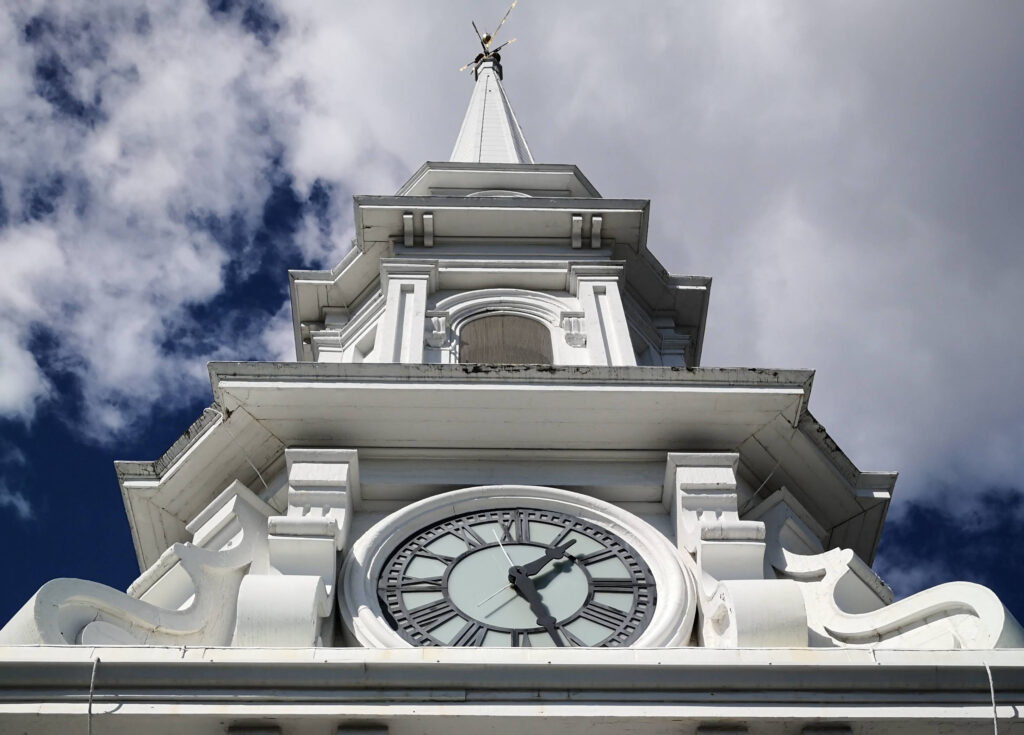
Today the Old North Church spire is the most recognizable image in the city. It links the Seacoast to its past, to a time when Washington and Daniel Webster attended services here in Market Square. In this poem, written after the Civil War, newspaper editor Charles Brewster remembers when the old weathervane came down. He lets the steeple tell its own story.
Notes on Brewster’s North Church Poem
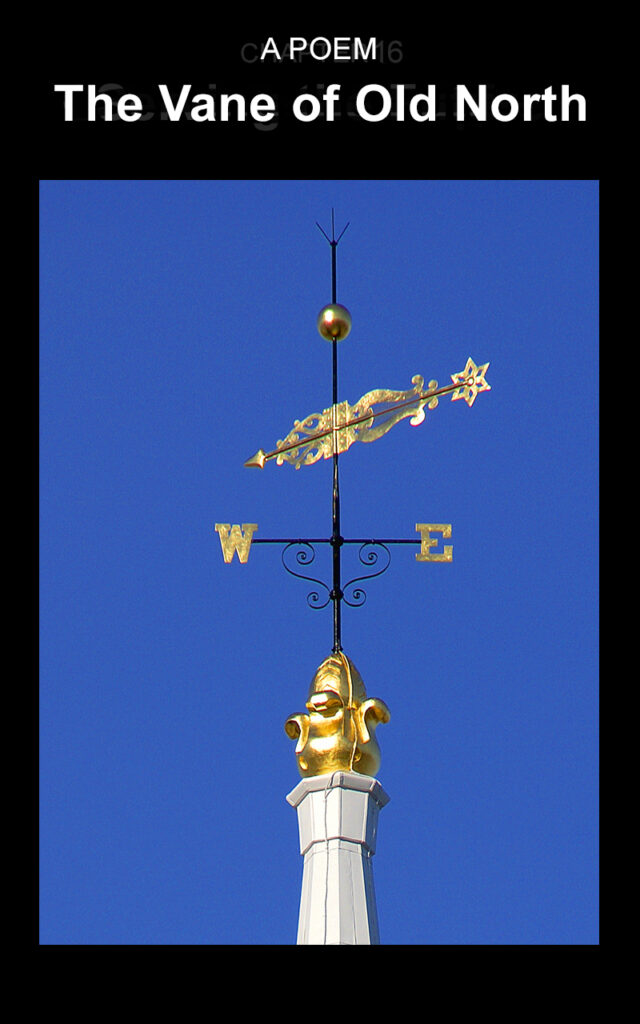
It may not be top-notch poetry, but this little chestnut offers a quick history of Portsmouth from a unique perspective. Charles W. Brewster (1802-1869) is remembered today for his two-volume collection of essays about the history of his native New Hampshire town in Brewster’s Rambles. Shy and unassuming in person, Brewster rarely traveled beyond the few city blocks of downtown Portsmouth. He worked there for 50 years.
In “The Vane of the North Church,” Brewster uses a simple poetic form. The personified weather vane, set to come down after more than a century atop the highest point in the city, recalls a few historic moments it has seen. In that time, the city had changed from a British colony to a member of the United States. New Hampshire’s original State House had been built in the center of Market Square and removed. Revolutionaries Washington, Jones, Langdon, and a series of famous North Church ministers had come and gone. Ben Franklin had installed his famous lightning rod on the Warner House. The “heathens” on the Isles of Shoals had been tamed by Rev. Tucke. Brewster even references the voyage of Capt. James Cook, whose famous ship HM Endeavour, a reproduction of which, visited the Port City in 1998. In recent decades, the aging North Church steeple has been repaired for $1.5 million, much of it raised by public and corporate donations. –JDR
History of the North Church
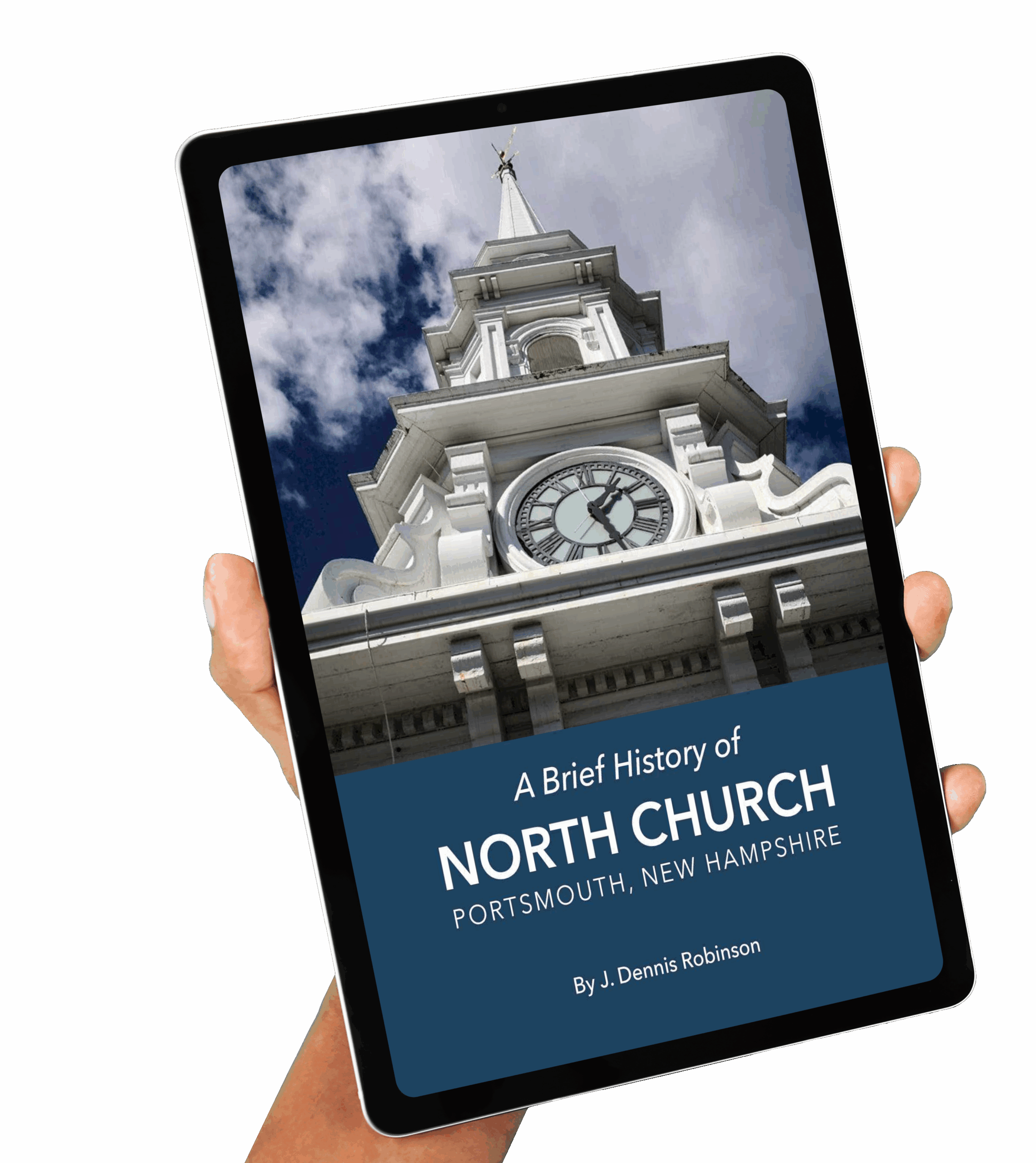
The first church was a Meeting House erected near the junction of South and Marcy Streets about 1657. In 1671, under the name “The Church of Christ in Portsmouth,” the church was formally organized. The first building was erected on the present site in 1714. It was a three-decker, in the second gallery of which worshiped slaves and servants. Noted worshippers in this edifice were General William Whipple, a signer of the Declaration of Independence; John Langdon, a signer of the Constitution of the United States; Daniel Webster; and John Paul Jones.
Some parishioners preferred to remain at the former location where they incorporated themselves into the South Parish, now the Unitarian Church. The older organization retained its original name, but by custom it assumed the name of the First or North Parish in Portsmouth under which title, it was formally incorporated in 1791.
About this time, the so-called “schism” developed in New England Congregationalism. In an endeavor to avoid the loss of church property through such a division, and to provide more adequately for the administration of trust funds, a corporation known as “North Church of Portsmouth” was formed in 1816 by action of the legislature.
The building was renovated in 1837 and changed to a two-story structure. Because fashions were changing around it, the building was torn down and the present edifice constructed and ready for dedication on November 1, 1855.
– History courtesy of the North Church
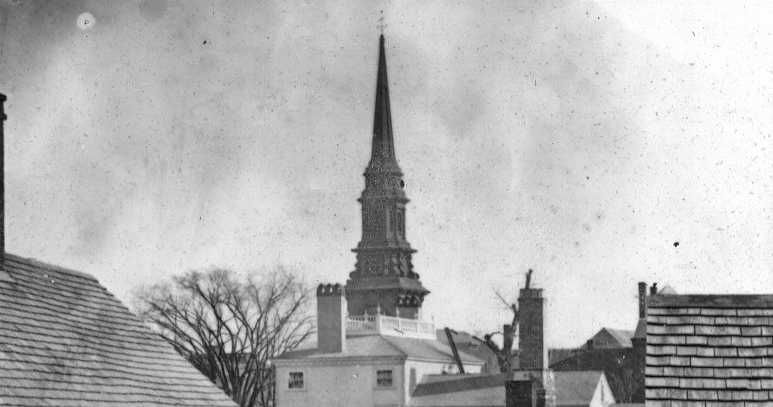
(Copyright Portsmouth Athenaeum, all rights reserved.)
Original commentary copyright ©1998 SeacoastNH.com. All rights reserved
The Vane of the Old North Church By CHarles W. Brewster (1864)
Original Author’s Note: The vane of the Old North Church bore the date of 1732 when it was put up. It was not gilded until 1796. When destined to come down in 1854, the vane is thus personified, to enable it to tell its story.
I can’t come down! I can’t come down!
Call loudly as you may!
A century and a third I’ve stood;
Another I must stay.
Long have I watched the changing scene,
As every point I’ve faced;
And witnessed generations rise,
Which others have displaced.
The points of steel which o’er me rise
Have branched since I perched here;
For Franklin then was but a boy,
Who gave the lightning gear.
The day when Cook exploring sailed,
I faced the eastern breeze;
Stationed at home, I turned my head
To the far western seas.
I’ve stood while isles of savage men
Grew harmless as a dove;
And spears and battle-axes turned
To purposes of love.
I looked on when those noble elms
Upon my east first sprung,
And heard, where now a factory stands,
The ship-yard’s busy hum.
When tumult filled the anxious throng,
I found on every side
The constant fanned flame,
And freedom’s fire supplied.
William and Mary’s fort I’ve oft,
Through storms, kept full in view;
Queen’s Chapel in the snow’s squalls faced;
And west, looked King Street through.
For Constitution now takes place,
To meet my south-east glance;
The shrill north-easters from St. John’s
Up Congress Street advance.
In peace I once felt truly vain;
For ‘neath my shadow stood
The man whom all the people loved, —
George Washington the good!
But why recount the sights I’ve seen?
You’ll say I’m getting old:
I’ll quit my tale, long though it be,
And leave it half untold.
The name of Rogers, Fitch and Stiles,
And Buckminster, — all true;
And later men, whom all do know,
Come passing into view.
Their sainted souls and hearers too —
Your fathers — where are they?
The temple of their love still stands, —
Its memories cheer your way.
Till that old oak, among whose boughs
The sun my first shade cast,
Lays low in dust his vigorous form,
A respite I may ask.
This little boon I now must crave, —
(Time’s peltings I will scorn,) —
Till coward like, I turn my head,
Let me still face the storm.
From POETS OF PORTSMOUTH (1885), edited by Albert Laighton
 More Rare Images: “Old Ironsides” in Portsmouth Harbor