


What goes around comes around. Back in the Fabulous Fifties, when your humble historian was just eight years old, his parents made him take piano lessons–on a real wooden piano with ivory keys and no amplifier. The stories Boomers tell about childhood freedom are true. After walking unaccompanied over half a mile–up a steep hill and through the center of a little Massachusetts town called Grafton–I spent the day in second grade at Norcross School.
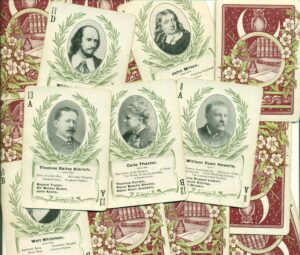
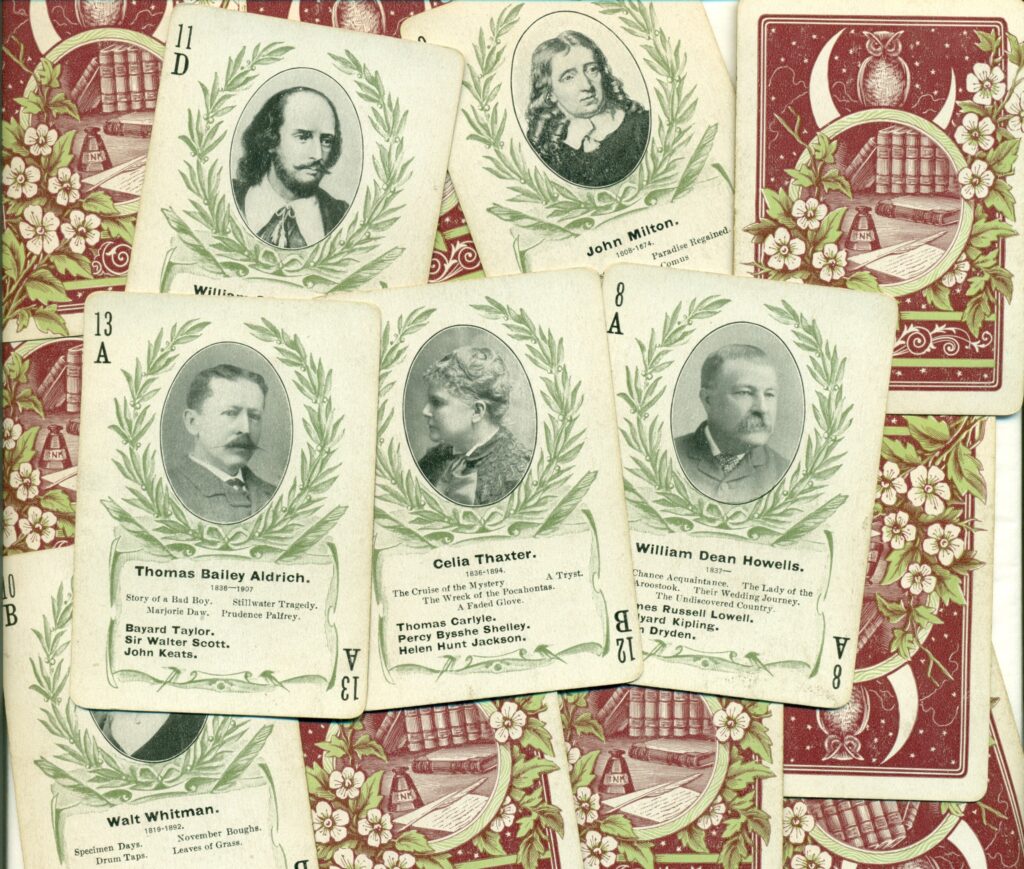
Once a week, instead of walking straight home, I crossed the road and went through a grove of trees to the home of Mrs. Pond, my piano teacher. I was a terrible student, rarely practiced, but I had long fingers and a passable sense of pitch and timing. When we moved from Massachusetts to New Hampshire the following year, Mrs. Pond gave me a vintage pack of cards. I don’;’t know how she knew what I would become, but it a 1910 edition of the game AUTHORS.
It’s basically GO FISH. Cards list four books or poems for each author. Shuffled in among Shakespeare, Milton (later my major subjects in college), were lesser-known writers. I still have the deck and was amazed to discover two of Portsmouth, NH’s most famous authors. Celia Thaxter, the poet of the Isles of Shoals, and Thomas Bailey Aldrich, author of The Old Town by the Sea and Story of a Bad Boy. William Dean Howells, who summered at Kittery Point, also made the cut.
Who knew I’d spend countless hours reading, researching, and writing about these local literary lions? Mrs. Pond did.
Copyright J. Dennis Robinson, all rights reserved.
 How Harvard Helped Portsmouth and Vice Versa