



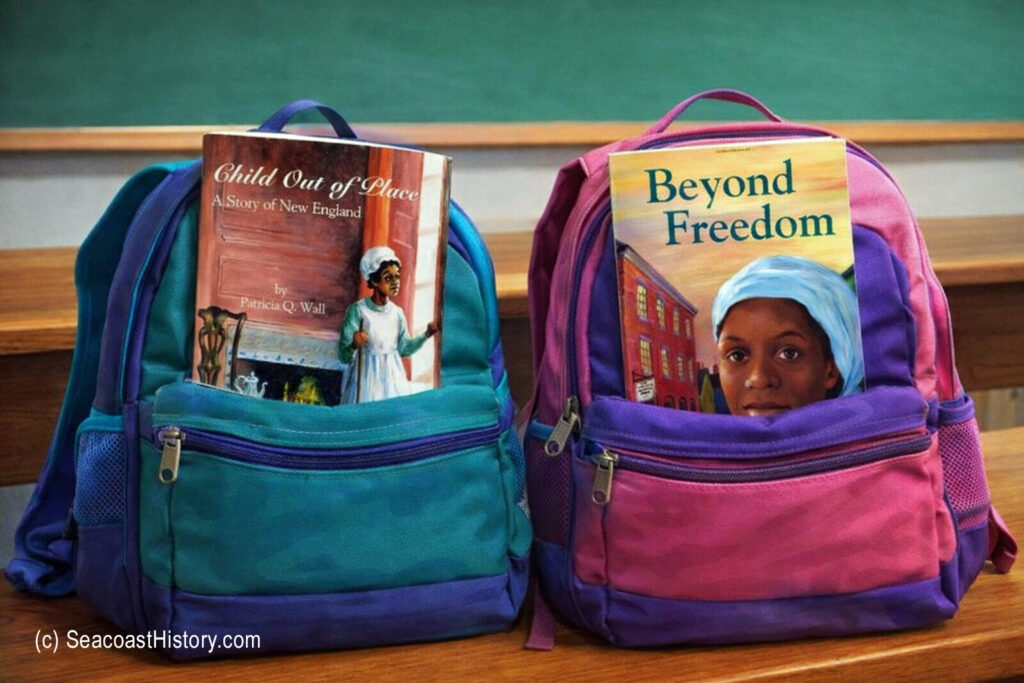
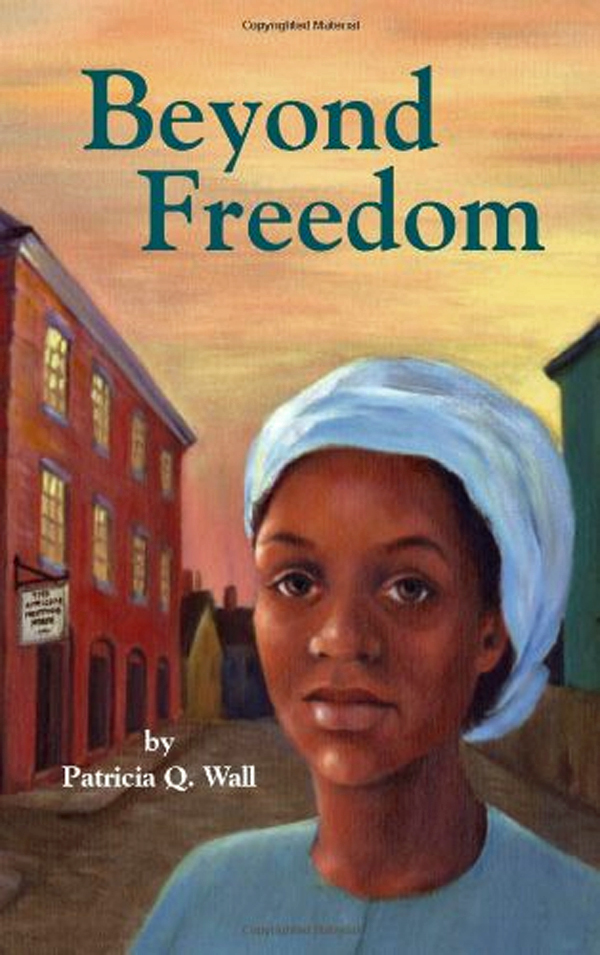
NOTE: When we last interviewed Pat Wall she had released her first children’s book, the story of an enslaved black child in a white Portsmouth, NH household. Now Matty is older and her family has moved to the big city of Boston at the dawn of the War of 1812. The sequel, BEYOND FREEDOM, picks up where CHILD OUT OF PLACE left off in our exclusive author interview. Pat is also the autor of the nonfiction book LIVES OF CONSEQUENCE. –JDR
More Voices in Her Head
Interview with BEYOND FREEDOM author Patricia Q. Wall
SEACOASTNH: When we last spoke in 2004, you said your first children’s book about slavery in New England came about by accident. Is that true of this new one?
PAT WALL: I’d say this book, BEYOND FREEDOM, came more from imperative. My invented haracters, young Matty and her family, kept talking to me, telling me there was so much more to their story.
SEACOASTNH: Hearing voices?
PAT WALL: No, I’m not losing it. It was just that by the time I’d finished CHILD OUT OF PLACE, I was hooked on the subject of New England’s early black history, as well as that topic elsewhere in America. Couldn’t read enough, attend enough black history conferences — I was so eager to fill that inexcusable hole in my education.
SEACOASTNH: Most Americans, even those who know history, are likely clueless about the African American story.
PAT WALL: True. This may seem odd to say, but I’ve finally grown up in regard to American history. After delving into African American history, so much more of this country’s overall history comes clear. I get it.
SEACOASTNH: We’ve found the same thing in research here. The pieces of American history never seemed to fit together without black history – and other ethnic histories, women’s history, and children’s history. We really have always had only one point of view – white male history.
PAT WALL: If only my teachers had drawn those “black threads” into the tapestry of American history from its very beginning, l would have had a far better understanding of this nation’s economic, political and social development.
SEACOASTNH: Tell us more about writing BEYOND FREEDOM and why you felt compelled to do so.
PAT WALL: Well, reading took me into the early aftermath of slavery in New England. I was appalled by what I learned and also how much of that history is still little known by the public. Here was another neglected part of our children’s education, one perhaps even more important to their understanding of American history than the colonial era.
SEACOASTNH: What makes you think so?
PAT WALL: To me, it isn’t enough to simply know that slavery existed in New England and the North. Children need to know about the discouraging aftermath in order to gain insight into the struggles of newly-freed black people trying to find a footing in a town such as Boston.
SEACOASTNH: The undeclared second era of American slavery?
PAT WALL: My first book ended on such a hopeful note with young Matty believing that her future would be bright. The error of this was brought home to me quite sharply on one of my visits with fourth graders in a New Hampshire school.
SEACOASTNH: How so?
PAT WALL: Before launching into the topic, I asked students what they already knew about slavery in America. A boy eagerly put up his hand. “Oh, I know all about that stuff,” he said. “You see, they brought over all these slaves from Africa and made ‘em work hard on southern plantations. Then there was the Civil war and after that President Lincoln freed all the slaves. And, after that, everything was okay.” I’ve discovered that this error-fraught statement is not uncommon among adults, too.
SEACOASTNH: That’s the Reader’s Digest view we’ve been teaching our students for 150 years.
PAT WALL: Exactly. In BEYOND FREEDOM, I wanted to set at least some of the record straight. Trying not to be stuffy, I made a list of points to be covered in Matty’s later story in Boston, after she leaves Portsmouth. I wanted children to know of the discouraging racism, the economic and social roadblocks, the precarious future black people faced at that time. And, it is my hope this new story will move children beyond mere racial tolerance, that it will bring them deeper understanding along with compassion.
SEACOASTNH: Why choose the summer of 1812 for the sequel? Why not set it in the 1830s when abolition got started in Boston?
AT WALL: So much has been written about abolition, the so-called “Underground Railroad” and Harriet Tubman. And, though important, those topics are often the alpha and omega of elementary school curricula regarding African American history – until it’s time to talk about the Civil Rights Movement. My writing is an effort to begin at the beginning, try to plant a few seeds to correct that disjointed curriculum. For BEYOND, I was more interested in what life might have been like for newly freed blacks in the region, in finding details of how that small black community and its African Meeting House developed. What challenges did they face in Boston? That’s where I’d left Matty, and it felt right to pick up her story soon.
The summer of 1812, when she was fifteen, proved useful to bring in a number of key points on my list regarding the social, political and economic background of that time. I wanted to show how and why black people then were caught between hopefulness and despair over their future. Though all this sounds kind of heavy going, the actual story isn’t that way at all. Like the first one, I had fun with the characters, giving them laughter and light heartedness as much as the story allowed.
SEACOASTNH: It’s been a little over five years since the first story. Did you have problems in putting BEYOND FREEDOM together?
PAT WALL: I was busy with promoting the first book, giving talks and visiting elementary school classes. The latter was, and still is, the most gratifying. I love witnessing children’s (and also their teachers’) responses to new information. So far I’ve met with almost 6000 students –4th to 6th graders — in various parts of New England.
But mainly it was the research that delayed the second book. There’s such a scarcity of information concerning those formative years of that Boston community. Even the early records of the First Baptist Church, the reason-for-being of the African Meeting House, have been lost.
Dig though I did, I mostly came up with bits and hints, matter between the lines, as it were. Of course, since I was writing historical fiction, I took courage and filled in as best I could. I promise, I was extremely careful, checking and re-checking what factual material I incorporated into Matty’s story. BEYOND FREEDOM has much more historical notation in back pages for teachers and curious readers than the first book did. There’s even a bibliography.
SEACOASTNH: You self-published the first book with great success. How about this one?
PAT WALL: That was the other thing that was holding up the book’s publication. I hoped to find a commercial publisher. I didn’t want to have to do it as Fall Rose Books again. But it was such prolonged agony, trying to get past publishers’ gatekeepers whom I suspect never read the manuscript before sending form-letter rejections.
Also, since I’m well along in my seventh decade, waiting is a gamble. I do worry about the posterity of my go-it-alone books, especially as paperbacks. But I haven’t entirely given up seeking a regular publishing house to buy printing rights to them.
SEACOASTNH: Will Matty’s story continue into a third book? The ending of BEYOND FREEDOM seems to beg for one.
PAT WALL: Right now, I don’t plan to. Still, with what I continue to learn about the time between 1812 and 1830, when the African Meeting House community gets into abolition, perhaps my imaginary Matty and her relatives will keep whispering, forcing me to the keyboard.
© 2010 SeacoastH and SeacoastHIstory.com
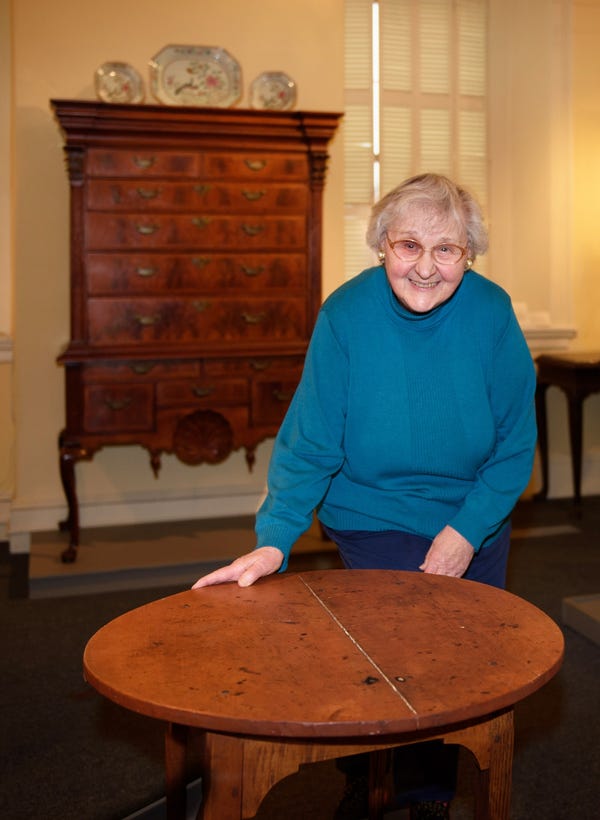
BONUS: Read about Pat Wall and Molly Miles” table
 Reaction to the FB-111A Jet Crash Anniversary
Leave a Reply