


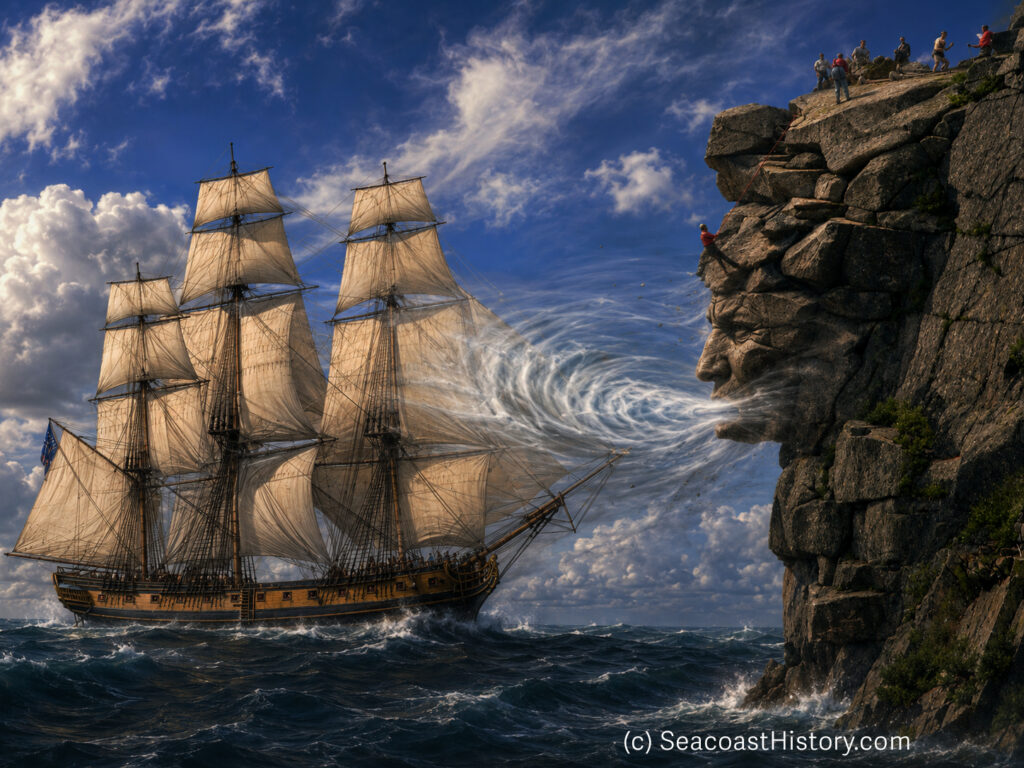
It’s been decades since the Old Man of the Mountain collapsed. Twenty tons of cement, plus plastic sheeting, steel rods, and turnbuckles were no match for deep cracks caused by thousands of years of freezing and thawing. The Great Stone Face, first named by Abenaki natives, tumbled out of existence at 2 a.m. on May 3, 2003. Mourners placed flowers on the rock pile at the base of Cannon Mountain in Franconia.
Symbols are powerful. For some, the Granite State had lost its soul. And it was because of a rocky emblem that we almost lost the New Hampshire state seal. The Old Man, you might say, nearly sank the USS Raleigh.
Emotional reaction
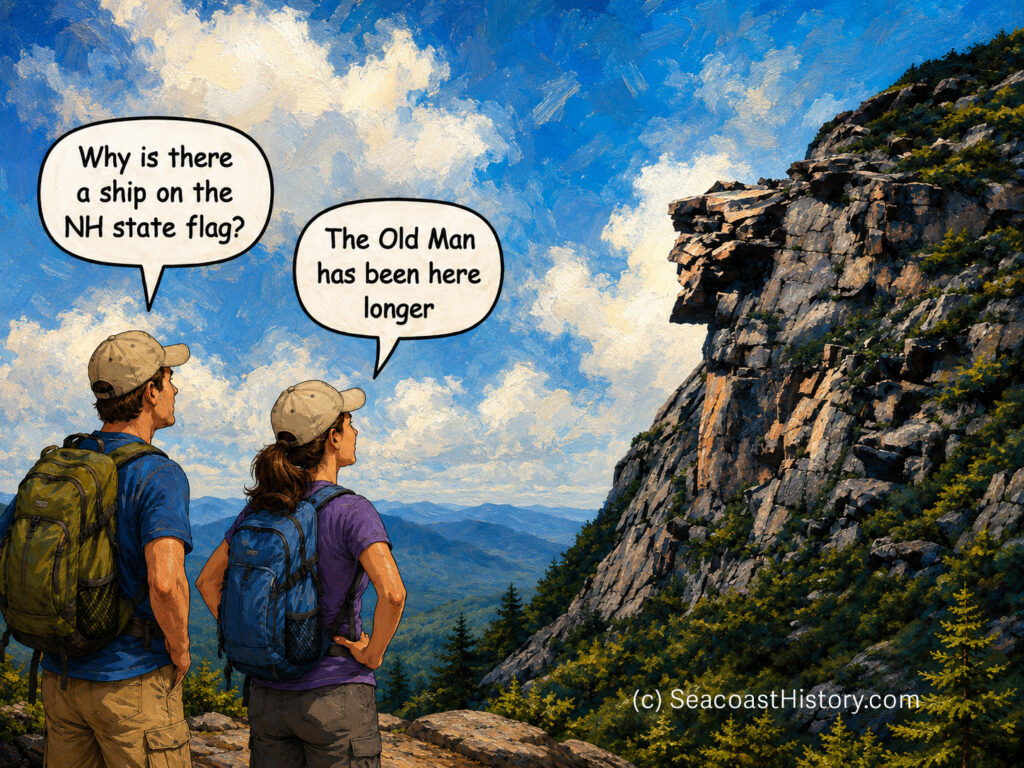
Back in 2004, legislators proposed three bills designed to change the state seal. One urged lawmakers to replace the illustration of a tall ship, launched at Portsmouth Harbor on May 21, 1776, with an image of the Old Man of the Mountain. A similar bill suggested adding the motto “Live free or die.” A compromise bill suggested using both the Old Man and the tall ship on the seal.
You can see the problem. The demise of the Old Man was not only an emotional blow to hardy Granite Staters, but there was the potential impact on white Mountain tourism. And why, people wondered, was there a ship depicted on a state that barely kissed the ocean? Our coastline is only 18 miles long.
Historians quickly pointed out that New Hampshire was born, not in the majestic White Mountains, but at the sea. It was another two centuries before the profile of a stone face was “discovered” in 1805. By then, New Hampshire had adopted two official seals. The first, created at the outbreak of the American Revolution in 1775, showed a fish and a tree, the key drivers of the New Hampshire economy. It also included a quiver of five arrows in honor of the five original seacoast settlements. A Latin phrase printed around the outside of the seal read “In Unity There is Strength.”
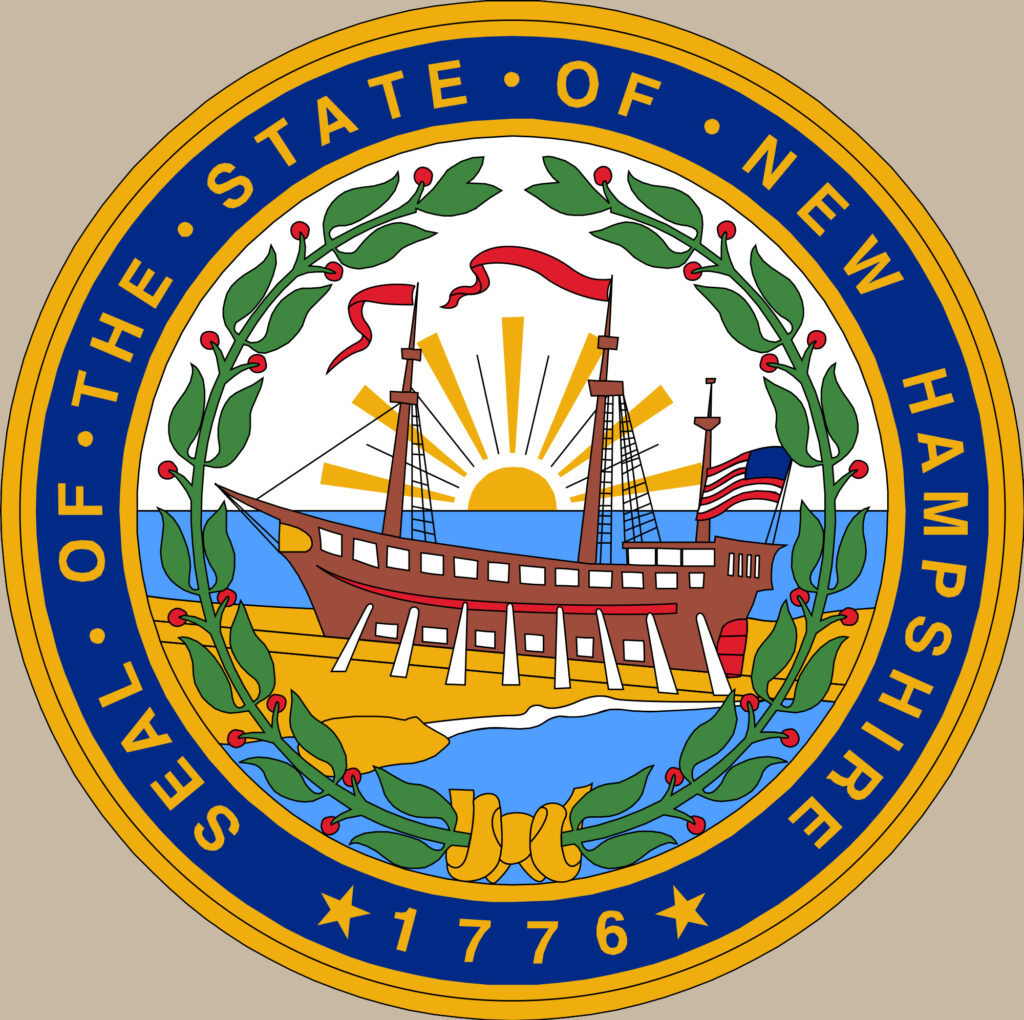
The state seal has seen only one major change since then. In 1784, capitalizing on the state’s growing shipbuilding trade, NH legislators changed the seal to a wooden ship under construction “on the stocks” with a rising sun in the background. Artists and engravers have reinterpreted the design, but the essential elements remain. A pair of human figures, stacks of lumber, and tiny wooden barrels (some say they were rum barrels) appeared and disappeared in various versions of the seal. The flag hoisted above the tall ship was altered as if shifting in the wind. In 1909, the seal was added to the design of the New Hampshire state flag.
Nailing down the details
In 1931, Governor John Winant, a former St. Paul’s School teacher, appointed a special commission to crack down on unauthorized state imagery. The committee understood its mission well. “We early came to the conclusion,” they reported, “that no material change in the device of the seal was expected or would be desirable.”
The group drew up a detailed description of the official seal, including the angle of the ship, the direction of the fluttering flags, and the percentage of sunshine on the horizon. Loose barrels and random human figures were banned, but one item was added. The seal now included “a granite boulder on the dexter side” of the ship. The boulder was to symbolize the solidity of the Granite State and the solidarity of its citizens. So in one small sense, the Old Man of the Mountain was already depicted – in spirit anyway.
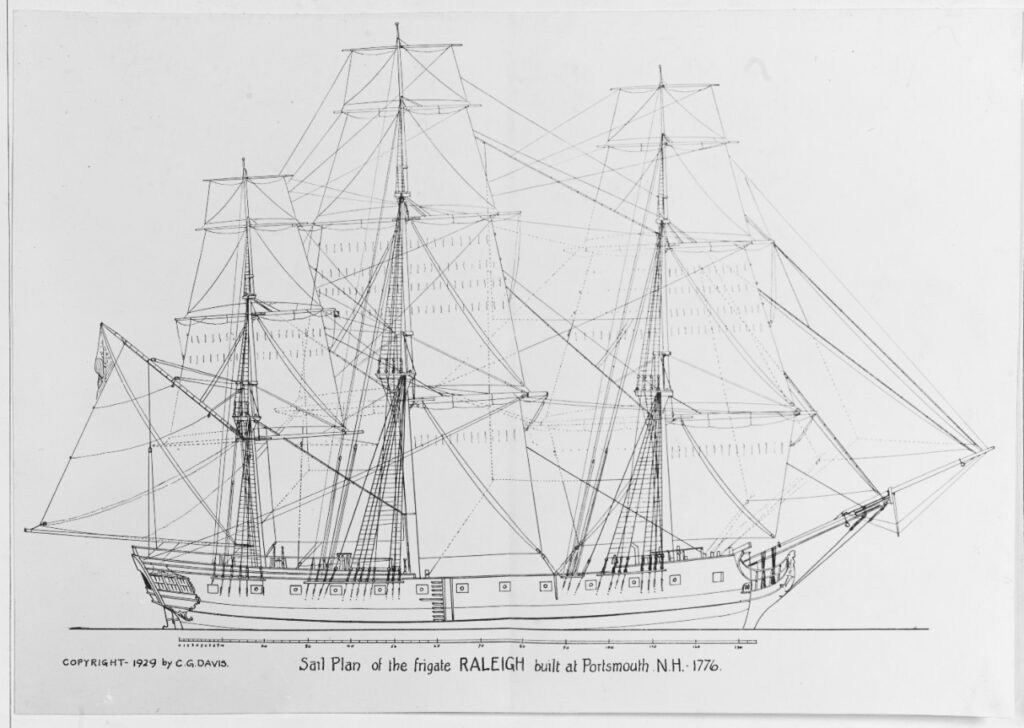
It was under Winart’s committee that the anonymous tall ship finally got a name. It was the USS Raleigh, built at Portsmouth Harbor in 1776. Technically, the Raleigh was built at Langdon’s Island, now Badger’s Island, which is in Kittery, Maine. It wouldn’t be the last time Portsmouth took credit for a Kittery-built ship.
According to state records, while looking for a famous Portsmouth-built ship from the American Revolution, a researcher found an article about the Raleigh in a 1917 copy of National Geographic. The article claimed that Raleigh was the first ship to carry the new American flag into battle at sea. Historians dispute that claim. The credit often goes to John Paul Jones, who, ironically, sailed the first “stars and stripes” into battle aboard the USS Ranger, also built at Langdon’s Island (also Rising Castle Island) in Kittery.
Rally Round the Raleigh
Historians know a lot about the Raleigh. Thomas Thompson, the ship’s first captain, kept a scrupulous log. We know that most of the men aboard for the maiden voyage to France were, like Thompson, from Portsmouth. We know what the Raleigh looked like because it was captured by the British in 1778. The Royal Navy took accurate measurements of their prize and these records were used to create the artwork on the 1931 seal.
The Raleigh was among the very first ships built for the tiny American Continental Navy. Local seaports rushed to see which coastal port could get its ship into the water first. Amazingly, the skilled New Hampshire and Maine craftsmen built the large man-of-war in just 60 days. According to the NH Gazette, the Continental frigate was launched “amidst the acclaim of many thousand spectators” in May of 1776. It was remarkable, the newspaper noted, that with 500 men involved, “not a single person met with the least accident” in a launch that took only six minutes.
It was August 12, 1777, before Captain Thomas Thompson of Portsmouth secured a crew and his 32 guns to depart on a mission with USS Alfred to pick up military supplies in France. Thompson captured a few small prizes along the way, but here the Raleigh story darkens. The Alfred was captured on the return home and Thompson was severely criticized for not going to the aid of his sister ship.
Raleigh was captured the following year under Captain John Barry and joined the Royal Navy fleet. In a twist of fate, it was Raleigh under British command that later captured Ranger off the coast of South Carolina. The Raleigh was decommissioned in July 1781 at–you guessed it–Portsmouth, England. Capt. Thompson, by the way, later built a mansion next door to ship builder John Langdon. Both homes are still standing side-by-side on Pleasant Street.
Liquor license
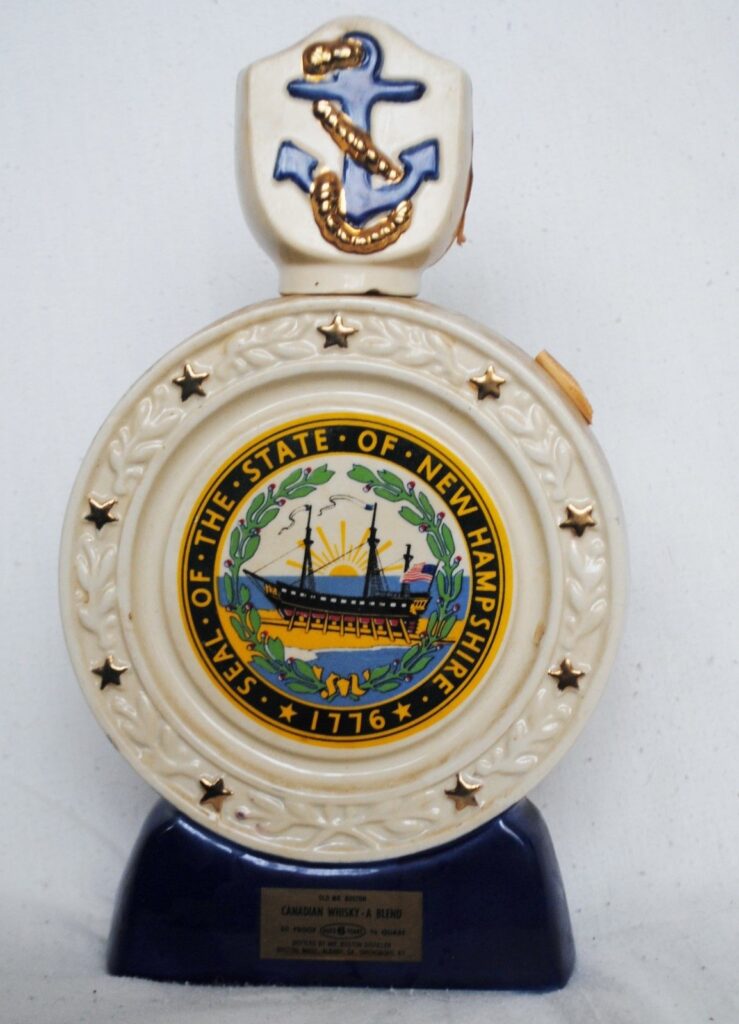
It wasn’t until the lead-up to the American Bicentennial of 1976 that the report of Gov. Winant’s 1931 committee became public. Someone suggested that the colorful state seal would make a classy souvenir as a liquor decanter. Costas Tentas, chairman of the NH Liquor Commission, agreed. So did NH Governor Meldrim Thompson, Jr.. Thompson wrote Tentas in 1975 to say how pleased he was that the history of “our handsome State Seal” was to be distributed in pamphlet form to school children in the Granite State. The pamphlet, prominently showing a photograph of the liquor decanter on its cover, was paid for by Mr. Boston Distillers. The state government proudly shipped off copies to teachers, children and libraries around the state.
It is from that liquor bottle pamphlet, written by state legislative historian Leon Anderson, that much of this information is drawn. Anderson created similar booklets for commemorative liquor decanters of the Cog Railway, General John Stark and John Paul Jones. In a gruesome footnote, another souvenir liquor decanter by Jim Beam depicts Hannah Duston, controversial heroine of the 1697 massacre of her Indian captors, including two men, two women, and six children. In Hannah’s tiny porcelain hands are her hatchet and the scalps of her Wabenaki victims.
Efforts to replace the sailing ship with the Old Stone Face did not pass the state legislature in 2004. The image of a ship in the ways with the rising sun remains the official New Hampshire emblem. Our seacoast, small as it may be, dominated early New Hampshire history for almost two centuries. Portsmouth, once the colonial capital, remains a working port with one of the swiftest tidal currents in the world–and many stories to tell.
© J. Dennis Robinson, all rights reserved.
 The Murder House on Smuttynose Island Is Long Gone