


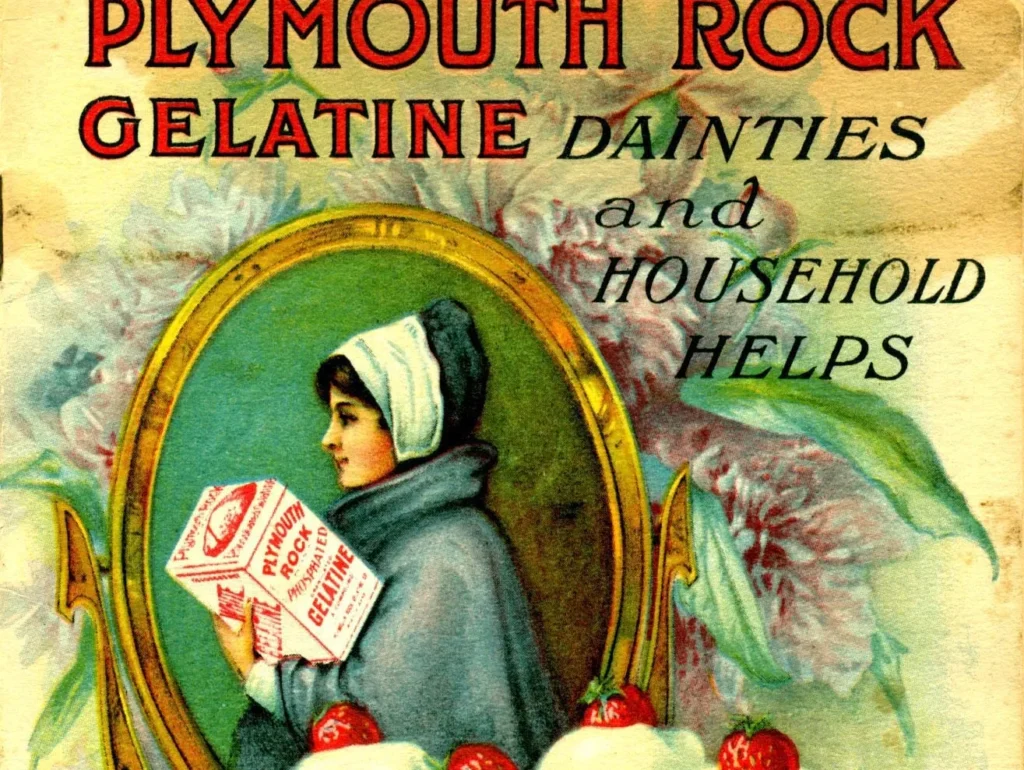
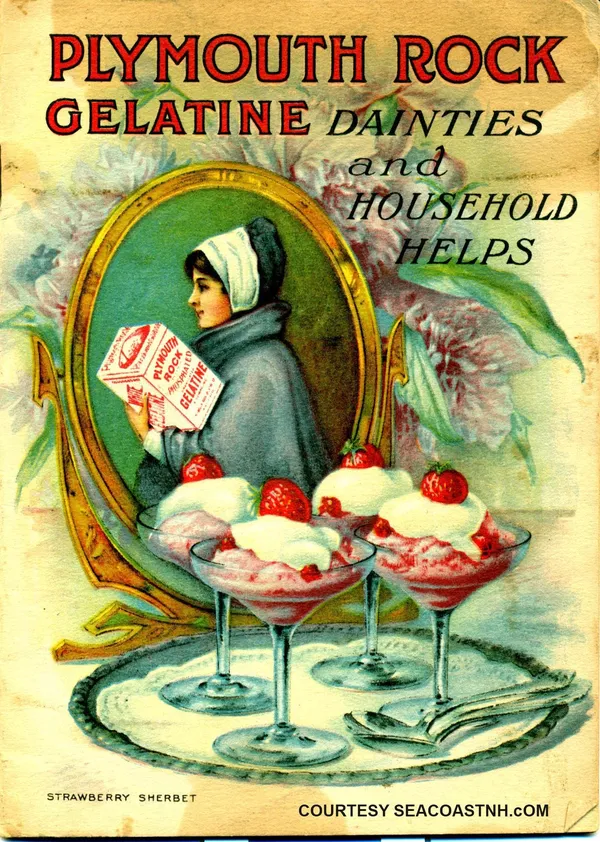
One surefire way to make your brand feel familiar is to connect it with a historic name we already know. Think of Lincoln Logs or John Hancock Insurance or Quaker Oats. Jell-O arrived on the American holiday menu in 1897. This similar company registered its brand in 1905 as Plymouth Rock Phosphateol Gelatine. Good logo, bad name. The company trademark appears to have expired in 1986. Attempts to track down the Massachusetts company, so far, have failed. This illustration is the cover of a vintage six-page promotional booklet sent from a reader of this column.

While we’re on the subject, although the band of English “Separatists” now known as Pilgrims, did not actually land at or on Plymouth Rock, it makes an enduring symbol. First described in 1741, the rock has the distinction of being the nation’s oldest historical tourist attraction. An inspiration to Revolutionary Americans, the upper portion of the world famous rock was dragged to Plymouth Town Square in 1774. The slab of Dedham Granodiorite was later placed on display at Plymouth’s Pilgrim Hall in 1834. Later, in 1880, it was returned to the waterfront and covered in an ornate Victorian portico. That was replaced in 1921 by the Greek-style canopy seen today by countless Plymouth tourists.
The colorful booklet offers holiday recipes for jellied asparagus, tomato jelly, mint jelly, and jellied wine. Gelatin is defined as “a flavorless, transparent thickener derived from animal collagen that dissolves when heated and congeals when cooled.” Collagen is defined as “the flesh and connective tissues of vertebrates.” Yummy!
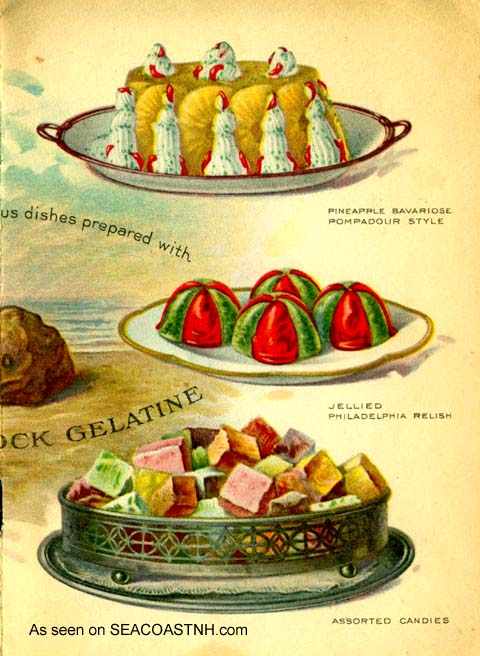
Early ads for Plymouth Rock Gelatine show the Pilgrims enjoying cubes of the wiggly dessert treat. Historically, that’s possible. Gelatin has been around since at least the Middle Ages, but these days who has time to spend six hours boiling down cattle and pig hooves to get collagen? Among the enticing illustrations is what appears, at first, to be a curved gray blob. On closer examination, the picture shows – you guessed it – an edible version of Plymouth Rock emblazoned with the 1620 date.
How does all this relate to Portsmouth? It’s just my annual reminder that, almost 400 years have passed, and still New Hampshire has been unwilling or unable to create an effective memorial to the landing site of the state’s first family of European settlers. David and Amais Thomson arrived at what is now Odiorne’s Point in Rye early in 1623, possibly with seven other men. The trip was funded by three former mayors of Plymouth, England. Their fortified fishing site known as Pannaway (or Pascataway or Rendezvous) was visited by just about everyone passing through in 1623 – from the first “governor” of New England, Robert Gorges, to explorer Christopher Levett, to the Pilgrim’s military enforcer, Myles Standish. See Monday’s upcoming “History Matters” for a not-so-uplifting story of how our founding fathers wiped out the early records of Strawberry Bank at a secret meeting in 1652.
 Was That a Bellamy Eagle?