


Future historians may well remember July 2019 as the unprecedented moment when a sitting president of the United States told four freshmen members of the U.S. Congress to “go back and help fix the totally broken and crime-infested places from which they came.” The fact that President Donald Trump targeted four women of color was an unmistakable reference to the 19th-century “Back to Africa” movement that encouraged African Americans to return to the homeland of their ancestors.
Deeper even than the nation’s 400-year struggle with racism, the president’s latest “tweetstorm” is a sharp reminder of our historical view of the role of women that harkens back to the Middle Ages and beyond. A woman’s world in centuries past was largely limited to her household and the yards surrounding that space. With the U.S. Congress now 23.7 percent female and the “Me Too Movement” against sexual crimes on the rise, one wonders whether the president would prefer that all women who challenged him “go back” home.
How we got here
As unpresidential as these tweets appear, they are not un-American. The idea of equality between men and women was a foreign concept to our early European settlers who defined the world as a highly ordered place in which everyone had his or her role. Husbands and wives were partners, but the woman was secondary. A “good wife” as historian Laurel Thatcher Ulrich reminds us, was obedient to God and to her husband. She was a loving mother and a good neighbor. She performed the tasks assigned to her sex. Her goal was to conform, not express her independence.
This obedience was not simply a social convention, but the law. The legal existence of a woman in colonial America was “suspended” by her marriage to her husband “under whose wing, protection, and cover she performs everything.”
Under colonial law a woman could be severely punished simply for speaking her mind. Nineteenth century Portsmouth historian John Scribner Jenness cited a number of court cases where a woman of the Isles of Shoals in the 1600s was fined or whipped as a “common scold” for speaking against a neighbor, officer of the law, or her husband. The term comes from English common law where a “common scold” was considered “a troublesome and angry person who broke the public peace by habitually chastising, arguing and quarreling.”
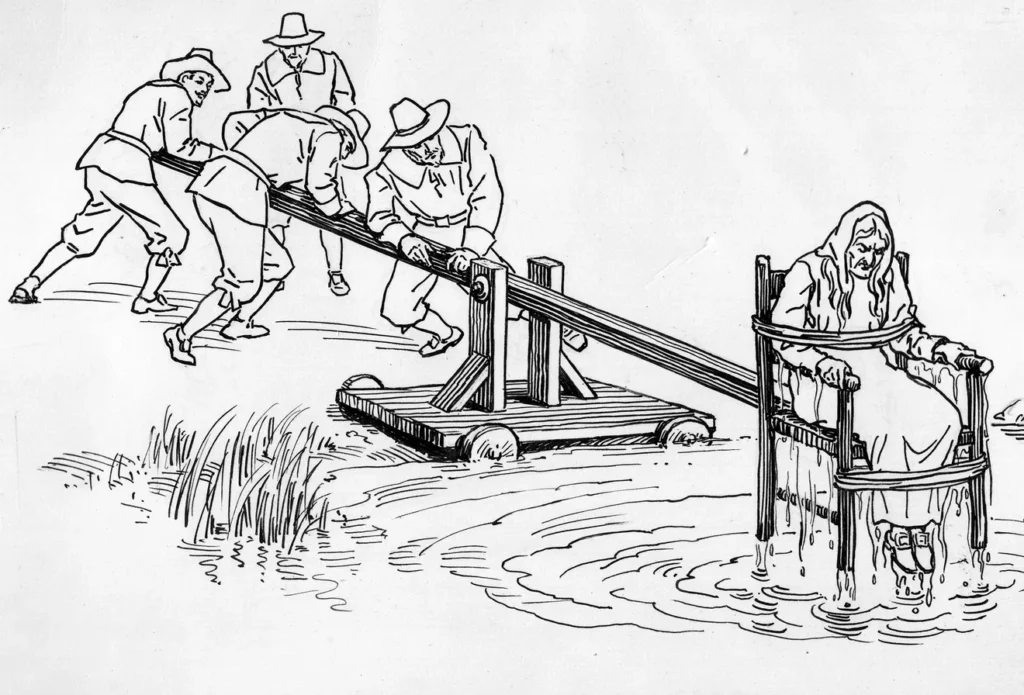
Scolds were almost always women. The “ducking stool,” a punishment borrowed from our English ancestors, was designed to publicly humiliate women who quarreled or repeatedly spoke out. According to the Encyclopedia Britannica, “the apparatus consisted of a wooden or iron armchair onto which the culprit was strapped. The chair was attached to a long wooden beam, usually located alongside a pond or river, and was lowered into the water. Repeated duckings routinely proved fatal, the victim dying of shock or drowning.”
In nearby Hampton, NH Eunice Cole was frequently jailed as a witch in the late 17th century. Her crime was that she expressed herself loudly and did not back down in the face of authority. The complaint of witchcraft was likely a tactic used by Goody Cole’s neighbors in a dispute over property ownership.
While few New Englanders were hanged for witchcraft, the tradition of torturing and executing thousands of people suspected of having supernatural powers — mostly women — has a long and dark history in Europe. And it’s worth remembering that three of the four people hanged at South Cemetery in Portsmouth in the mid-18th century were women. A jury of 12 men found Ruth Blay, Sarah Simpson, and Penelope Kenny guilty, not of infanticide, but of concealing the death of a live-born or stillborn child.
Unseen America
The historic record for New Hampshire’s founding century is scarce and what exists is almost exclusively about influential white males. We have no diaries from women until 1750 and few letters. And while 19th century journalists Charles Brewster and Tobias Ham Miller often remembered to include a few anecdotes about Portsmouth women in their newspaper articles, the dearth of data about women can be frustrating even to the most dedicated researcher. A published biography about a Portsmouth businessman, for example, notes that he “fathered” a dozen children, yet his wife goes unnamed. When mentioned in documents, right into the 20th century, women were often recorded as “the wife of” or as “Mrs. John Doe,” their identities and their personalities stripped away.
There are exceptions, of course, and Portsmouth has come a long way in recent years by focusing on the lives of local women in lectures, books, exhibitions, feature stories, and walking tours. Names like Celia Thaxter, Mary Carey Dondero, Ona Judge, Harriet Livermore, Martha Hilton Wentworth, Sarah Purcell, Virginia Tanner, Bridgett Graffort, Sarah Haven Foster, Maren Hontvet, Dorothy Vaughan, Esther Buffler, Betty Hill, and dozens more are being woven into the narrative of New Hampshire’s only seaport. But they remain the exceptions. A Wikipedia page entitled “List of People from Portsmouth, New Hampshire,” includes only 12 women out of 114 memorable names.
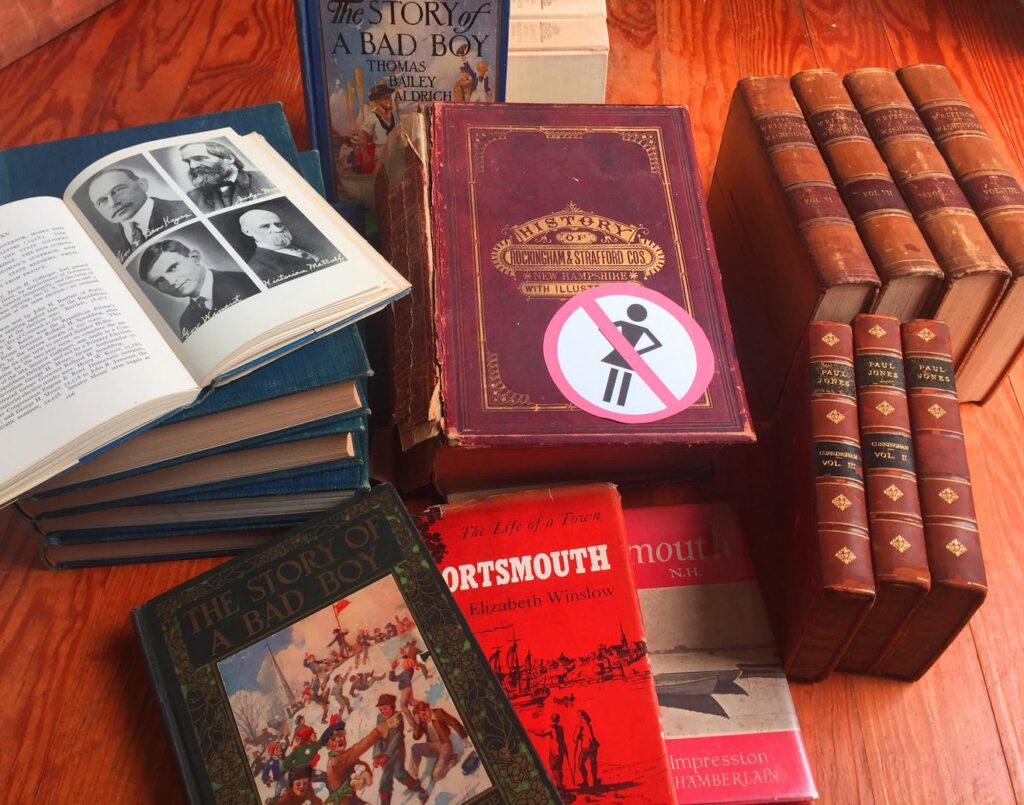
And while the future looks bright for the history of women, the past remains a vague and lonely landscape. Pulling a local history book off the shelf at random we find the History of Rockingham and Strafford Counties, published in 1882. This gigantic 900-page volume measures four inches thick and weighs 10 pounds. It includes hundreds of engraved portraits of prominent local citizens edged in gold foil–and not one of them is a woman. The even heavier four-volume History of The Granite State of the United States by James Duane Squiers contains almost a hundred full-page portraits, again flecked in gold and each separated by a delicate sheet of tissue paper. It was published in 1956 and yet it contains only one portrait of a woman.
The impact is undeniable. In an article about women in history textbooks (“Voices Not Heard”), media specialist Joyce A. Delaney pointed out “a noticeable imbalance” in the importance of women’s roles in American history to that of men. American history texts focused on the pivotal role of men in shaping the nation, Delaney wrote, while offering “little more than lip service to the contributions of women.”
That article was published in 1995. Things have gotten a lot better since then. At least, they were getting better until July 2019 when the President of the United States told four female members of the House of Representatives to “go back” to where they came from. The most powerful man on the planet then called the four minority women “a very racist group of troublemakers who are young, inexperienced, and not very smart.” One of the women, he added, is a “crazed lunatic.”
In the past, the same president has openly described prominent women using words like “slob, pig, fat, crazy, wacky, Miss Piggy, unattractive, crooked, low-I.Q., goofy, ugly, stupid” and worse. As with the ducking stool of days gone by, the president’s goal is to punish outspoken women with public humiliation. Future historians will judge whether such medieval tactics were effective in sending outspoken women back home–or whether American voters elected to return decorum and dignity to the presidency.
Copyright 2019 by J. Dennis Robinson, all rights reserved.
 Do Not Open Until 2123