


It’s boom time for Bunker Hill. The brutal battle between the New England militia and British redcoats took place on June 17, 1775, in Charlestown, Massachusetts. On that date, 50 years later, the Marquis de Lafayette dedicated the cornerstone of an iconic 221-foot monument. Without support from New Hampshire, however, this would be a very different story.
Rehearsal for rebellion
To appreciate New Hampshire’s role at Bunker Hill, let’s turn back the clock. England and France have a checkered past. From 1099 AD, historians calculate, the two nations declared war on one another 41 times. What we call the French and Indian War (1756-1763) was, in fact, a global conflict. French and English forces wrestled for territory in India, Europe, and here in North America.
As a royal English province, New Hampshire had been sparring with New France (Canada) over fishing grounds and the fur trade since the early 1600s. The French and Indian War turned out to be an American training ground for the coming revolution against King George III. And while none of the action took place on New Hampshire soil, the war turned British-American citizens into hardened fighters. John Stark of Manchester, for example, would later employ his skills against the redcoats at Bunker Hill.
France ceded Canada to the British in 1763, but the Seven Years’ War was costly. The protracted conflict nearly doubled Britain’s national debt. Having saved the American colonies, King George hoped to recover some of the Crown’s expenses from his American subjects. Taxes on sugar, stamps, tea, documents, and other goods sparked unrest in New England, highlighted by the Boston Tea Party and the Boston Massacre. When British soldiers tried to control the king’s armory and arrest rebels Sam Adams and John Hancock, they met armed resistance at Lexington and Concord. Seventy-nine redcoats and 43 Americans were killed in the first armed rebellion on April 19, 1775.
Enter John Stark

John and Elizabeth “Molly” Stark had welcomed nine of their 11 children before the Revolution began. A farmer and lumberman, Stark was in his mid-forties and working at his sawmill in Derryfield (Manchester) when he received the “Lexington Alarm.” The uprising had begun. Minutes later, according to legend, he was on his way to Medford, Massachusetts to join thousands of New England militiamen encamped around Boston. On April 23, Stark received word from the NH Provincial Government in Exeter that he was to command the 1st New Hampshire Regiment.
For weeks after Lexington and Concord, British and Colonial leaders struggled to plan their next move. General Thomas Gage, in command of the Siege of Boston, wanted to crush the American rebellion quickly. Gage planned to seize and fortify the Boston high ground at nearby Dorchester Heights. From there, his forces could control Roxbury, Charlestown, and Cambridge. With thousands of fresh troops and cannons arriving at Boston Harbor aboard warships from England, the attack was set for June 18.
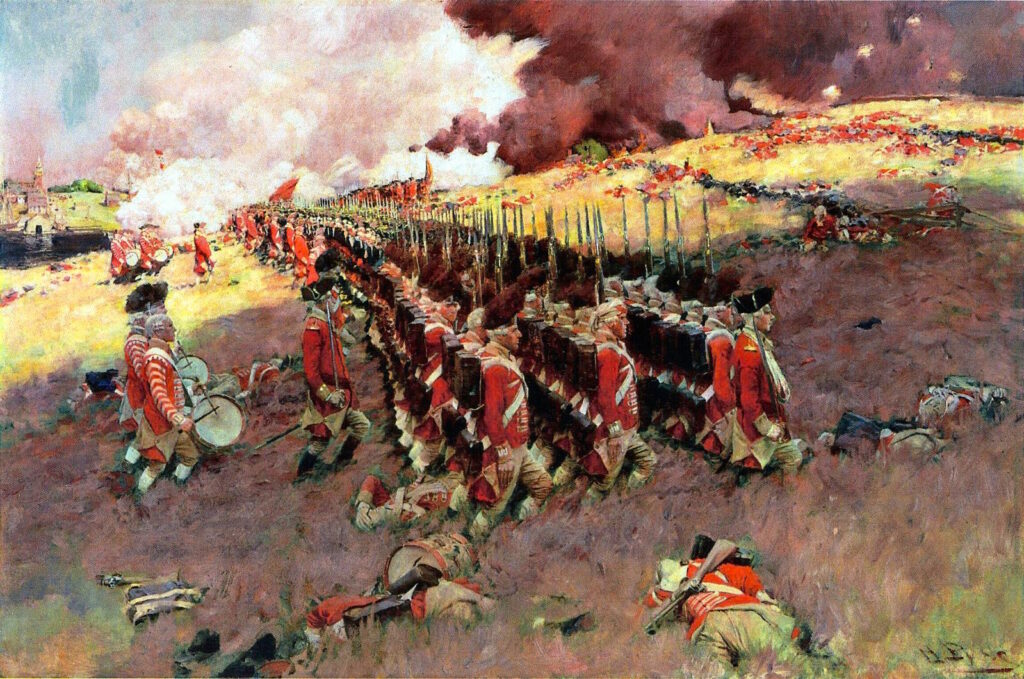
But word of the British plan leaked to the Colonial forces. On June 16, Colonel William Prescott secretly led 1,200 New England men on a midnight mission to fortify a spot called Breed’s Hill (accidentally identified as Bunker Hill). Quickly and quietly, they dug a ditch and built up a six-foot-high wall of dirt called a “redoubt” for protection from the inevitable British assault. At daybreak on June 17, cannon fire from a ship in Boston Harbor reached Prescott’s crude fortification but did little damage. By early afternoon, in warm and sunny weather, 2,500 British forces led by General William Howe assembled at the foot of Breed’s Hill. They would charge the hill three times in two hours of fierce fighting.
At the rail fence
At first, Prescott’s small force held the hill against an onslaught of men in red uniforms. Hope and ammunition, however, were running low when John Stark and his New Hampshire force arrived. Spotting a serious breach in Prescott’s defense, Stark positioned his 900 men further left of the hill by a ragged 600-foot rail fence and stone wall that hugged the shore of the Mystic River. Drawing on his experience in the French and Indian War, Stark made the best of an impossible situation. Each of his men received a small portion of gunpowder, one flint, and 15 musket balls.
With little ammunition against thousands of redcoats, he ordered his men to set out markers 150 yards ahead of the rail fence. This was the ideal distance, he knew, for dead-on accuracy with colonial muskets. “If any man dares fire before the redcoats reach this stake,” Stark warned, “I will knock him down.” Waiting behind the wooden barrier stuffed with hay, his militia bravely held their ground, then rose suddenly, as bursts of withering fire tore into the advancing enemy line.
During the battle, the colonel received word that his 16-year-old son Caleb had been killed. Stark told the messenger that this was “not a time to talk of private affairs.” Caleb Stark, however, was alive. He went on to earn the rank of major and later served in the New Hampshire Senate.

As the red tide turned against the Americans, a supply of gunpowder arrived from New Hampshire. According to lore, “old John Demeritt” had delivered the powder 60 miles overland by oxcart from where it had been hidden at his Madbury farm. This was the same gunpowder stolen from Fort William and Mary during the famous colonial raid at New Castle Island on December 13, 1774. Stark knew when it was time to fight and time to quit. Demeritt’s ammunition allowed New Hampshire forces to cover the retreat of the surviving troops fleeing the redoubt as the British stormed Breed’s Hill. Today, the Powder Major’s Forest is a 193-acre recreational preserve on the Lee/Madbury border.
The British had won the day, but at a staggering cost. By evening, a thousand redcoats were dead, wounded, or missing versus 450 colonial casualties. Instead of crushing a protest, the British had been lured into a war for American independence. The Siege of Boston continued until March 1776 in a war that lasted eight deadly years.
Building memory
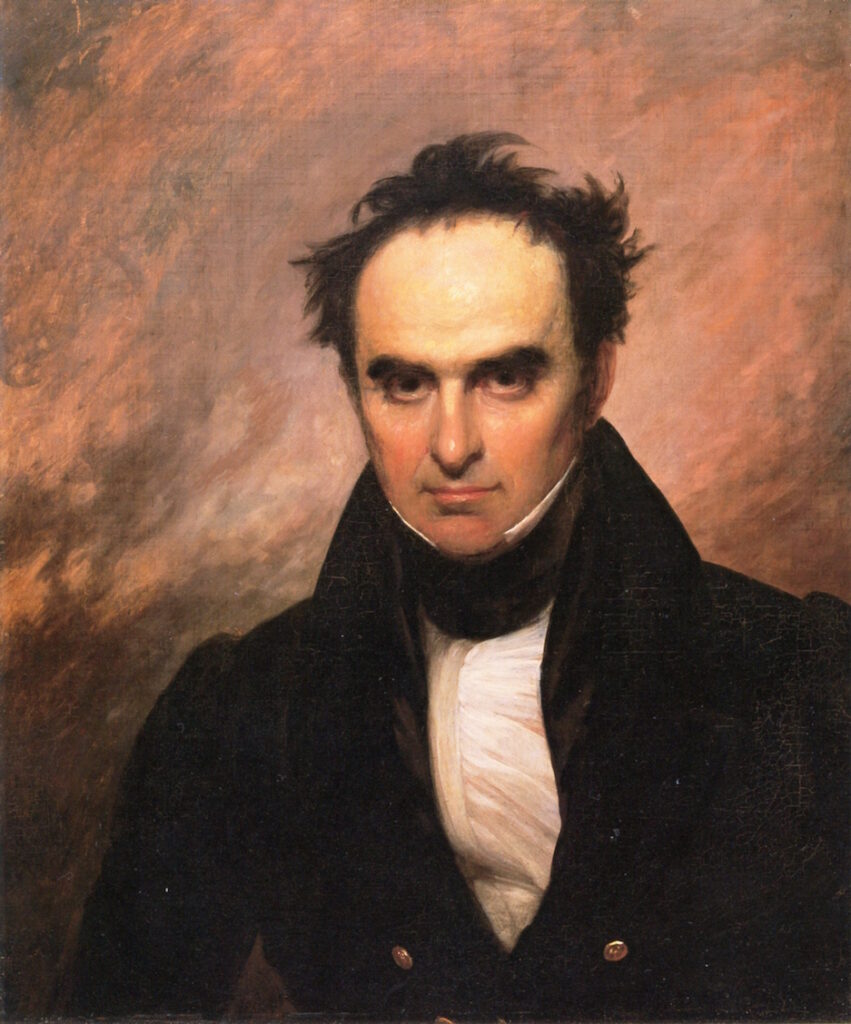
Fresh from Phillips Exeter Academy and Dartmouth College, a hick young lawyer named Daniel Webster arrived in the bustling seaport of Portsmouth at the peak of its prosperity in 1807. New Hampshire’s only seaport (population 5,000) was the ideal spot to open a law office. Webster served in the NH House of Representatives. In his autobiography, America’s famous orator would recall his nine years in Portsmouth as the happiest in his life.
By 1823, as the 50th anniversary of the Siege of Boston loomed, Webster had moved his practice to Massachusetts, where he was again a member of the US Congress. Revolutionary War veterans were fading. To keep their memory and the pivotal Charlestown battle alive, Daniel Webster and four other influential men established the Bunker Hill Monument Association. Donors who joined for five dollars received an official certificate. The BHMA bought land at the site of the battle and sponsored a contest for the monument design. Horatio Greenough, a 20-year-old Harvard student, won the prize. His model of a granite obelisk was inspired by an ancient Greek memorial.
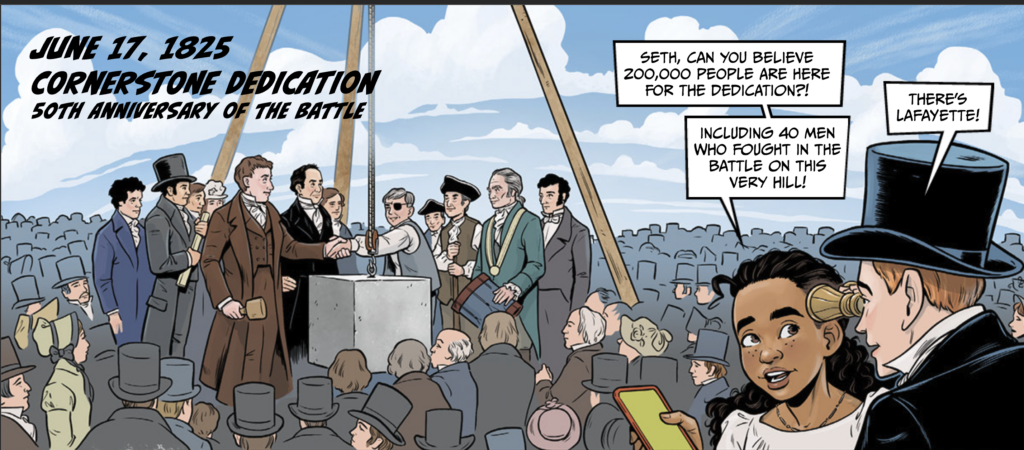
On June 17, 1825, an aging Marquis de Lafayette dedicated a granite block at the future site of the monument to a massive crowd. “We live in a most extraordinary age,” Daniel Webster told 15,000 VIP guests. “The whole world seems changed.”
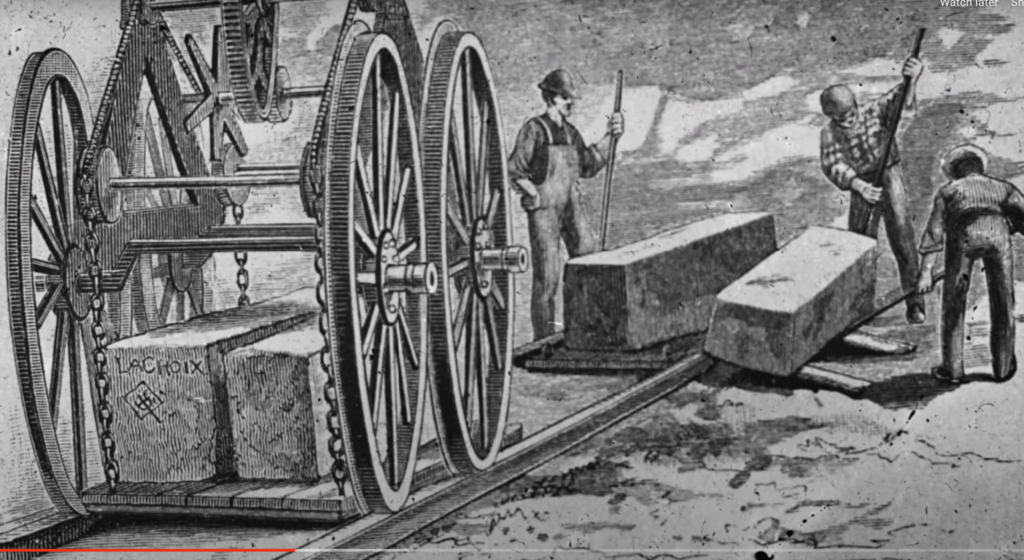
Three thousand granite blocks, each weighing five tons, were needed. To move the stone from a quarry 12 miles away in Quincy, engineers created the nation’s first commercial railroad. The horse-drawn line carried the heavy blocks to the Neponset River, where they were floated by barge to Charlestown. Construction began in 1827. But the founders had underestimated the cost. Money soon ran out, and, at only 37 feet tall, work on the Bunker Hill Monument stopped for seven long years. Renewed funds pushed the height to 85 feet before construction was halted again in 1834.
A Ladies Fair
Sarah Josepha Buell Hale of Newport, NH, was born in 1788. By 1822, she was the widowed mother of five children. The following year, as Daniel Webster was promoting a granite monument in Boston, Sarah Hale published her first novel. Entitled Northwood, her book was a sensitive study of a New Hampshire family struggling to adjust to life in the American South before the Civil War. Hale then moved to Boston, where, as “editoress” of a ladies’ fashion magazine, her writing reached 150,000 monthly subscribers.
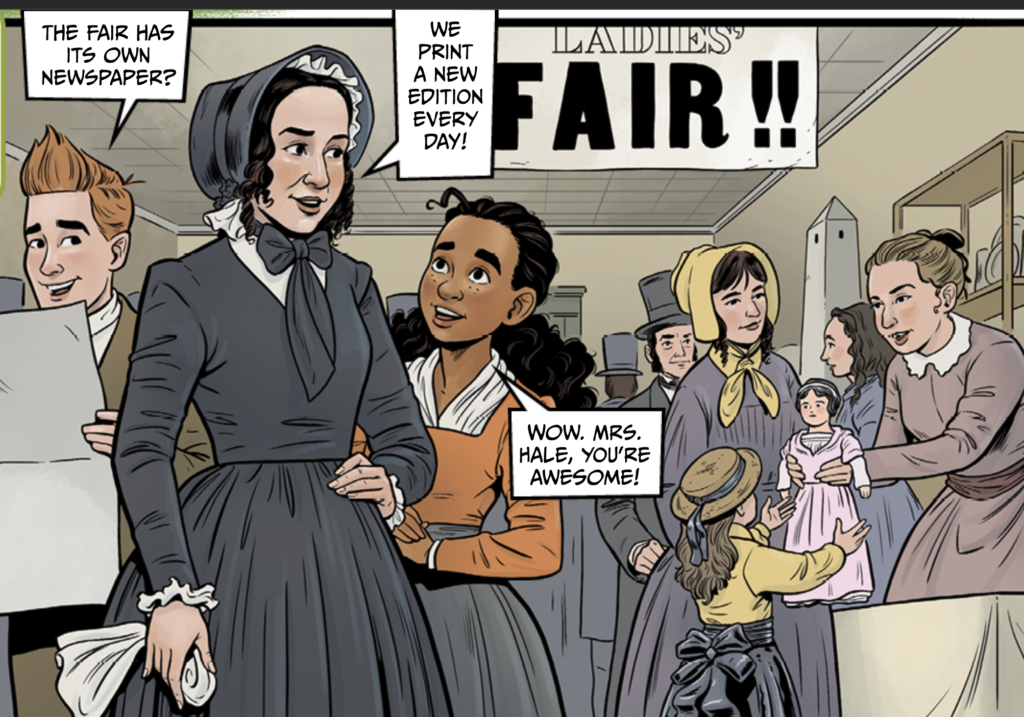
Most of us know Sarah Hale as the author of the nursery rhyme “Mary Had a Little Lamb,” based on a true story. Or we remember her campaign to turn Thanksgiving into a national holiday. She also promoted higher education and employment for women.
But there’s more. In 1840, to support the stalled monument project, Hale organized a sales bazaar at Quincy Market in Boston. The fair sold goods sewn, knitted, baked, crafted, canned, and painted exclusively by women. Funds from the five-day Ladies Faire totaled $30,000, worth close to a million dollars today.
Hale’s contribution to the BHMA sparked new sponsors and, on June 17, 1843, the tallest monument in the nation was dedicated. Daniel Webster, of course, delivered a speech that would be required reading in schools for decades to come. Flanked by John Tyler, our tenth president, Webster spoke once more.
“A duty has been performed,” Webster said, as the obelisk loomed overhead. “A work of gratitude and patriotism is completed.” Only a dozen veterans of the battle had survived to see it. Within days of the dedication, an abolitionist newspaper criticized Daniel Webster. His speech had failed to mention that, in 1843, a so-called “free America” also included over three million enslaved Africans.
Redefining the battle
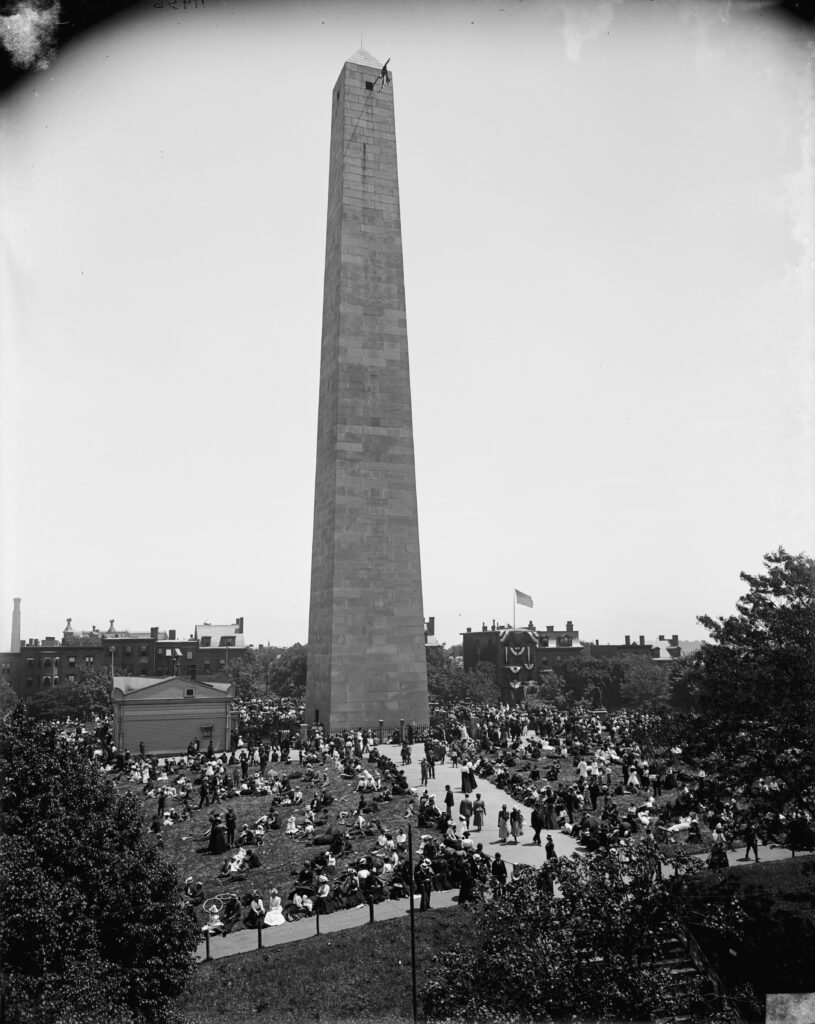
The monument transformed an American defeat into a towering symbol of resistance against British rule. It was an instant tourist attraction. Visitors climbed 294 steps to a 360-degree view of the Mystic and Charles rivers, the city hub, and the Charlestown Navy Yard. It was, for countless visitors, a Boston thing. Bunker Hill was, after all, the tallest war memorial in the country. Then, in 1884, another granite obelisk opened to visitors in the nation’s capital. At 555 feet, the new Washington Monument was twice the height.
In 1902, Henry M. Baker, a New Hampshire lawyer and politician, offered a stirring reminder of the Granite State’s historic role in 1775. Baker calculated that 1,211 officers and men who were residents of New Hampshire participated in the battle. This he compared to roughly 200 men from Connecticut, 660 from Massachusetts, and 300-400 men who worked on the Breed’s Hill redoubt but did not participate in the fighting.
“No battle of the Revolution accomplished more for the patriot cause,” Baker said at a gathering of the NH Society of Sons of the American Revolution in Concord, NH. “Without it, Bennington, Saratoga, and Yorktown might not have been possible. That New Hampshire bore so conspicuous and honorable a part at Bunker Hill confers renown upon our state and…upon the brave men whom this society especially represents. We sustain just pride in their work, achievements, and glory.”
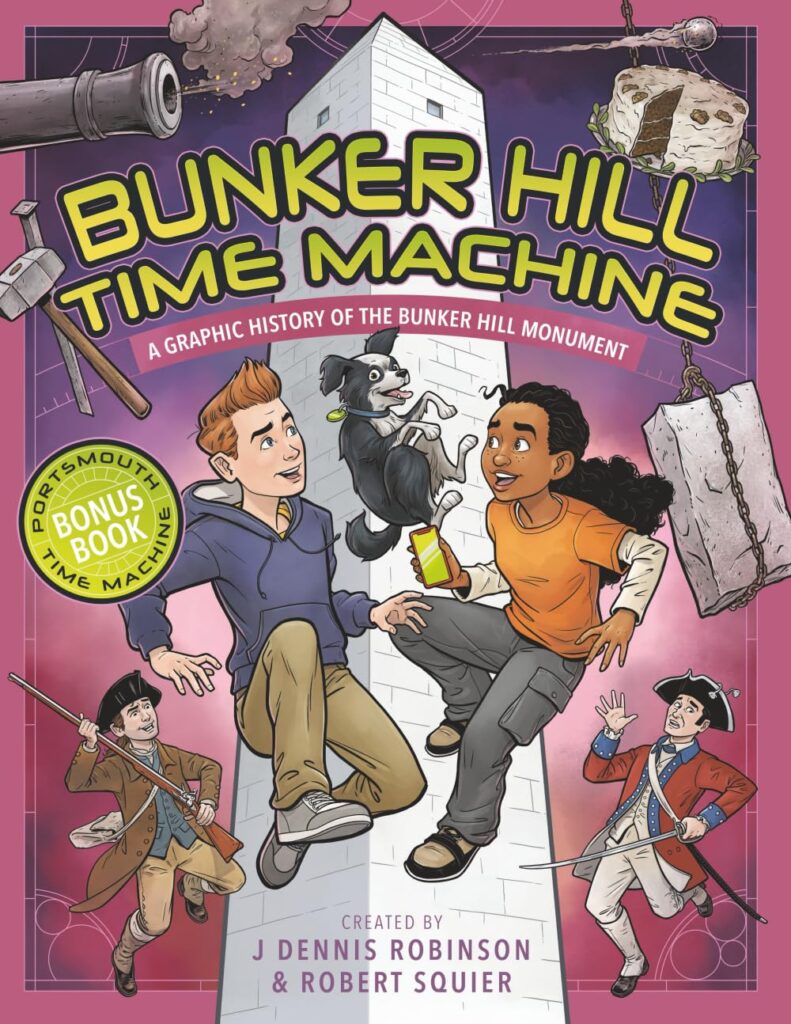
A larger-than-life statue of Dr. Joseph Warren, who died at the battle, was added to the monument grounds in 1857. Another of Colonel William Prescott, sword in hand, appeared in 1881. Then, in 1902, the same year as Henry Baker’s speech, the Monument Association opened “The Lodge.” Shaped like a Greek temple, it offered visitors a place to gather, view exhibitions, and pay a 25-cent fee to ascend the monument stairs. There was talk about adding a third statue to honor Colonel John Stark. It never happened. Today, a bronze image of Stark stands outside the Capitol in Concord, NH, not far from a likeness of Daniel Webster.
In 1951, Boston Evening Traveler reporter Bill Schofield suggested combining Boston’s key historic sites into a self-guided walking tour that includes Paul Revere’s House, Faneuil Hall, and the tall ship “Old Ironsides.” Schofield suggested the names Patriot’s Path and Liberty Loop. Luckily, the name Freedom Trail stuck instead, and Boston Mayor John B. Hynes made it official that year. A painted red line was added in 1958. Today, millions of visitors follow the trail that concludes at Bunker Hill Monument.
The never-ending skirmish
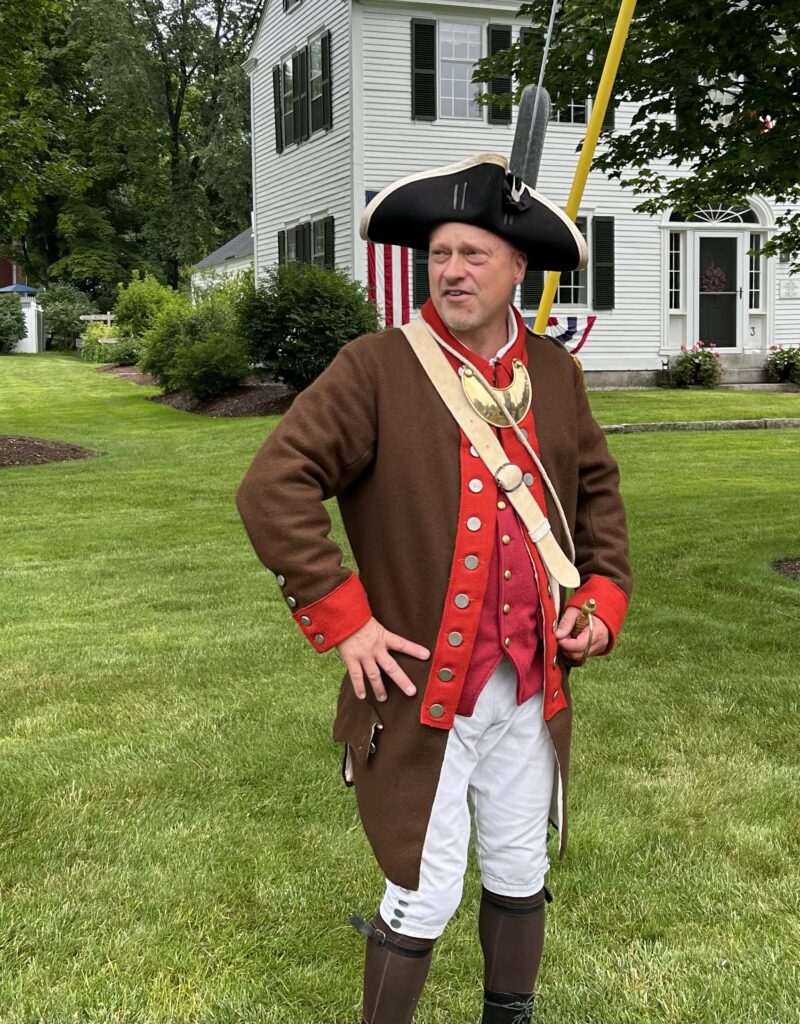
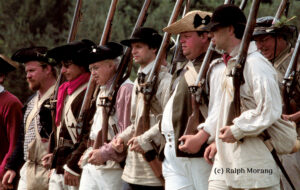
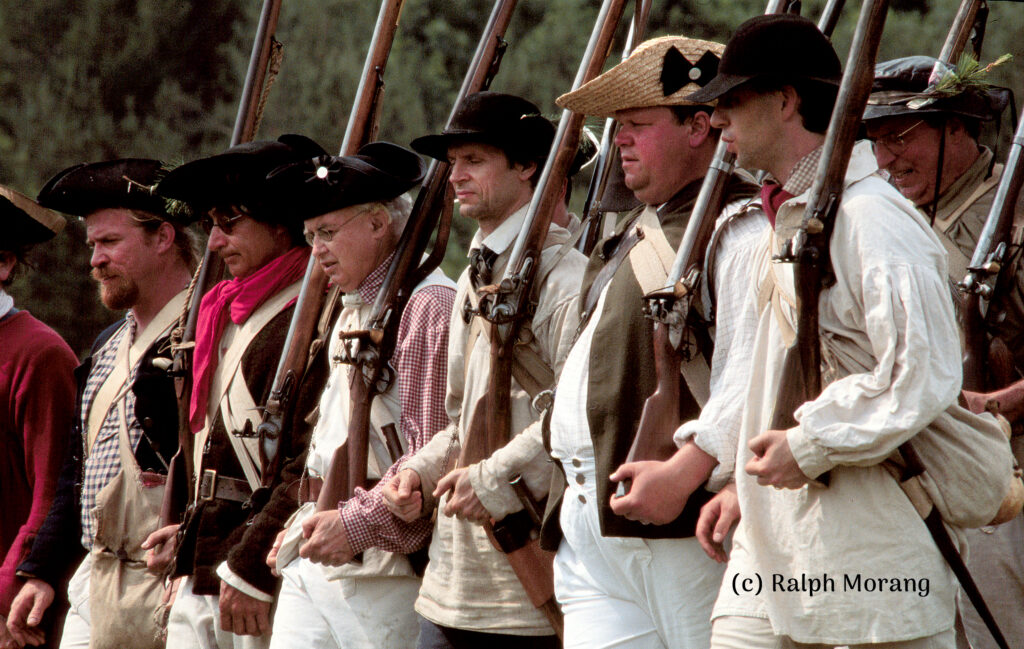
Bob Davidson of Nottingham grew up loving history, especially the World War II era of his grandparents. He was 12, he recalls, when he first climbed the Charlestown monument with his grandmother. A scholar of the battle, Davidson, 54, is Adjutant/Lieutenant of the First New Hampshire Regiment. The modern group of reenactors is dedicated to keeping the Revolution going.
Davidson got the “living history bug” about a decade ago and has been active in the 1st NH since 2018. As a 21st-century adjutant, his advisory role is similar to an event coordinator, he says. His group includes about 35 men and women. Past Bunker Hill anniversaries have been staged in Epping and Durham. Last year’s 250th anniversary battle was assigned to a hill in Gloucester, Massachusetts.
These are not costumed hobbyists out for a lark. Volunteers are trained in the safe use of ancient weapons. They wear authentic handmade outfits, study battle strategy, follow strict regulations, and endure authentic 18th-century encampment conditions. The 1st NH is a member of the nonprofit Continental Line that manages groups from Georgia to New England. The British re-enactors belong to a separate organization. Davidson, a merchandiser for a beer distributor in the real world, does about 15 battles, parades, and historic events per year.
There were many storied Granite Staters at Bunker Hill. General George Reed of Londonderry fought in Charlestown and in battles for the next eight years of the Revolution. Young Henry Dearborn was a captain in Stark’s regiment. Joseph Cilley, of the 2nd NH Regiment, went on to become a state senator. But it was Stark, who Davidson compares to a top-notch coach, who stands out.
“If it wasn’t for John Stark at Bunker Hill, the Revolutionary War might not have lasted.
There would have been no men left,” Davidson says.
Not forgotten
Visitors who climb the initial steps to the base of the monument from the east, known as The New Hampshire Gate, will discover a tomblike granite plaque. An early New Hampshire seal depicting a fish, a tree, and a quiver of arrows is etched into the polished stone. A carved motto reads: “Strength United is Stronger.” A second inscription briefly tells the story of John Stark and the 900 men of the 1st NH Regiment.
For some, the plain marker dedicated during the American Bicentennial of 1978 tells the story. For others, not so much. At the nation’s centennial of 1876, a minister named Increase Tarbox worried that the Granite State deserved more. “We have the full conviction,” Tarbox wrote, “that the time will come when the whole nation will give the honors of the battle of Bunker Hill largely to the common soldiers of New Hampshire who, more than any other men, fought it.”
© J. Dennis Robinson. This article appeared in a 2025 issue of NH Magazine.
 Slaves at the William Pitt Tavern