



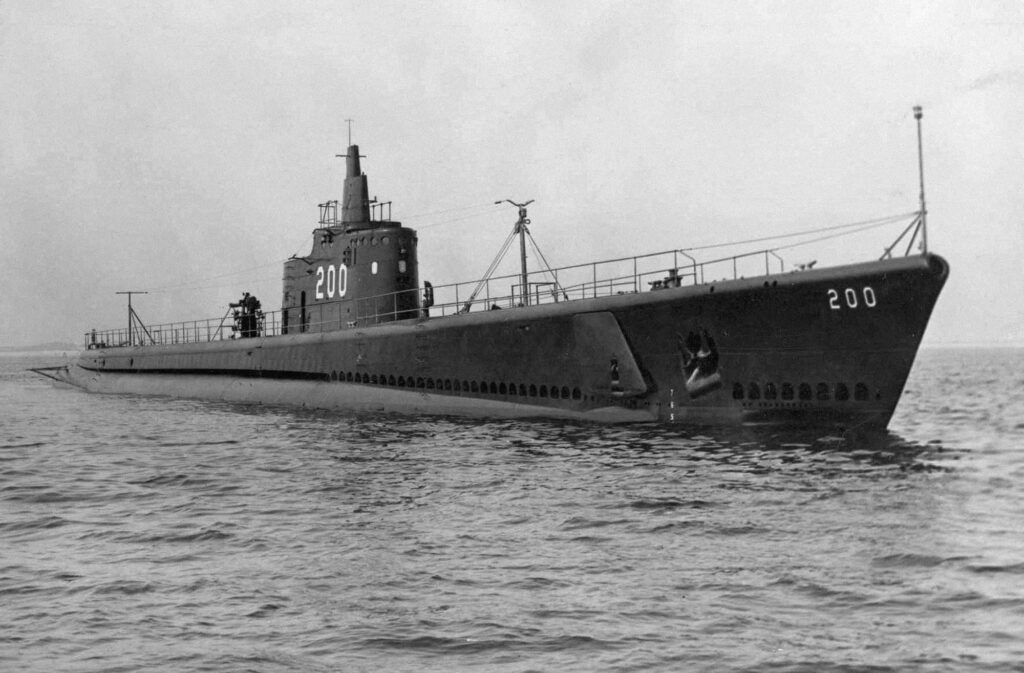
I selected this 1965 news photograph for the sign in the background. It shows a tall ship and a USS Albacore-shaped submarine passing Whaleback Light in Kittery. The painted mural was a larger version of the familiar red-white-and-blue “Sails to Atoms” logo of Portsmouth Naval Shipyard. This version reads “From SAILS and smooth Bores to ATOMS and Missiles. Hidden behind the arm of the man in the hardhat the text reads: “Established 1800. Dedicated to Submarine Progress.”
What I didn’t know, until I read a caption glued to the back of this photo, was that it depicts perhaps the most tragic and controversial event in Portsmouth-area history. There are, today, a dozen books about the tragic accident. On April 13, 1963, the Navy’s most advanced submarine, USS Thresher built at PNSY, was lost during a deep dive off the coast of New England. As this region knows too well, all 129 officers, crew, and civilians aboard were lost.
In early May 1963 newspapers across the nation announced the Navy would hold a press conference on the tragedy. Portsmouth Naval Shipyard foreman pipefitter Edmund T. Scarponi was among the officials participating in the news conference. A court of inquiry was then meeting behind closed doors “to study the highly classified design of the Thresher,” newspapers reported. The accident, following the tragedy of USS Squalus in 1939 off the Isles of Shoals made the inquiry even more tense for locals.
Days after the sinking, several witnesses testified “the work at the shipyard on the Thresher had been sloppy and that parts had been put in backward,” according to UPI news. In June 1963, after interviewing 120 witnesses, the Navy issued a press release stating it was “most likely that a piping system failure had occurred in one of the Thresher’s salt water systems, probably in the engine room.” Sea water probably affected electrical circuits that caused a loss of power, causing the ship to sink, exceeding her collapse depth, the national media reported.
The Navy later released a report saying “conditions and standards existing at the time were short of those required to insure safe operation of the Thresher.” According to the AP report, the Navy said 14% of the 155 [piping] joints on Thresher failed to meet standards.
This week’s photo appeared in an Associated Press story almost two years later in 1965. It shows PNSY chief pipefitter Edmund T. Scarponi and master pipefitter Thomas Plumpton. In 1965, the Navy reported it had “acted on 20 safety recommendations aimed at protecting the lives of its men who cruise the ocean depths in submarines.’
Although neither Scarponi nor Plumpton were mentioned in the 1965 AP story, they appeared in this accompanying photo. The caption notes the men “had some comments about the pipe fitting.” The caption continued: “Scarponi, a veteran of 29 years at [the] yard who supervised pipe work on the ill-fated Thresher said he wouldn’t have hesitated to go to sea on the vessel. He denied charges there was pressure to deliver the ship before it was ready for sea.”
“Faulty piping was indeed the official finding of the Navy’s court,” says naval historian D. Allan Kerr, “but there are still those who dispute this. Since there were no survivors and little remaining evidence to be retrieved 8,400 feet below surface, no one can say definitively.” Kerr is the author of “Silent Strength: Remembering the Men of Genius and Adventure Lost in the World’s Worst Submarine Disaster” (Peter E. Randall, Publisher, 2014). Sales of Silent Strength help fund the Thresher Memorial in Kittery, Maine.
Copyright 2020 by J. Dennis Robinson, all rights reserved.
 Before TV, There Was Tableaux Vivant