

If I ever get to Portsmouth, England, I’m booking a room at Ye Spotted Dogge. Also known as Buckingham House, it was licensed as a tavern in 1523, a hundred years before New Hampshire’s first English settlers arrived here. In 1628, the building was owned by Capt. John Mason, best known as the “founder of New Hampshire.” It was Mason who set up the trading outpost known as Strawberry Bank in 1630, later renamed Portsmouth in his honor. And if you don’t know beans about Mason, join the crowd.
The only biography of the man credited with kick-starting the Granite State was written in 1877. His entry on Wikipedia is scarcely 400 words long. As far as I can tell, no image of Capt. John Mason (1586–1635) exists. He is sometimes mistaken for Major John Mason, another English adventurer, who led a group of Connecticut Puritans in a massacre of the indigenous Pequot people in 1636. But by that year our John Mason was dead and the investors in the Strawberry Bank settlement had abandoned the original colonists to fend for themselves.
Spending a night in Capt. Mason’s house, therefore, should be a rite of passage for New Hampshire historians. It’s one rare way we can commune with our little known and almost forgotten founder. Mason’s descendants would battle for ownership of New Hampshire for generations, making the state’s complex early history so confusing it is rarely even talked about.
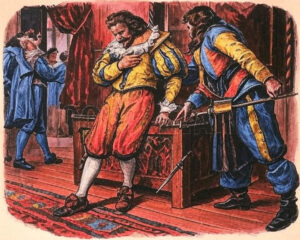
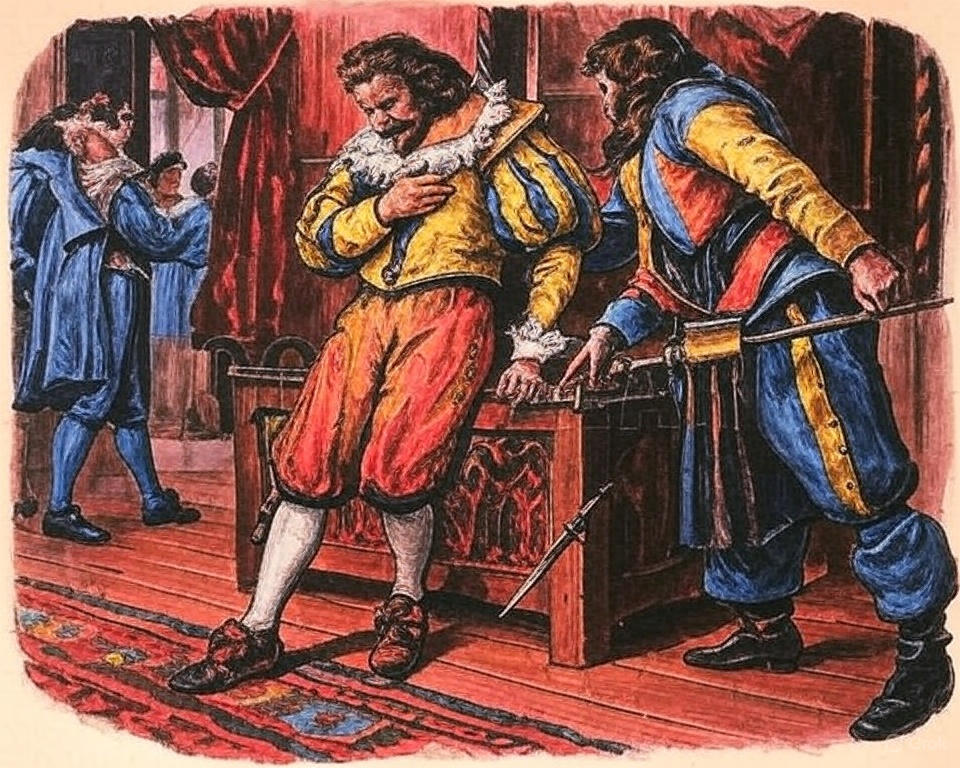
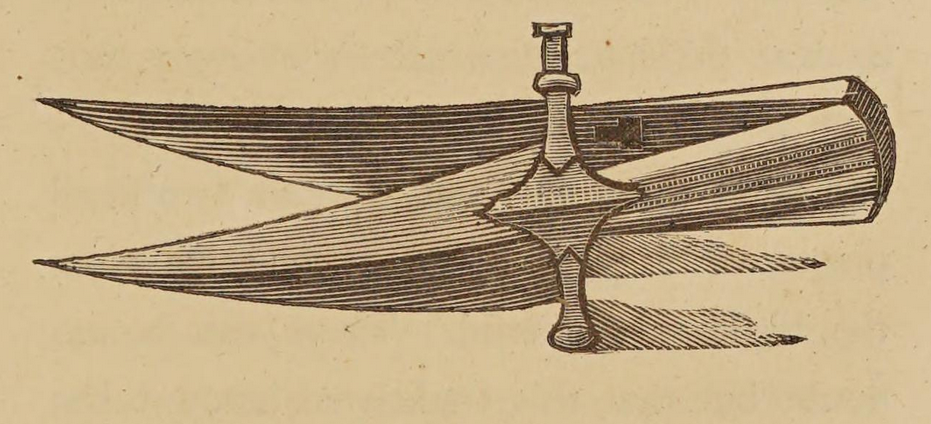
There’s a dagger on display at Ye Spotted Dogge. Legend says it’s the weapon used to assassinate George Villiers, the Duke of Buckingham. The extremely powerful and widely despised duke, the closest advisor to King James I, was stabbed to death at John Mason’s home on Aug. 23, 1628. More on that to come.
One year later Mason formalized his claim to colonize the land between the Merrimac and the Piscataqua rivers. Although Mason died without ever seeing his Strawberry Bank colony, by 1630 his ragtag group of settlers were setting up an experimental mining and trading post on the Portsmouth waterfront.
About “founder” John Mason
As with David and Amais Thompson who briefly established the first British fishing outpost at what is now Rye in 1623, New Hampshire seems to care little for its European founders. We do know that John Mason was born at King’s Lynn to wealthy merchant parents. His father died when he was 5. By age 20, Mason was married to Anne Green whose father was a goldsmith.
A sea captain with his own ship, young Mason was heavily involved in trade with Amsterdam. Frustrated by business deals gone wrong, he turned to piracy, capturing merchant ships in the waters between Scotland and Norway. Mason owned a small island reputed to be a waystation for pirates and thieves. He was arrested, stripped of his ship and all his goods, and thrown into an Edinborough prison in 1615, a detail I’ve yet to see mentioned in a New Hampshire history book.
Through the influence of Scottish friends, Mason earned a new and dangerous position as governor of a fishing outpost in Newfoundland. His successful six-year term in North America gave him the opportunity to explore the coast of what had recently been dubbed “New England.” Back home by 1621, Mason was determined to set up a colony across the sea. Aligned with fellow colonizer Sir Ferdinando Gorges, Mason was granted land along the New England coast in 1622, but was initially unable to find willing investors.
A Church of England man, Mason had little interest in bringing religious freedom to a new continent. While certainly a patriot hoping to hasten British interests in North America, his primary goals were wealth and power. To quickly repay his investors, Mason instructed the Strawberry Bankers to search for precious stones and metals and establish profitable mines. He also had high hopes the Piscataqua River was a secret gateway to Lake Champlain where the French were successfully trading with the Natives. But things didn’t go as planned. Mason was on his way from England with supplies for the failing Strawberry Bank plantation when he died in 1635. Help was not on the way, and those colonists who remained at Strawberry Bank squatted on what land they could find and eked out a living.
About George Villiers
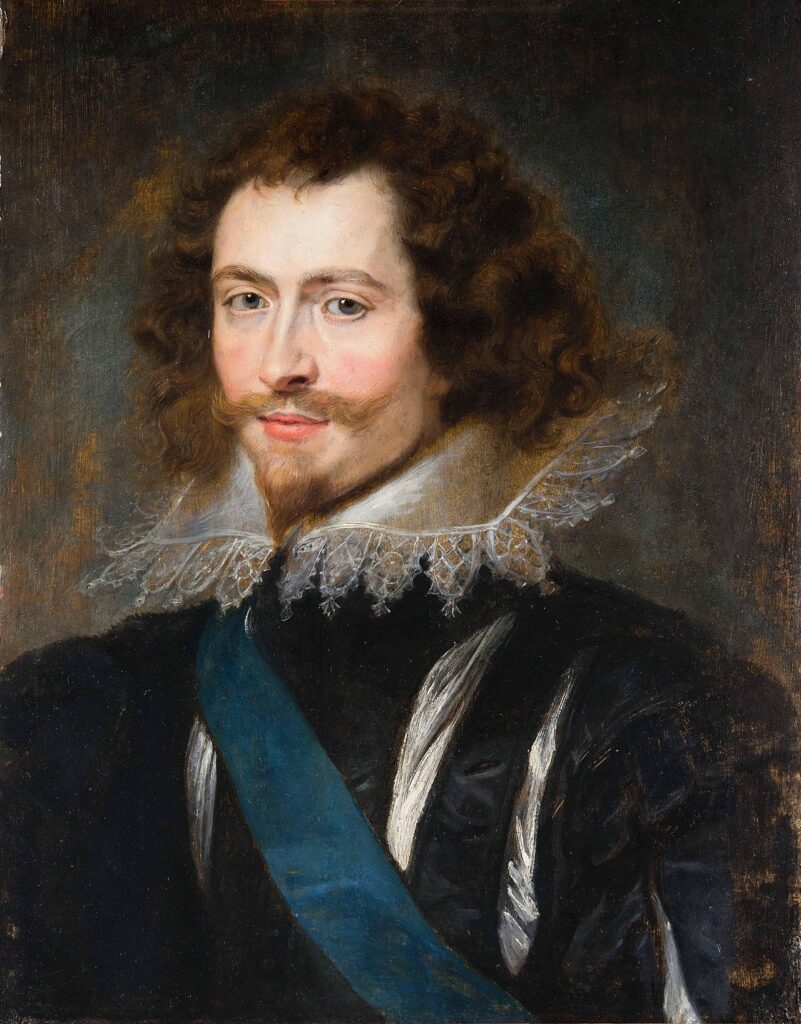
George Villiers (1592-1628) according to a Portsmouth, England historian, was “one of the most conspicuous and disastrous figures in seventeenth century history.” Engaging and handsome, Villiers became a court favorite and was rewarded with lands and honors by the king, including his title. Considered generous and lavish by some, devious and arrogant by others, the Duke of Buckingham was the favorite of King James I.
“You may be sure that I love the Earl of Buckingham more than anyone else, and more than you who are here assembled,” King James famously informed his Privy Council in 1617. “I wish to speak in my own behalf and not to have it thought to be a defect, for Jesus Christ did the same, and therefore I cannot be blamed. Christ had John, and I have George.”
Despite disastrous results in military battles when appointed Lord Admiral, Villiers is credited with improving the derelict British Navy. John Mason was among his most competent naval leaders and was also appointed paymaster to the army. It was during this period in 1627 that Mason bought his Portsmouth house, then known as the Greyhound Tavern. But due in large part to Buckngham’s incompetence, funds for failed naval missions left Mason with enormous unpaid bills. Besieged by angry sailors and creditors, Mason described his situation as “hellish,” and became quite ill.
Murdering the Duke
By this time, Charles I was king. Like his father, James I, Charles loved the handsome Duke of Buckingham. But after Buckingham’s costly, failed attack against France, the duke was hated by Parliament. When government leaders tried twice to impeach Buckingham, the king simply shut down Parliament. The rift between Parliament and the monarchy was also widening. It would later explode into a civil war and the beheading of Charles I in 1649.
By 1628, the king and Buckingham were unpopular among the public. That was especially true in Portsmouth, England, where the launch of another battle fleet was underway. Rumors spread that the French were about to attack the British port. Angry mariners refused to board ships, feigning illness. But despite the danger, Buckingham made a grand appearance in Portsmouth. His fine coach was mobbed by sailors demanding to be paid. The Duke then made his way to the Greyhound Tavern.
“This must have seemed to Mason the zenith of his career,” English historian Dorothy Dymond wrote. “The greatest man in England was actually a guest under his roof… no other commoner had that distinction.”
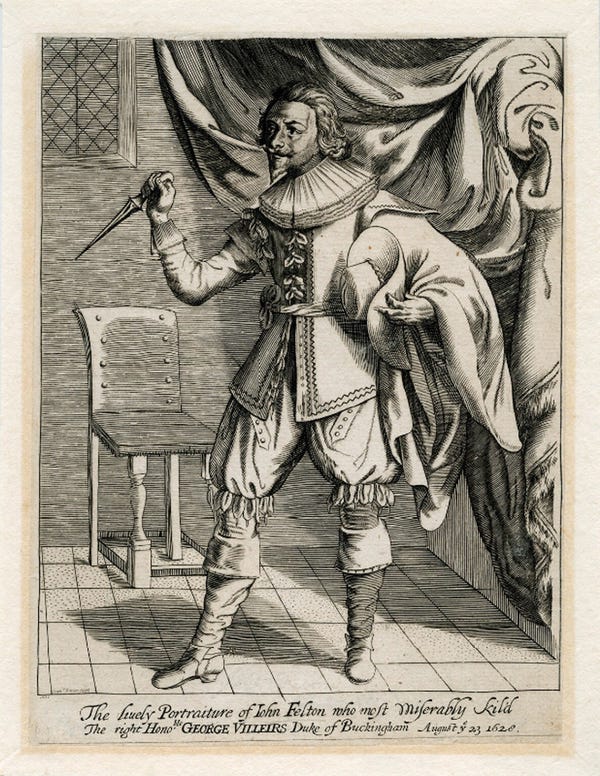
Enter John Felton, an army officer who, for both personal and political reasons, believed England would be better off without the pompous, duplicitous George Villiers. Felton attacked the Duke in a dark hallway by a crowded parlor in Mason’s home. According to a witness, Buckingham fell, then jumped up shouting “Villain!” He appeared ready to chase Felton, then dropped down dead.
The Aftermath
John Felton did not slink away. Instead, as the pregnant Duchess of Buckingham lay fainting, he confessed to the murder. Cheered as a hero by many, Felton was hanged in London. His body was delivered back to Portsmouth in chains and left to rot in public view. Buckingham’s planned naval battle by the British fleet never materialized.
John Mason bought two more houses, one in London and another in Deptford, but he remained in Portsmouth, England for the rest of his life. While continuing to oversee army finances, he revived his plan to launch a New Hampshire colony. “His busy brain was always hatching schemes for getting rich,” according to historian Dymond, “and nothing was too far-fetched.”
By November 1629, his royal grant in hand, Mason was ready to finally make his mark on the world. But his Strawberry Bank colonists found no profitable mines and the Piscataqua River was not the legendary Northwest Passage to vast riches. Today Capt. John Mason is largely forgotten in both Portsmouth, England, and in Portsmouth, New Hampshire. And while George Villiers, the assassinated Duke of Buckingham, lies with kings and poets amid the splendor of London’s Westminster Abbey, the burial place of Capt. Mason remains unknown.
For more information, see “Capt. John Mason” by Charles Wesley Tuttle (1877) and “Capt. John Mason and the Duke of Buckingham” by Dorothy Dymond (1972). For more on Mason’s home today, visit yespotteddogge.co.uk. Copyright 2021 by J. Dennis Robinson, all rights reserved.
 Exhibition Illuminates Edmund C. Tarbell’s Legacy