




WHITE NH ABOLITIONISTS
It was called The Morning Star. But what was an anti-slavery newspaper doing in a Seacoast town largely dependent on enslaved southern workers in the cotton trade? Ask William Burr, the feisty editor who refused to give up the fight against slavery. Veteran writer and Dover historian Ed Wentworth offers this rarely told tale of NH black history.
William Burr takes over
By Ed Wentworth
Dover, New Hampshire seemed an unlikely place for an anti-slavery movement beginning in the 1830s. After all, the town had huge mills using millions of bales of cotton produced in the South by slave labor.
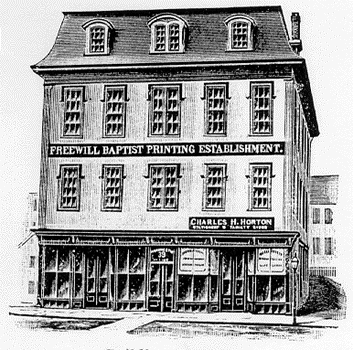
But Dover was the site of a radical, tenaciously anti-slavery newspaper produced by Freewill Baptists. Its publishers stuck to their guns despite opposition, even within their own denomination, eventually winning over those who thought then that slavery was a subject outside the realm of religious discussion.
The newspaper was “The Morning Star.” It had been published in Limerick, Maine, before moving to Dover in 1833 because of its more convenient location. Established in 1826, by the time it moved to Dover one of its up-and-coming stars was William Burr, then on its publishing committee.
But the newspaper was not involving itself in the anti-slavery movement. Its editor, Samuel Beede, wrote an article called “Slavery and Abolition,” in which he stated that, although slavery was evil, the North was as guilty as the South. He denounced the course of emancipationists and “counseled the exercise of moderation and charity.”
But Beede died suddenly on March 28, 1834. It was the last time such counsel would appear in “The Morning Star,” because William Burr was named editor and the newspaper launched into a campaign to abolish slavery and continued its campaign until the close of the Civil War.
The anti-slavery position was a bold decision by Burr. After all, this was essentially a religious newspaper and many thought it had no business delving into social issues. Burr thought of slavery as a moral and religious issue as well, and he led a concerted campaign against the evil practice.
Bad time for THE START
It nearly ruinedthe newspaper financially. Subscriptions plummeted. The shrinkage continued for about two years. State officials refused incorporation papers because of its anti-slavery stance; mail brought abusive letters from all across the denomination; many wanted to force the editor to take a more moderate position.
When the General Conference of Freewill Baptists met in Greenville, RI in 1837, members attempted to water down “The Morning Star’s” position “so as to avert from the denomination the public odium heaped upon abolitionists, and to reconcile the disaffected members.” The delegates refused.
The paper’s board of trustees chose principle over policy and decided to continue their anti-slavery campaign. So even though financially strapped, the struggle continued. That didn’t stop opposition, however, and Burr’s biographer says ” . . . there continued both in and out of the denomination a deep-seated opposition to the anti-slavery positions of the Star, and there were those, ministers and laymen, who were untiring in their efforts to effect a change.”
Isaac D. Stewart, who in 1851 wrote a history of the denomination’s anti-slavery society, had kinder words. He wrote, “As our patriotic fathers, in their struggle for liberty, stood undismayed through the darkest gloom of our country’s adversity, so the body of the denomination at this time proved themselves worthy of their noble ancestry, in opposing a system of oppression, with which British aggression bore no comparison.”
The most outspoken opposition to the paper’s position came from none other than the leading Democratic newspaper in town, The “Dover Gazette and Strafford Advertiser.” It advised the Star to stick to the business for which it was designed instead of being “intermingled with Politics, Abolition, and the Lord knows what, until some of the most respectable members, Elders and others of their own persuasion, have become disgusted . . .”
There was continued fear of violence and police protection was used, but no documented evidence of racial incidents have been found. This was, ultimately, a white protest in a white NH town where blacks, mostly domestics, comprised a small percentage of the population. When Abraham Lincoln visited Dover in his run for President on March 2, 1860, he spoke at city hall across the street from the newspaper headquarters. William Burr, among others, was invited to sit on the speaker’s platform with Lincoln.
Victory! Emancipation at Last
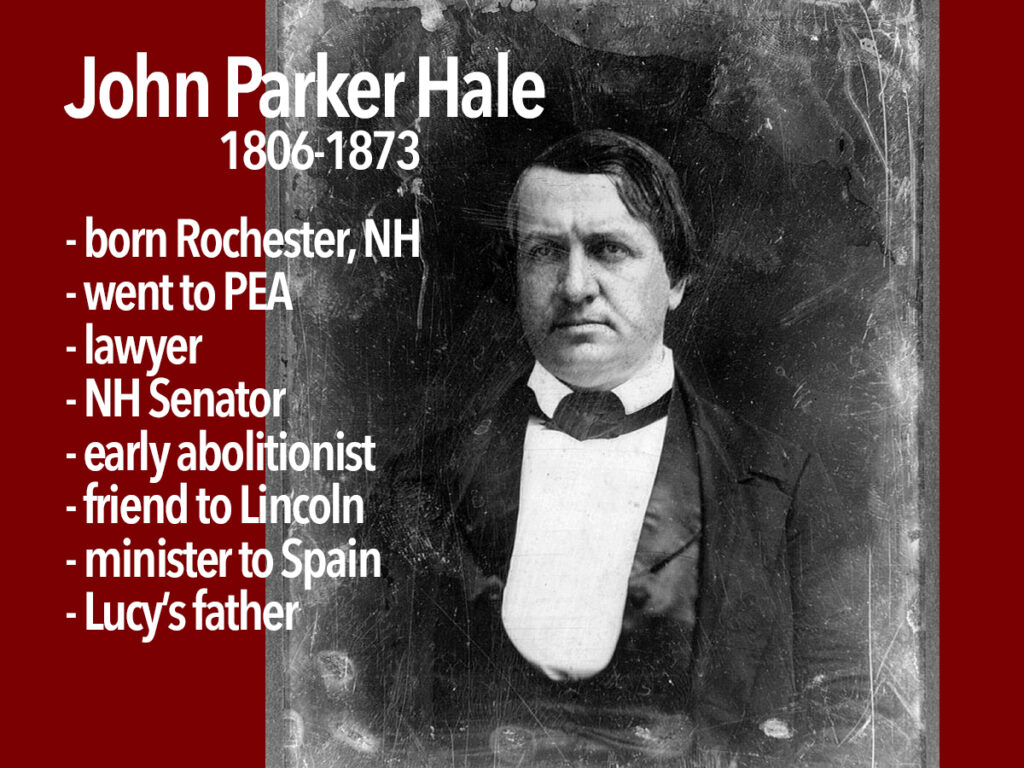
The Morning Star eventually prospered as opposition waned as more members and those outside the denomination began to realize what a great evil slavery was in a nation that had declared that all men were created equal. The newspaper had made a decisive impact on the subject in New Hampshire, and Dover was the first city in the state to send to the state Legislature members who espoused strong anti-slavery sentiment. And of course Dover’s John Parker Hale, once a Democrat but now out of the party because of his anti-slavery stand, would become the first anti-slavery Senator elected to Congress.
The Gazette never gave up in its opposition, though, and its diatribes against the Star continued until the end of the Civil War. Eventually, William Burr triumphed in his war against the evils of slavery. His newspaper was a leader at a time when the struggle was unpopular. He was able to say at the denomination’s general conference in 1865:
“Since the last conference, the Star has had the unspeakable joy of announcing the most important event of the nineteenth century. viz. the overthrow and, as we hope in God, the final death of American slavery, for which it has so long and arduously labored, and ardently hoped and prayed, but which at times it has almost despaired of living to see.”
Burr had lived to see his great struggle triumph. But he died the next year, on November 5, 1866. His death was sudden. In contrast to the violent opposition that had railed against him in earlier years, it seemed as if the whole city turned out for his funeral. The mayor and other city officials were at the service in the packed Washington Street Freewill Baptist Church (now Dover Baptist). Stores in downtown Dover closed; some of the newspapers that had lambasted him for his stand on slavery were kinder this day. Times had changed.
Burr lies in the same plot in Dover’s Pine Hill Cemetery in which six of his children preceded him. His wife Frances would follow in 1895. “The Morning Star” eventually moved its operation to Boston.
About the Author
Ed Wentworth moved to Dover from Newton, NH in 1936 when he was five.
 FW Hartford Founded Portsmouth Herald