


It was a newspaper editor’s worst nightmare. On Sept. 21, 1912, in large bold letters, the front page of the Portsmouth Herald announced: CITY MARSHAL ENTWISTLE RESIGNS.
The surprising headline was accompanied by an oval portrait of the controversial police chief. Thomas Entwistle “has had a long and honorable career” the paper announced, and “no man will be more thoroughly missed at city hall.” The story, however, was not true.
For years Portsmouth Democrats had been trying to remove the ailing, elderly, staunchly Republican police chief from office. Entwistle’s refusal to shut down the city’s many “disorderly houses” had made him a political target for local progressives and reformers. Mayor Daniel Badger, a Democrat seeking reelection, took up the campaign to oust the long-serving chief. But under fire, Thomas Entwistle doubled down and refused to leave his post.
“It is not the Herald’s intention of providing anything but the facts,” the newspaper explained two days later while recanting its original story. The article, editors noted, should have read Mr. Entwistle “had been asked to resign” by Police Commissioner Morris C. Foye, who owned a popular department store in Market Square. Entwistle told reporters he had considered resigning, but changed his mind. “I need the money and I need the position,” the chief told the Herald.
On the job too long
Born in England in 1840, by 1912, Thomas Entwistle was the oldest police chief in New Hampshire. As a boy he had worked in a Portsmouth cotton mill. He enlisted twice in the Civil War, fought in at least 20 battles, was wounded twice, and was thrown into a crowded Confederate prisoner of war camp for 18 months. He escaped prison by jumping off a moving train and finding his way back to the Union army. He then worked as a blacksmith and a guard at Portsmouth Naval Shipyard.
The father of four girls and a boy, Entwistle was a prominent churchgoer, politician, charitable fundraiser and a member of many fraternal organizations in town. On his 50th wedding anniversary, in a rare display of public affection, two large portraits of Entwistle and his wife Elvira appeared on the front page of the Herald. His loyal patrolmen presented the couple with $50 in gold. But times change, and by 1912 Thomas Entwistle was both a legend and a dinosaur.
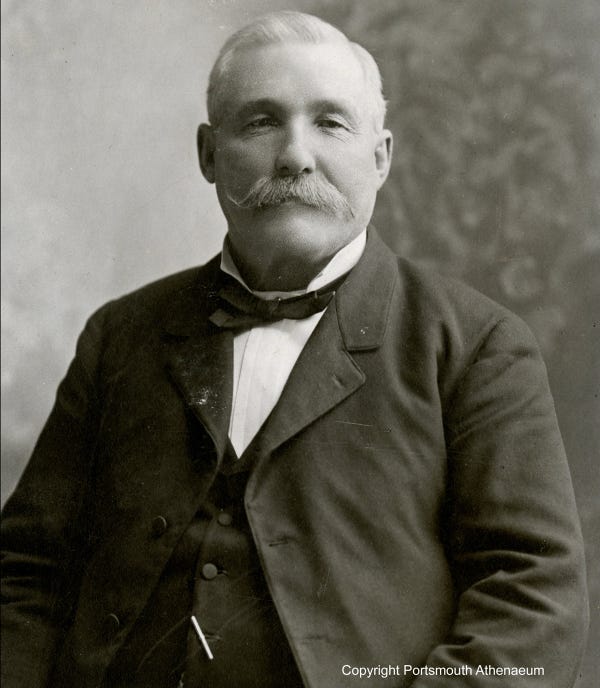
(Portsmouth Athenaeum Collection)
Entwistle did not invent the Portsmouth sex trade. Between 1850 and 1912 more than 30 Portsmouth mayors, all influential men, had turned a blind eye on the city’s illegal waterfront bars and bordellos that flourished across the Piscataqua River from the shipyard in Kittery, Maine. Keeping a “disorderly house,” gambling, and the sale of illegal liquor were clearly prohibited by state law. But in Portsmouth these laws were lightly enforced, leading to few arrests, limited fines, and rare penalties. Cases that made it to court were often suspended or permanently delayed. The thriving “combat zone,” reformers argued, had become a commercial benefit for entertaining mariners, businessmen, tourists, and visiting dignitaries.
By the early 20th century, however, the Progressive political movement advocating women’s suffrage, child labor laws, prohibition, and an end to political corruption was on the rise. Gov. Badger, who owned a dairy farm at what is now the Portsmouth Country Club, sided with reformers who proposed enforcing the law and closing all brothels. John Pender, his Republican opponent, supported the “regulate and control” plan that had been in play for decades. Police officers winked at the thriving bordello trade, relying on local madams and saloon proprietors to tamp down the inevitable violence, scandal and sexual abuse of minors that ensued. Besides running “clean houses,” Portsmouth madams maintained cheery fronts as respectable boarding houses, dance halls, grocery stores, oyster bars and ice cream shops.
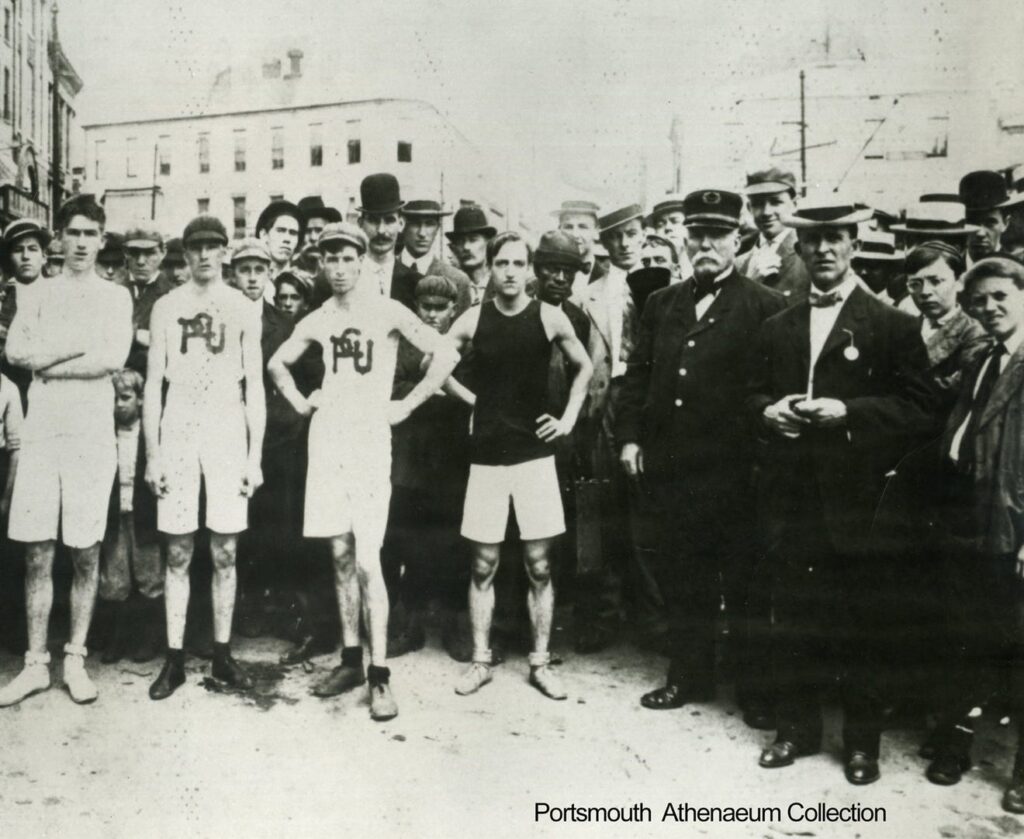
It is evident from newspaper accounts that Marshal Entwistle was feeling the pressure. In 1909, he announced warnings were being issued to a “bunch of females” on Jefferson Street including “a colored woman” who had been giving the police trouble. A brief and hard-to-believe report from the state licensing commission claimed “nowhere have they visited more orderly or better managed places” than in Portsmouth. Chief Entwistle, meanwhile, continued his charm offensive by attending church services and charitable events. Each year he was on hand to kick-start the annual town marathon that began in Market Square and ended at Rand’s Grove in Rye.
When a frightened man speaking a foreign tongue appeared naked on Cabot Street, the kind marshal calmed him, dressed him and located his family. When Louise Roach, a housekeeper, “took a fancy to” a 5-year-old boy on the streets of Boston and kidnapped him to Portsmouth, Mr. Entwistle and his men saved the day. He had always “been a friend to those who have to struggle to make a living,” the chief told the Herald. The marshal, the Herald responded, was “a man with perhaps as remarkable a history as any man now living in the Granite State.”
In 1910, as Daniel Badger contemplated his run for mayor, Marshal Entwistle got into a skirmish with Robert Harding, the city’s progressive attorney. Harding claimed the chief refused to take on people he knew to be in the illegal liquor business. To “clean up the town,” Harding took his complaint over Entwistle’s head to the county sheriff who raided 10 local businesses. Entwistle called the raids “spite prosecution” by the Democrats and claimed he would never be a “cat’s paw” – a person who gets tricked into doing the dirty work of another.
Despite frequent calls for his resignation due, at least in polite conversation, to his advanced age, the chief soldiered on. During the summer, while attending a Republican conference at Hampton Beach, Mr. Entwistle fell backwards down a flight of stairs, cutting his head and damaging his shoulder. Although “severely shaken up” the police chief was back at work the next day.
A zealous politician, Thomas Entwistle had served Portsmouth’s Ward 1 as a selectman, alderman and councilman, moving on to serve three terms in the N.H. Senate. The marshal brazenly took on a second job as adviser to Republican Gov. Robert Bass, giving the chief two salaries. He also gained the power to appoint members of the Portsmouth Police Commission, whose job it was to oversee him. Asked by a Boston newspaper if he could legally and effectively serve two masters, the now legendary police chief said he had done it many times.
Enter Mayor Badger
The election of Daniel Badger was a clear indication the “regulate and control” era for the red light district was over. A month before the new administration took office Marshal Entwistle declared war on the city’s “shady resorts.” After clearing out a disorderly house on State Street, the chief claimed to have driven off “about 10 inmates… that the city could very well do without.” But the real crime wave was about to begin.
On Jan. 2, 1911, even as Mayor Badger was being sworn in at City Hall, two men with pistols conducted a shootout on Thornton Street. Both survived. A month later two sailors stole a car on Water Street, crashed through the toll gate to New Castle, then led the police on “a merry chase” down Congress Street as pedestrians scattered in fear.
Following a severe bout of winter pneumonia, the chief returned to active duty in the summer of 1911. This time, he declared war on penny gambling machines. Crime, he admitted, was on the rise, but it was the fault of the Democrats who had reduced his police force from 18 to 13 men. The chief posted a weekly newspaper warning to drivers using excessive speed, then he appointed his son William to the new post of automobile officer. Despite the reduction in force and a rising city population, Entwistle reported 1,200 arrests in 1911. In another interview the chief claimed 2,000 arrests leading to 1,000 court cases.
Full court press
The next year opened badly for the chief when, early in April 1912, a guard stationed aboard the USS Southery was stabbed 23 times by two other marines. Because Mr. O’Brien was attacked while crossing the pile bridge from Portsmouth to Kittery, the crime fell under the jurisdiction of the Navy yard. But it was an omen of things to come.
In August, the body of David H. Carlson, his head unsupported by a recently broken neck, was discovered propped against the wall of a Portsmouth whorehouse like a discarded puppet. Over the next 10 days three more mariners turned up dead in the Portsmouth Harbor area. Their unsolved cases, in the middle of a sweltering summer crime wave, drew the media spotlight onto the seaport’s smoldering South End
The city was also in “a state of siege” according to the Portsmouth Times over a series of unsolved daylight robberies. Men armed with shotguns held midnight vigils to protect their homes while the local police appeared powerless. The Times featured a shocking interview with a 14-year-old girl who, after being abducted in Dover, was delivered to Water Street brothel.
Enough was enough. In September, Police Commissioner Morris Foye told Thomas Entwistle it was time to go. If he did not leave, Entwistle was told, the mayor would be forced to take further action. On Sept. 24, Entwistle called their bluff and refused to resign. That same day, the body of Mrs. Richard F. Sears of Brooklyn, New York, an apparent suicide, washed ashore in New Castle.
Early Portsmouth mayors were elected for only a one-year term. Re-elected in 1912, and facing his third annual campaign, Daniel Badger finally insisted the police enforce the law. “As mayor of this city,” he announced to the chief, “I call on you to close forthwith and permanently keep closed all houses of ill repute in this city, and to close forthwith and keep closed all places where intoxicating liquor is sold illegally.”
Farewell Mr. Entwistle
Claiming public sentiment was in favor of keeping the bordellos open, Entwistle took no action against them. In November, with another deeply divisive election imminent, Mayor Badger instructed Entwistle to post more police officers both inside and outside the polls to “vigilantly watch for any violation of the law against bribery and vote selling.”
Three weeks later, 10 Portsmouth citizens, including the re-elected Mayor Badger, petitioned Gov. Bass to remove Chief Entwistle and police commissioners Morris Foye and True L. Norris for failing to do their duty. Shifting with the political winds, the Portsmouth Herald reluctantly admitted the public had spoken by re-electing Badger and that the chief, though an honorable man, should resign.
An editorial, likely written by Herald owner and future Portsmouth mayor FW Hartford (who also owned the Portsmouth Music Hall), stated “Portsmouth would be a better governed city if politics could be wiped out entirely.” Perhaps, Hartford suggested, future leaders should be judged by their principles rather than their party affiliation.
The next day, under the headline “HOUSE CLEANING COMMENCED,” the Herald uncomfortably reported that – under orders from Gov. Bass, the state attorney general, and the county attorney – four owners of “disorderly houses” in Portsmouth had been marched off to jail. Local proprietors including Mary Baker, Ella DeForrest Alta Roberts and Eva White were to serve 90-day sentences. Their brothels remained closed permanently. Four more “fancy house” owners were about to be arrested, the paper reported, while another owner was in the wind.
John Barrett, a local attorney and future New Hampshire governor, explained in a Herald op-ed that Mayor Badger, indeed, had the legal right to appeal to the governor for action. Gov. Bass, in return, had the power to outrank Marshal Entwistle who, curiously, was also a member of the governor’s Executive Council. It was unfortunate, Bartlett added, that Mayor Badger had not been able to solve the problem more discreetly.
Referring to the competing Portsmouth Times as the “yellow press,” FW Hartford also regretted that the mayor and certain “antagonistic” local citizens had taken the fight to the state level. The resulting embarrassing publicity, he feared, would be a blot on “the good name of the city.”
The mayor’s next reformist step, the Herald complained, might be to enforce all the city’s old blue laws. Would he also shut down bake shops and prevent drug stores from selling candy, soda and newspapers on Sundays? “All indications point to the fact that Portsmouth is to be made a spotless town,” the editor whined.
“All kinds of rumors have been in circulation for the past few days and one can hear most anything,” the marshal, still at his post, told the Herald in response to the closure of the combat zone. “I have not resigned and I don’t intend to resign under fire. I never have quit without a fight, and why should I do it now, because a few people want it that way? If these reformers have anything against me, I want them to produce it.”
Three days later, on Dec. 17, 1912, Thomas Entwistle called it quits. The reformers under Mayor Badger, in turn, withdrew their petition to remove the marshal and reinstated the two police commissioners who had failed to fire the chief. M.J. Hurley, who had served 25 years on the force, was appointed to replace Entwistle. Sperry H. Locke, owner of the Dover News, head of the local Progressive Party, and a resident of Portsmouth, was appointed to head the Portsmouth Police Commission. Mr. Entwistle resigned his post with the governor’s Executive Council.
Denying he had been forced to resign, Entwistle told the Herald no official charges had been filed against him. His reputation was intact. He had withdrawn voluntarily, he explained, to prevent two upstanding police commissioners, Mr. Foye and Mr. Norris, from being “put on the grill” by the Democrats.
“Tom” Entwistle, the editors added, “is to be congratulated for heeding the call of the people.” The long-serving policeman had been “a vigorous sturdy official with a big heart and lots of good common sense.” Beyond the closure of 11 “shady resorts” on Water Street, as the weeks progressed, the Portsmouth Herald reported raids on additional disorderly houses on Market, Charles, Bow, Daniel, Court, Jefferson, and State streets.
Copyright 2020 by J. Dennis Robinson, all rights reserved.
 Colonel John Walbach’s Strange Little Tower